North Korea, US-ROK Joint Naval Exercises and Vice President Harris's Visit to South Korea
North Korea Likely to Continue Strong Response Amid US-ROK-Japan Pressure
[Asia Economy Reporter Yoo In-ho] The situation on the Korean Peninsula has reached a ‘strongman-to-strongman’ confrontation phase.
As our government has stepped up pressure on North Korea through trilateral cooperation with the United States and Japan, North Korea responded with missile launches, putting the situation in a difficult position.
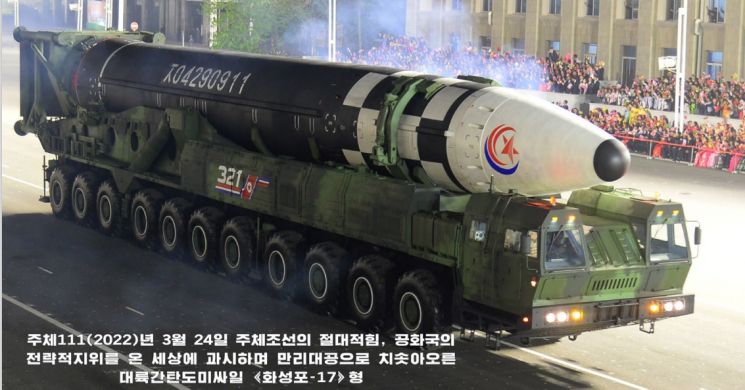
According to diplomatic sources on the 25th, North Korea launched an unidentified ballistic missile into the East Sea on the same day. Military authorities are analyzing specifications such as range, altitude, and speed. They are also investigating whether it was an SLBM (Submarine-Launched Ballistic Missile).
Based on ballistic missile launch criteria, North Korea launched eight short-range ballistic missiles (SRBMs) simultaneously on June 5, and this launch on the 113th day since then marks another missile launch.
This year, North Korea has launched ballistic missiles 17 times and cruise missiles twice, which were detected by the military and disclosed to the media. Since the inauguration of the Yoon Suk-yeol administration, this is the fifth missile launch.
On the 23rd, the U.S. carrier strike group, including the nuclear-powered aircraft carrier USS Ronald Reagan (CVN-76), guided missile cruiser USS Chancellorsville (CG 62), and Aegis destroyer USS Barry (DDG 52), entered the Busan operational base and is scheduled to conduct joint exercises with the Republic of Korea Navy.
North Korea’s military demonstration in response to the deployment of U.S. strategic assets is interpreted as an attempt to shift the responsibility for escalating tensions on the Korean Peninsula to the U.S. and South Korea while strengthening internal unity.
Some interpret this as a military provocation conscious of U.S. Vice President Kamala Harris’s visit to Korea on the 29th. Foreign media have focused on North Korea’s missile launch ahead of the U.S.-ROK joint naval exercises and Vice President Kamala Harris’s visit.

Reuters reported from Seoul that “North Korea launched a ballistic missile into the East Sea ahead of the U.S.-ROK joint military exercises involving a U.S. aircraft carrier and Vice President Harris’s visit to the region.”
Vice President Harris, who is leading a condolence delegation to Japan to attend the state funeral of former Japanese Prime Minister Shinzo Abe scheduled for the 27th, will visit Korea on the 29th to discuss security issues including North Korea’s nuclear and missile threats with President Yoon Suk-yeol.
BBC of the United Kingdom also introduced that North Korea’s recent missile launch occurred just after the U.S. aircraft carrier entered Korea and before Vice President Harris’s visit, pointing out that the United Nations prohibits North Korea’s ballistic missile and nuclear weapons tests.
In this context, as South Korea, the U.S., and Japan have recently taken a firm stance in preparation for North Korea’s seventh nuclear test, there are expectations that North Korea will continue to adopt a hardline response in the future.
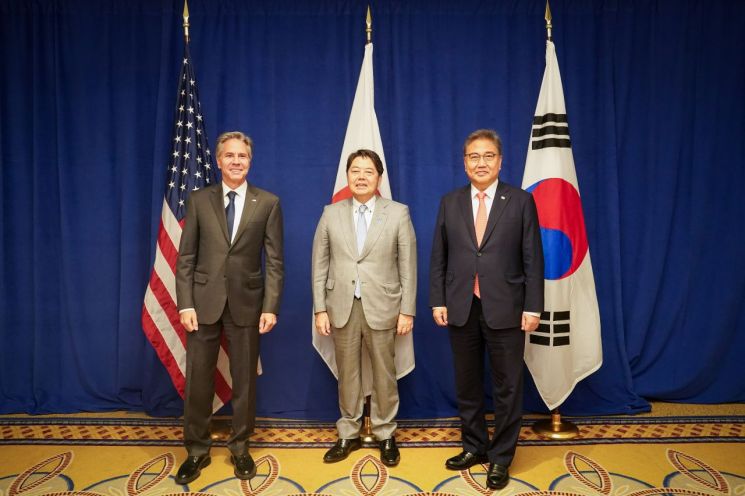
Foreign Minister Park Jin, U.S. Secretary of State Antony Blinken, and Japanese Foreign Minister Hayashi Yoshimasa recently held a diplomatic ministers’ meeting in New York and issued a joint statement expressing “serious concerns about North Korea’s escalation of tensions and destabilizing messages related to nuclear use, including the adoption of new laws on nuclear policy.”
© The Asia Business Daily(www.asiae.co.kr). All rights reserved.



















