Family Definition Deletion and Healthy Family Terminology Change Bill
Ministry of Gender Equality and Family Changes Stance to "Maintain Current Status"
Opposing Views Compared to April Last Year’s 'Basic Healthy Family Plan'
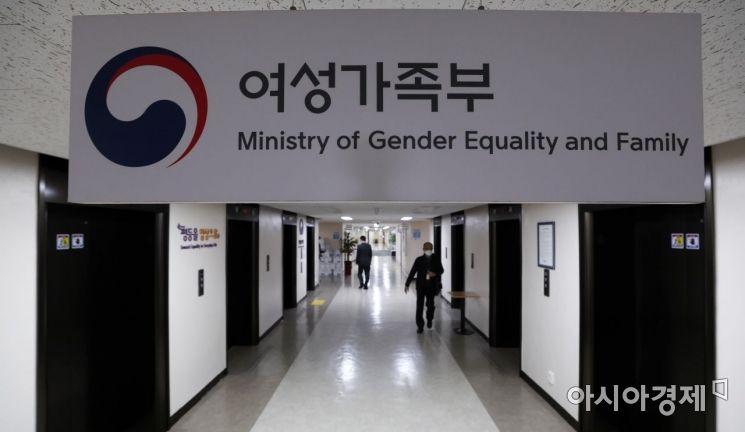 President-elect Yoon Suk-yeol reiterated his pledge to abolish the Ministry of Gender Equality and Family, stating, "Isn't it time for the ministry to fulfill its historical mission?" Meanwhile, on the 14th, the Ministry of Gender Equality and Family at the Government Seoul Office, facing a crossroads regarding its existence, is stirring unrest amid a restless atmosphere. Photo by Kim Hyun-min kimhyun81@
[Asia Economy Reporter Han Jinju] The Ministry of Gender Equality and Family had been pushing for a legal amendment to delete the definition of family so that unmarried cohabitation could also be protected as family, but reversed its stance after the change of administration.
According to the office of Jeong Gyeong-hee of the People Power Party on the 24th, the Ministry of Gender Equality and Family recently responded to opinions on the "Basic Act on Healthy Families Amendment Bill," which deletes the legal definition of family, by stating that "the current status should be maintained."
The amendment bill to the Basic Act on Healthy Families aims to delete the clause defining family as a "unit formed by marriage, blood relation, or adoption" and to revise the term "healthy family" to "family."
Last April, the Ministry of Gender Equality and Family announced the "4th Basic Plan for Healthy Families" and decided to pursue the deletion of the definition of family to reduce discrimination based on family types. However, after the launch of the Yoon Seok-yeol administration, it completely reversed the existing policy direction.
During the Moon Jae-in administration, the Ministry of Gender Equality and Family held the position that legal amendments were necessary to ensure that de facto families not connected by blood or marriage?such as cohabiting or common-law couples, elderly cohabiting couples sharing care and livelihood, or foster families?should also be protected by law. The concept of family in the Civil Code does not include unmarried childbirth, so the amendment also reflected the intention to bring about positive changes in discriminatory perceptions applied in other laws.
The stance on the term "healthy family" in the title of the "Basic Act on Healthy Families" also changed. Reflecting the National Human Rights Commission's opinion that the term "healthy family" implies the concept of "unhealthy family," the plan was to change it to a value-neutral term.
The Ministry of Gender Equality and Family stated, "The term 'healthy family' represents the policy goals we aim to pursue, and since the terms 'home' and 'family' are used interchangeably in daily life and law, it is necessary to maintain the current status."
With the change in policy direction after the new government took office, this effectively represents a regression to five years ago.
In response, the Ministry of Gender Equality and Family issued a press release stating, "Changing the position on the definition of family to maintain the current status does not mean that common-law or cohabiting families are not recognized as policy targets."
It added, "This is to avoid futile debates caused by the amendment to the Basic Act on Healthy Families and to expand practical support so that no blind spots occur, considering the rapidly changing social environment of family forms."
© The Asia Business Daily(www.asiae.co.kr). All rights reserved.

















