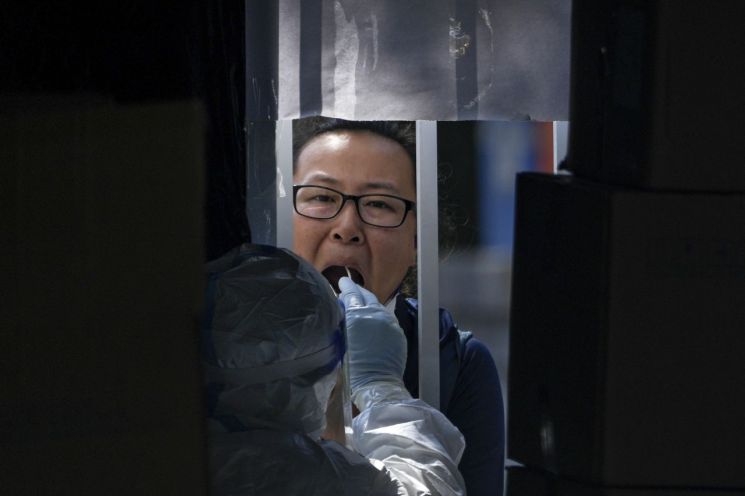
 On the 21st, a citizen is undergoing a polymerase chain reaction (PCR) test at a COVID-19 testing site in Beijing, China. [Image source=AP Yonhap News]
[Asia Economy Reporter Hwang Sumi] Controversy has arisen in China, which maintains a strict zero-COVID policy, after it was revealed that excessive quarantine fees were charged to COVID-19 quarantined individuals.
According to Xinlang Finance on the 23rd, Zhaotong City in Yunnan Province announced the day before that it would charge 150 yuan (about 30,000 KRW) per person per day for quarantine costs to those housed in centralized quarantine facilities. Chongqing's Changshou District also notified quarantined individuals that it would charge 300 yuan (about 60,000 KRW) per day, including 60 yuan (about 12,000 KRW) for meals. However, workers or residents within Changshou District were exempt from quarantine fee charges.
This sparked an outpouring of dissatisfaction on local social networking services (SNS) such as Weibo (China's version of Twitter). Many argued that it is unfair to impose quarantine and also charge fees. One netizen lamented, "China's Infectious Disease Prevention Law stipulates that authorities must guarantee the living conditions of people quarantined for COVID-19 prevention."
Some have raised suspicions that local governments, burdened by huge costs due to the prolonged zero-COVID policy, are enforcing such guidelines to resolve financial difficulties.
In fact, local government coffers have long been depleted. Among China's 31 provinces, municipalities, and autonomous regions, 30 except Shanghai reportedly recorded fiscal deficits from January to July this year.
This is attributed to the economic impact caused by city lockdowns due to the spread of COVID-19, which halted factory operations and led to the closure of various shops.
Additionally, the enormous expenses incurred for COVID-19 prevention, such as frequent polymerase chain reaction (PCR) testing to achieve zero-COVID, have also contributed. According to Bloomberg News, the accounts receivable from the Chinese government to eight publicly listed Chinese coronavirus diagnostic companies amounted to 14.1 billion yuan (about 2.8 trillion KRW), an increase of about 73% compared to the previous year. In particular, Bloomberg reported that Shanghai Langwei Medical's accounts receivable surged by 189% compared to the previous year.
© The Asia Business Daily(www.asiae.co.kr). All rights reserved.
![Clutching a Stolen Dior Bag, Saying "I Hate Being Poor but Real"... The Grotesque Con of a "Human Knockoff" [Slate]](https://cwcontent.asiae.co.kr/asiaresize/183/2026021902243444107_1771435474.jpg)
















