4.6 Times the 10-Year Average
Wage Increases, Raw Materials, and Exchange Rates Are Main Causes
Significant Expansion of Manufacturing Production Cost Burden
Difficulty in Reflecting Increased Costs in Product Prices
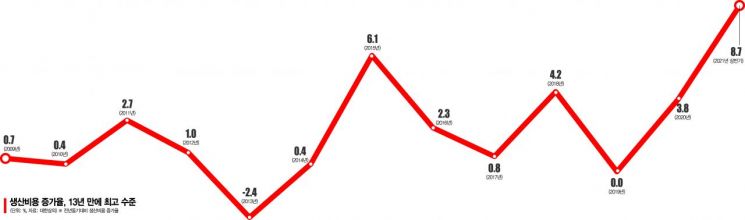
[Asia Economy Reporter Jeong Dong-hoon] Concerns are rising that a "perfect storm" (a large-scale complex crisis) may hit the South Korean economy, which is based on manufacturing in a "resource-poor" country, as high inflation, high interest rates, high exchange rates, and signs of low growth converge. The rise in raw material prices and inflation directly increase production costs, burdening companies. According to a survey by the Korea Chamber of Commerce and Industry on companies' costs involved in production activities in the first half of this year, the increase rate was the highest since 2009, right after the financial crisis. With the exchange rate continuing to rise in the second half and growing pressure for wage increases, the shock to companies' production costs is expected to persist. The prolonged energy crisis due to the war between Russia and Ukraine is also a factor exacerbating the crisis.
Companies facing an uncertain business environment are in a situation where they must strategically delay or reduce investment plans this year and focus on risk management. However, they cannot simply hunker down. The global industrial landscape is changing moment by moment, and due to the supply chain war between the United States and China, it has become difficult to slow down production and investment speed.
Experts point out that survival strategies need to be more precise. Professor Lee Jeong-hee of the Department of Economics at Chung-Ang University said, "Production costs are increasing, but inventories are not being depleted and are piling up. Ultimately, this leads to an economic recession, but companies face increased burdens due to the implementation of the 52-hour workweek and rising unit wages, so they need to consider measures to reduce costs, such as lowering corporate taxes."
The increase rate of companies' production costs in the first half of this year reached 8.7%. This is the largest increase since the 10.8% recorded in 2009, right after the financial crisis.
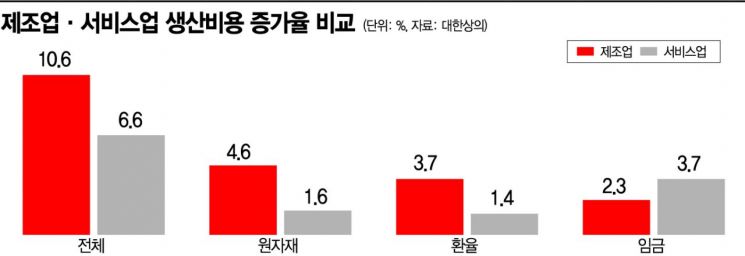
According to the "Estimation and Implications of Corporate Production Cost Increase" published on the 24th by the Korea Chamber of Commerce and Industry's SGI (Sustainable Growth Initiative), the average production cost increase rate across all industries over the past 10 years (2011?2021) was 1.9%, which is about 4.6 times lower than this year's rate. The production cost increase rate was calculated using a price ripple effect model linking industries, based on the year-on-year changes in raw materials such as crude oil, iron ore, copper, aluminum, the won-dollar exchange rate, and wages. Breaking down the production cost increase rate by production factors, wage increases had the largest impact at 3.2 percentage points out of the total 8.7%. Raw materials contributed 3.0 percentage points, and exchange rates 2.5 percentage points.
In particular, the manufacturing sector, which is the largest pillar of our economy, showed a greater increase in production costs compared to the overall industry. Manufacturing requires a large amount of imported raw materials such as crude oil and iron ore in the production process. Manufacturing production costs increased by 10.6% compared to the same period last year, surpassing the service sector's 6.6%.
Within manufacturing, production costs increased significantly in petroleum refining (28.8%), which uses crude oil as the main raw material; chemicals (10.5%); and non-metallic minerals (9.7%), primary metals (8.2%), and metals (7.2%), which use minerals such as copper, aluminum, and iron ore as intermediate inputs.
This increase in corporate production costs worsens profitability in the short term, but if this trend continues long-term, there are concerns about a decline in corporate competitiveness. Due to concerns about inflation and the resulting global economic slowdown, companies find it difficult to prepare exit strategies. Especially in a situation where the global industrial sector is undergoing continuous changes due to the implementation of the U.S. Inflation Reduction Act (IRA), it is difficult to adopt passive investment or production strategies citing cost burdens.
The won-dollar exchange rate surpassing 1,400 won for the first time in 13 years and 6 months is also a red flag for our economy. The market evaluates that the usual formula?where exchange rate increases benefit export companies?will be different in this crisis. Typically, when the exchange rate rises, the won depreciates, increasing the price competitiveness of Korean exports and boosting won-denominated sales. However, recently, as domestic companies have built factories overseas to increase production and sales, they are less affected by exchange rates. Moreover, the sharp rise in raw material prices has worsened profitability due to cost burdens. The global economic slowdown also makes it difficult to fully reflect the increase in raw material prices caused by exchange rate hikes in product prices.
In fact, LG Energy Solution, a battery company that had been aggressively investing in North America and Europe, is reconsidering its U.S. investments. In March this year, it announced a 1.7 trillion won investment to build a new cylindrical battery plant with an annual capacity of 11 GWh in Arizona, but in June, it began a full review. This is because construction and logistics costs surged within just three months due to inflation, high exchange rates, and rising interest rates.
Kim Cheon-gu, a research fellow at the Korea Chamber of Commerce and Industry's SGI, said, "The current increase in corporate production costs is largely due to macro-environmental changes, making it difficult for individual companies to respond. It is a time when not only internal cost-cutting efforts by companies but also active government support are necessary."
© The Asia Business Daily(www.asiae.co.kr). All rights reserved.
![Clutching a Stolen Dior Bag, Saying "I Hate Being Poor but Real"... The Grotesque Con of a "Human Knockoff" [Slate]](https://cwcontent.asiae.co.kr/asiaresize/183/2026021902243444107_1771435474.jpg)

















