Namji-eup Gujinsanseong Revealed as the First Mountain Fortress of Bihwa Gaya
Gaya Era Civil Engineering and 5th Century Bihwa Gaya Pottery Fragments Excavated
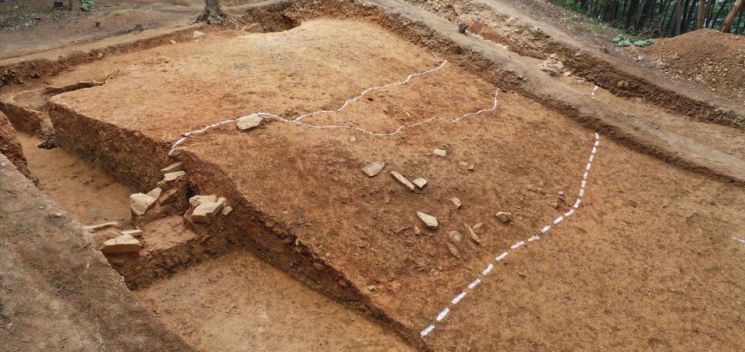 Pottery fragments discovered during the excavation of Gujinsanseong Fortress located in Namji-eup, Changnyeong-gun, Gyeongnam. [Image source=Changnyeong County Office]
[Asia Economy Yeongnam Reporting Headquarters Reporter Kim Wook] Historical evidence has emerged that puts an end to the debate over whether Changnyeong-gun in Gyeongnam was once a local region of Silla or an independent state.
On the 23rd, Changnyeong-gun announced that the excavation of Gujinsanseong, located in Gogok-ri, Namji-eup, previously known as a mountain fortress built during the Joseon Dynasty, has confirmed it as the first mountain fortress from the Bihwa Gaya period.
The excavation of Gujinsanseong was conducted as part of the Bihwa Gaya historical and cultural restoration project, supported by the investigation and research of unregistered Gaya relics in Gyeongsangnam-do.
Gujinsanseong is a taemoe-style mountain fortress surrounding the summit of Gujinsan, which stands 308 meters above sea level, towering along the eastern bank of the Nakdong River.
The fortress, which encircles the mountain peak with walls, was named after General Gwak Jae-woo deployed nine camps here to repel Japanese forces during the Imjin War, and has been known as a Joseon Dynasty fortress.
The county explained that the recent excavation revealed the construction of a stone foundation at the base of the fortress walls, with earthen embankments built on top, showcasing Gaya period civil engineering techniques.
Pottery shards from the 5th century Bihwa Gaya period were unearthed inside the fortress walls, indicating that the walls were constructed by the Changnyeong Bihwa Gaya power.
The county estimated that Gujinsanseong, geographically located along the eastern bank of the Nakdong River, likely served as a defensive stronghold during the Three Kingdoms period.
A county official stated, “Along with the Changnyeong Gyodong and Songhyeon-dong tumulus clusters, which are being considered for World Cultural Heritage registration, we are investigating various cultural assets such as production sites and fortress remains for the comprehensive restoration of Bihwa Gaya,” adding, “We will continue systematic investigations and research going forward.”
Previously, on November 12, 2009, at 2 p.m., the county held the first academic conference titled ‘Changnyeong in Ancient History’ in the main conference room of the county office to establish ancient history.
At the time, Professor Joo Bo-don of Kyungpook National University stated, “Changnyeong is recorded as Bihwa Gaya (Bulsaguk) in Chinese and Japanese historical records,” and “The Changnyeong area before the late 4th century, prior to its subjugation by Silla, proves the existence of Bihwa Gaya as an independent state.”
© The Asia Business Daily(www.asiae.co.kr). All rights reserved.
![User Who Sold Erroneously Deposited Bitcoins to Repay Debt and Fund Entertainment... What Did the Supreme Court Decide in 2021? [Legal Issue Check]](https://cwcontent.asiae.co.kr/asiaresize/183/2026020910431234020_1770601391.png)
















