Concerns Over Profitability Decline as Rising Exchange Rates Increase Production Costs Including Imported Raw Materials
[Asia Economy Reporter Park Sun-mi] Major domestic companies expect the average KRW-USD exchange rate to be around 1,400 won by the end of the year. The rise in exchange rates has increased production costs such as imported raw materials, raising concerns over deteriorating corporate profitability. Most companies have already entered a phase of tight management, including cost reduction.
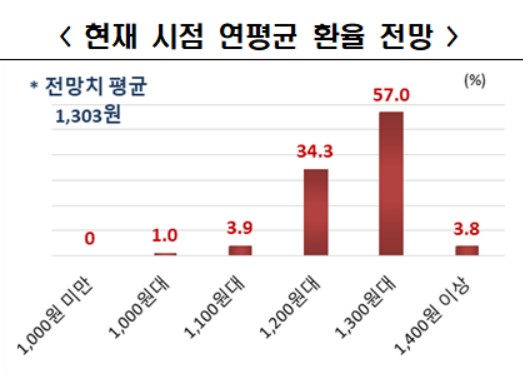
On the 25th, the Federation of Korean Industries (hereafter FKI) commissioned market research firm Mono Research to survey financial officers of export companies engaged in manufacturing among the top 500 companies by sales. The survey on ‘Exchange Rate Outlook and Corporate Impact’ revealed that companies expect the average exchange rate for this year to be 1,303 won.
This is the first time in 24 years since the 1998 foreign exchange crisis (1,395 won) that the annual average KRW-USD exchange rate has exceeded 1,300 won. Considering the exchange rate level at the beginning of the year, companies are bracing for the KRW-USD exchange rate to fluctuate around an average of 1,400 won by year-end.
The current forecasted annual average exchange rate of 1,303 won is 89 won higher than the 1,214 won forecasted at the beginning of the year when companies were establishing their business plans. Notably, the proportion of companies expecting the annual average exchange rate to exceed 1,300 won has increased more than sevenfold from 8.6% at the start of the year to 60.8% currently.
The breakeven exchange rate for companies was found to be 1,236 won, which is lower than the current forecasted annual average exchange rate of 1,303 won. Specifically, the breakeven exchange rates were distributed as follows: ▲1,200 won range (48.5%), ▲1,100 won range (29.5%), ▲1,300 won range (17.2%), ▲1,000 won range (2.9%), and ▲1,400 won or higher (1.9%).
Due to the expected exchange rate forecast exceeding the level at the beginning of the year, companies anticipate an average operating profit decline of 0.6%. Regarding the impact of the rising exchange rate forecast on operating profit, the responses were ▲decrease in operating profit (45.8%), ▲increase in operating profit (36.2%), and ▲no impact (18.0%).
On the other hand, the rise in exchange rate forecasts is expected to increase companies’ sales by an average of 0.3%. By response proportion, ▲sales increase (44.7%) was the most common answer, followed by ▲sales decrease (34.4%) and ▲no impact (20.9%).
The FKI analyzed that the increase in production costs such as raw material import prices and logistics costs due to the rising exchange rate is offsetting the sales growth effect from improved price competitiveness.
Meanwhile, companies have reportedly entered tight management, including cost reduction, to minimize foreign exchange risk.
In response to the recent sharp rise in exchange rates, the most common response was tightening belts such as reducing costs including labor costs (31.1%), followed by adjusting export/import prices (or volumes) (24.8%), expanding foreign exchange hedging strategies such as product investment (14.0%), and no particular countermeasures (11.4%).
Choo Kwang-ho, Head of the Economic Department at FKI, stated, “In an uncertain business environment with recent global economic recession and high interest rates, the sharp rise in exchange rates may significantly worsen corporate performance,” and added, “There is a need for the government to implement active foreign exchange market stabilization measures such as expanding currency swaps.”
© The Asia Business Daily(www.asiae.co.kr). All rights reserved.

















