Restrictions on New Securities and Derivatives Transactions and Account Openings
Sale of Existing Products and EFF Transactions Allowed
Financial Firms Fined for Continuing Transactions with Unfair Traders
Restrictions on Listed Company Executives for 10 Years
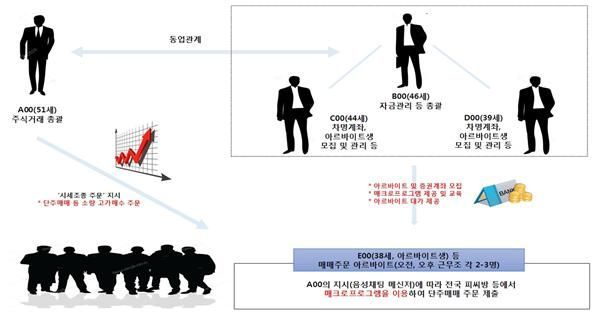
[Asia Economy Reporter Ji Yeon-jin] #1 Fourteen executives and relatives, including the CEO of KOSDAQ-listed company A, purchased the company's shares starting about two months before the disclosure of favorable information such as a paid-in capital increase and convertible bond issuance, earning several hundred million won.
#2 Full-time investor Kim invested in over 70 stocks over five years, manipulating prices to gain tens of billions of won in illicit profits after receiving a 10 million won fine and a suspended indictment twice in the past for price manipulation charges.
The government is pushing for measures to restrict trading and account opening of financial investment products for up to 10 years for unfair acts in the capital market, including stock price manipulation, and to prohibit executives of listed companies from engaging in such activities.
The Financial Services Commission announced on the 25th that it will prepare and promote legislation to amend the Capital Markets and Financial Investment Business Act containing these provisions.
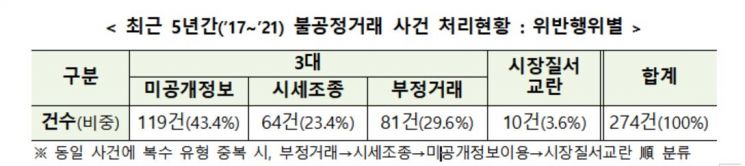
According to the FSC, a total of 274 unfair trading cases were submitted and approved by the Securities and Futures Commission over the past five years. Among unfair trading acts, insider trading accounted for 43.4%, followed by fraudulent trading (29.6%), price manipulation (23.4%), and market disorder (3.6%).
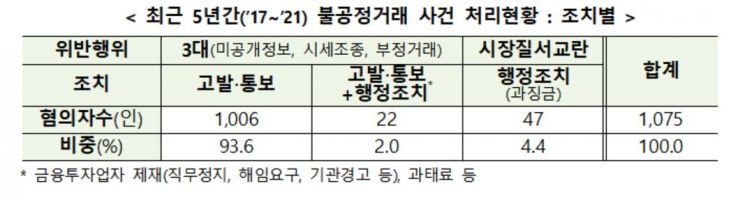
Unfair trading has often been criticized for its limited effectiveness in sanctions, as it takes an average of 2 to 3 years for court rulings to be finalized, allowing unfair traders to operate freely in the capital market for extended periods. Also, criminal penalties require strict proof, resulting in low prosecution rates and mild punishments, which undermines the effectiveness of sanctions.
Accordingly, the FSC plans to designate violators of the three major unfair trading acts as 'trading restriction subjects' and restrict their new transactions and account openings for securities, derivatives, and other financial investment products. Transactions refer to direct or indirect financial investment product dealings, including nominee accounts under acquaintances' names, stock lending, and borrowing.
However, exceptions will be made for transactions that are unavoidable to fulfill already concluded contracts, have a low possibility of unfair trading, or are due to external factors. Examples include purchases for repayment of loans, sales of already held products, indirect investments such as exchange-traded funds (ETFs), and stock acquisitions through stock dividends.
The trading restriction period can be up to 10 years, determined by considering the content, degree, duration, and frequency of the violation. Also, those subject to trading restrictions will be given prior notice and an opportunity to submit opinions during the Securities and Futures Commission's review stage, and may file objections if they disagree with the designation.
If a court acquits the individual or if there are errors in evidence documents leading to a judgment that the measure is illegal or unfair, the measure can be reconsidered to lift or reduce the restriction. The financial authorities will also be able to disclose the personal information, violation details, and restriction periods of trading restriction subjects on their website.
Additionally, regulations will be established to impose fines on financial companies that process transactions if trading restriction subjects continue to trade.
The Securities and Futures Commission will also designate trading restriction subjects as 'appointment restriction subjects' for up to 10 years. Appointment restriction subjects are prohibited from being appointed as executives of listed companies or financial companies, and if already serving as executives, they will lose their executive positions. Executives include directors, auditors, as well as chairpersons, presidents, executive directors, managing directors, directors, and other de facto executives responsible for business execution who use such titles.
© The Asia Business Daily(www.asiae.co.kr). All rights reserved.
![Clutching a Stolen Dior Bag, Saying "I Hate Being Poor but Real"... The Grotesque Con of a "Human Knockoff" [Slate]](https://cwcontent.asiae.co.kr/asiaresize/183/2026021902243444107_1771435474.jpg)


















