62 Nationwide Animal Burial Facilities... Seoul and Jeju Have None
Infrastructure Expansion Slowed Due to Resident Opposition Over Perceived Nuisance Facilities
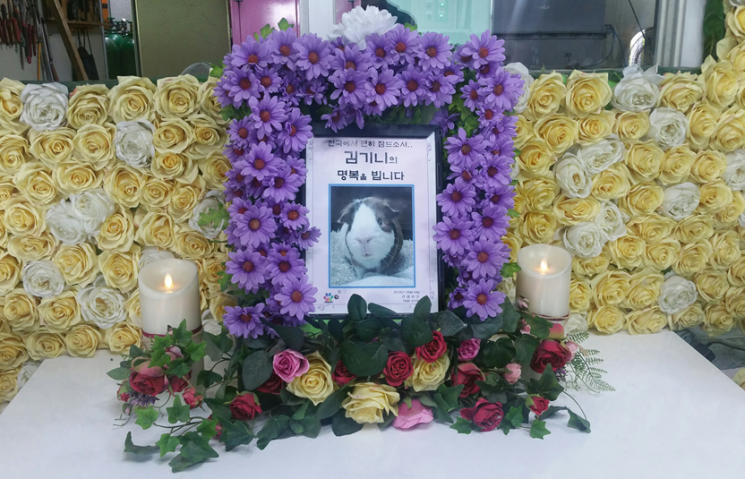 As more people consider their pets as family members, the number of people visiting pet funeral homes is increasing, but the related infrastructure is insufficient. Photo by Reader Provided.
[Asia Economy Reporter Yoon Seul-gi] As more people treat their pets like family members, there is a growing number of individuals who wish to humanely see off their pets through animal funeral facilities. However, the expansion of related infrastructure is slow due to animal crematoriums being perceived as undesirable facilities. Regions such as Seoul and Jeju have no animal funeral facilities at all.
With the rapid increase in pet-owning households, the number of deceased pets is also rising, but animal funeral facilities remain insufficient. According to the Ministry of Agriculture, Food and Rural Affairs on the 23rd, there are 62 animal-exclusive funeral facilities nationwide. By region, there are 22 in Gyeonggi, 2 in Incheon, 8 in Gyeongnam, 5 in Gyeongbuk, 2 in Jeonnam, 4 in Jeonbuk, 4 in Chungnam, 4 in Chungbuk, 2 in Gangwon, 1 in Ulsan, 1 in Gwangju, 2 in Daegu, 3 in Busan, and 2 in Sejong.
Under current law, pet corpses are classified as waste and must be handled according to the Waste Management Act. There are three main methods for disposing of animal corpses. If a pet dies at a hospital, it is classified as medical waste such as medical cotton or syringes and is either handled internally by the animal hospital or entrusted to waste disposal contractors or operators of waste disposal facilities.
If an animal dies outside a hospital, it is also possible to dispose of the corpse in a volume-based waste bag. Pet corpses are considered household waste and can be placed in volume-based waste bags and disposed of with general garbage. Additionally, there is a method of handling corpses through cremation, drying, or dehydration at funeral homes registered as animal funeral businesses.
However, even on private property, burying pet corpses is illegal. According to Article 65 of the Waste Management Act, burying (landfilling) animal corpses without permission can result in up to three years imprisonment or a fine of up to 30 million KRW.
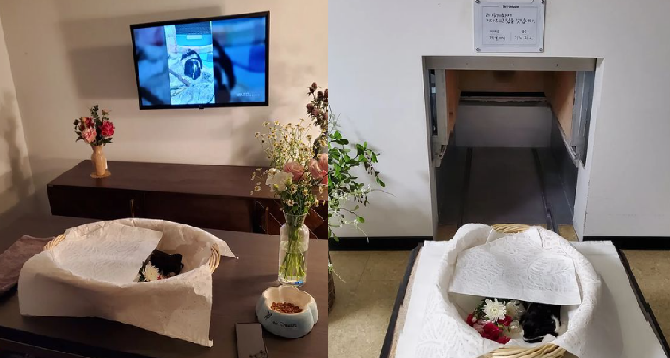 The scene of a pet funeral conducted by an animal funeral service provider. Photo by Reader Provided
Recently, as more people consider pets as family members, the number of those considering humane methods of corpse disposal is increasing. Mr. A, who lives in Seoul, said, "I used an animal funeral service when I had to say goodbye to my pet guinea pig," adding, "Since there are no places to hold funerals in Seoul, I had to go all the way to Gyeonggi Province."
However, animal funeral businesses are perceived as undesirable facilities. In particular, the construction of animal crematoriums faces strong opposition from residents. On the 22nd, the development review for establishing Gwangju's first animal crematorium was postponed due to resident protests. Residents oppose the construction, fearing environmental pollution and other issues. Currently, there are funeral facilities in Gwangju, Jeonnam, but not a single facility capable of cremating animals.
In some regions such as Seoul and Jeju, there are neither animal crematoriums nor funeral facilities. According to the 2022 Population and Housing Census sample survey by Statistics Korea, about 500,000 households in Seoul own pets, second only to Gyeonggi (860,000 households). Although the establishment of public funeral facilities in Seoul was expected after the enactment of Article 27 of the Animal Protection Ordinance in 2019, discussions have not progressed due to anticipated resident opposition.
As a result, only about 6% of corpses are processed at registered funeral facilities. It is estimated that about 700,000 pets die annually, but funeral facilities are severely lacking. Some pet owners resort to using illegal businesses.
Meanwhile, although there is a prejudice that animal funeral facilities are undesirable due to environmental pollutant emissions, the registration criteria and operator compliance requirements are quite strict.
Currently, to start an animal funeral business, formal registration under the Animal Protection Act is required. According to the Ministry of Agriculture, Food and Rural Affairs' notice on "Facility Installation and Inspection Standards for Animal Funeral Businesses," cremators must have an incineration capacity of at least 25 kg per hour, and the smoke density in exhaust gases must be maintained at Ringelmann blackness level 2 or below. The combustion chamber exit temperature must be maintained at 800℃ or higher, among 14 facility inspection items.
Additionally, business operators must have emissions such as exhaust gases from cremation facilities measured at least once every six months by a measurement agency under Article 16 of the Act on Environmental Testing and Inspection, and promptly submit the results to the mayor, county governor, or district office chief.
© The Asia Business Daily(www.asiae.co.kr). All rights reserved.
![User Who Sold Erroneously Deposited Bitcoins to Repay Debt and Fund Entertainment... What Did the Supreme Court Decide in 2021? [Legal Issue Check]](https://cwcontent.asiae.co.kr/asiaresize/183/2026020910431234020_1770601391.png)

















