On the 23rd, Hana Bank's Mortgage Loan Interest Rate Tops 6.82%
Even the Cheapest Loans Start Above 5%
Woori Bank's Rate Also Exceeds 6%
Kookmin and Shinhan Banks to Raise Rates Soon
Jeonse Deposit and Credit Loan Rates Also Surpass 6%
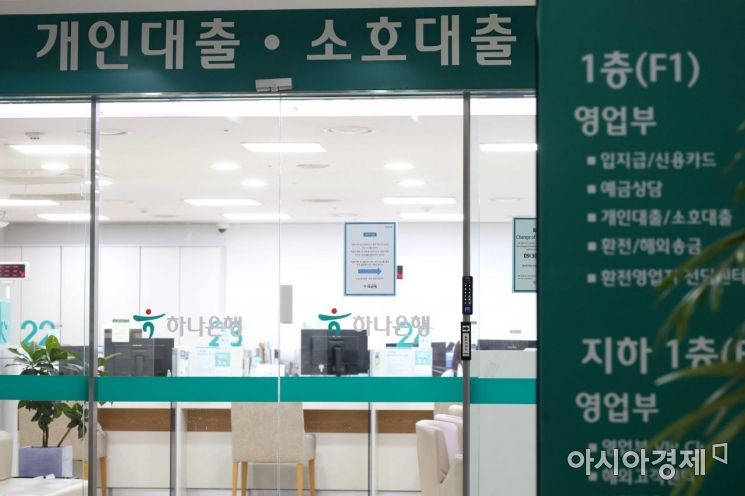
[Asia Economy Reporter Sim Nayoung] On the 23rd, mortgage loan interest rates at commercial banks approached 7%. Following the U.S. Federal Reserve's giant step (a 0.75 percentage point hike in the benchmark interest rate at once) the day before, domestic bank loan interest rates also rose accordingly. As the interest rates on bank bonds, which banks use to raise loan funds, hit an 11-year high, loan interest rates surged sharply within a day. With the prolonged trend of U.S. interest rate hikes becoming certain, the interest burden on the public has also ballooned like a snowball.
Hana Bank's upper limit for mixed-type mortgage loan interest rates was 6.82% as of the 23rd, nearly reaching 7%. The lower limit was also in the mid-5% range at 5.5%. This is about 0.2 percentage points higher than the previous day. Hana Bank's variable mortgage loan interest rates ranged from 5.30% to 6.60%. Even borrowing at the lowest rate means mortgage loan interest rates start from the 5% range. The upper limits of mortgage loan interest rates at Woori Bank and NH Nonghyup Bank also exceeded 6%. KB Kookmin Bank and Shinhan Bank still have their highest rates in the 5% range, but the financial sector expects further increases are only a matter of time due to the time lag reflecting bond interest rate movements at each bank.
Some banks have also seen jeonse deposit loans and unsecured loan interest rates exceed 6%. KB Kookmin Bank's upper limit for one-year unsecured loan interest rates is 6.47%, and Hana Bank's upper limit for jeonse loan interest rates is 6.31%.

A representative from a commercial bank explained, "Due to pressure from financial authorities, banks artificially lowered loan spread rates by 0.2 to 0.4 percentage points from the end of August, and at one point in early September, the upper limit of mortgage loan interest rates even dropped to the 5% range. However, as soon as bond interest rates rose yesterday, these measures became meaningless, and bank interest rates surged sharply." The AAA-rated 5-year financial bond rate (based on mixed-type mortgage loan interest rates) was 4.679% as of the 22nd, marking the highest level in 11 years and 6 months since March 2011. This is 0.219 percentage points higher than the previous day.
After the U.S. took a giant step, Bank of Korea Governor Lee Chang-yong stated, "The premise that the benchmark interest rate would be raised by 0.25 percentage points until the end of the year has changed." Following this, the market highly anticipates that the Bank of Korea will implement a 'big step' (a 0.5 percentage point hike at once) in October, causing bond interest rates to jump significantly.
The current U.S. benchmark interest rate is 3.25%, and U.S. financial institutions, including Bank of America, expect the Fed to raise the benchmark rate to 5% next year. South Korea's current benchmark interest rate is 2.5%. Considering that the U.S. continues to push for interest rate hikes and that South Korea must also raise its benchmark rate accordingly, the probability of commercial banks' mortgage loan interest rates exceeding 8% is not low.
© The Asia Business Daily(www.asiae.co.kr). All rights reserved.
![Clutching a Stolen Dior Bag, Saying "I Hate Being Poor but Real"... The Grotesque Con of a "Human Knockoff" [Slate]](https://cwcontent.asiae.co.kr/asiaresize/183/2026021902243444107_1771435474.jpg)

















