Marcos Expresses Willingness to Strengthen Ties with the US
Conveys Intent for Peaceful Resolution in the South China Sea
China Uncomfortable with Philippines' Pro-US Stance
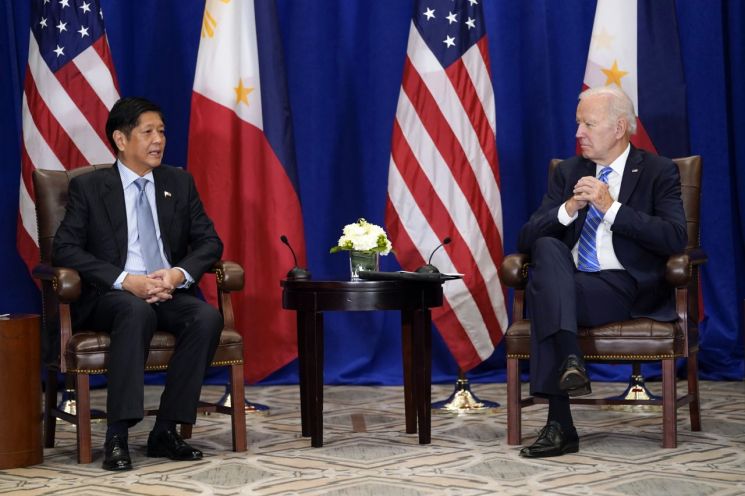 Philippine President Ferdinand Marcos (left) and U.S. President Joe Biden (right) are holding a summit on the 22nd (local time) in New York, USA. [Image source=AP Yonhap News]
[Asia Economy Reporter Lee Ji-eun] Philippine President Ferdinand Marcos on the 21st (local time) reiterated the importance of the alliance between the two countries during his first summit meeting with U.S. President Joe Biden. Unlike the previous administration, President Marcos is showing signs of breaking away from a pro-China stance by expressing a willingness to strengthen relations with the United States.
The two leaders discussed the security relationship between the U.S. and the Philippines, as well as the global economic crisis caused by Russia's invasion of Ukraine. Regarding the South China Sea, where territorial disputes between China and the Philippines have arisen, they confirmed support for freedom of overflight and the peaceful resolution of disputes.
At the meeting, President Biden stated, "The Philippines is one of the allies that immediately condemned Russia's invasion of Ukraine."
In response, President Marcos said, "The role of the United States in maintaining peace in our region is highly valued," adding, "The Philippines is your partner, ally, and friend." He also mentioned that "the relationship between the Philippines and the United States, which has lasted over 100 years, is facing new challenges," indicating that the bilateral relationship is at a crossroads.
President Marcos is drawing attention for taking a path completely opposite to that of former President Rodrigo Duterte, who pursued a pro-China policy. President Duterte criticized U.S. foreign policy and did not take a strong stance even as Chinese vessels remained for extended periods in the disputed South China Sea area. In 2020, he unilaterally notified the termination of the Visiting Forces Agreement (VFA), which stipulated the duties and rights of U.S. troops entering the Philippines, drawing criticism for loosening the military alliance with the United States.
On the other hand, Duterte sought cooperation with China by attending the Belt and Road Initiative (一帶一路: Land and Maritime Silk Road) forum and planning joint exploration of natural resources in the South China Sea.
Unlike the previous administration, President Marcos’s shift toward a pro-U.S. stance is underpinned by a calculation to gain advantages in territorial disputes with China. In his speech at the United Nations General Assembly on the 20th, President Marcos pressured China by stating, "Disputes such as those in the South China Sea should be resolved in a way that strengthens the predictability and stability of international law."
China expressed discomfort with the Philippines’ actions. On the 21st, Liu Jianchao, Director of the International Department of the Central Committee of the Chinese Communist Party, said, "There is no disagreement regarding the relationship between the Philippines and the United States," but added, "Our relationship with the Philippines has a long journey together, and we will consult with the Philippine government so that President Marcos can visit China."
© The Asia Business Daily(www.asiae.co.kr). All rights reserved.
![Clutching a Stolen Dior Bag, Saying "I Hate Being Poor but Real"... The Grotesque Con of a "Human Knockoff" [Slate]](https://cwcontent.asiae.co.kr/asiaresize/183/2026021902243444107_1771435474.jpg)
















