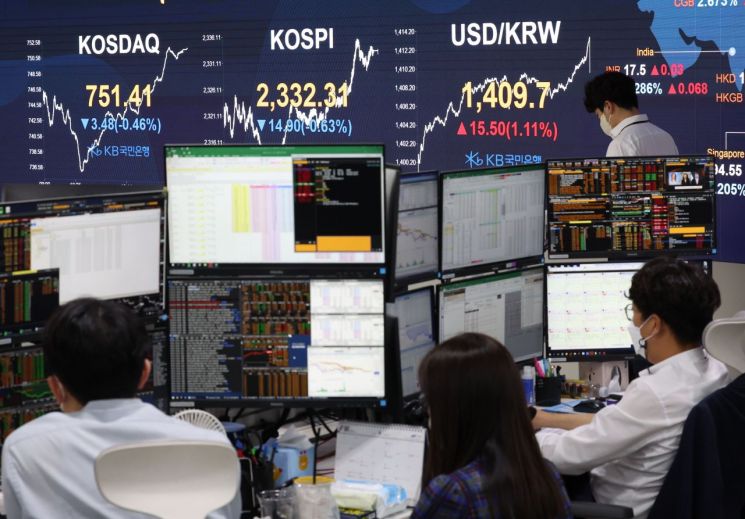
[Asia Economy Reporter Myunghwan Lee] On the 22nd, despite the impact of the U.S. Federal Reserve's (Fed) third consecutive giant step (a 0.75 percentage point hike in the benchmark interest rate at once), the domestic stock market partially reduced its losses. In the Korea Composite Stock Price Index (KOSPI) market, large-cap stocks such as Samsung Electronics and SK Hynix hit new 52-week lows during the session. The won-dollar exchange rate surpassed the 1,400 level for the first time in over 13 years.
On the day, the KOSPI closed at 2,332.31, down 0.63% (14.90 points) from the previous trading day. The KOSPI opened at 2,319.70, down 1.17% (27.51 points), deepened its losses, and at one point fell below the 2,310 level. However, it partially recovered losses in the afternoon session.
In the KOSPI market, individual investors defended the index decline by net buying stocks worth around 300 billion won. Individual investors purchased stocks worth 313.8 billion won on the day. Conversely, institutional and foreign investors sold stocks worth 283 billion won and 61.2 billion won, respectively.
Samsung Electronics, the KOSPI's leading stock, closed at 54,400 won, down 1.63% (900 won) from the previous day. Similarly, semiconductor stock SK Hynix closed at 86,000 won, down 2.27% (2,000 won). Both stocks set new 52-week lows during the session. Growth stocks representing the domestic market, Kakao (-4.22%) and Naver (NAVER) (-3.05%), also hit new 52-week lows.
On the other hand, secondary battery-related stocks such as LG Energy Solution (1.88%), Samsung SDI (1.62%), and LG Chem (0.16%) closed higher despite the overall market decline. In the KOSDAQ market, stocks like EcoPro (5.04%), EcoPro BM (3.75%), and L&F (2.65%) rose significantly. Regarding this, Kim Seok-hwan, a researcher at Mirae Asset Securities, noted, "Despite the index decline, secondary battery-related stocks maintained an upward trend," adding, "This reflects expectations of solid earnings despite recession concerns and their status as beneficiaries of the U.S. Inflation Reduction Act (IRA)."
By sector in the KOSPI market, defensive sectors such as electric and gas utilities (2.37%) and food and beverages (1.69%) showed gains, along with indices like non-metallic minerals (1.38%). Conversely, service industries (-2.23%), securities (-2.17%), and construction (-1.80%) declined.
The KOSDAQ index closed at 751.41, down 0.46% (3.48 points) from the previous day. The KOSDAQ opened at 746.82, down 1.07% (8.07 points), and deepened losses to over 2% during the morning session. The index gradually reduced its losses in the afternoon session.
Individual investors also bought stocks worth 24.6 billion won in the KOSDAQ market. Institutional investors were net buyers of 22.3 billion won in the KOSDAQ. Foreign investors sold stocks worth 46.9 billion won alone.
Except for secondary battery stocks, the top market capitalization stocks in the KOSDAQ showed a downward trend. The decline was significant among gaming and entertainment stocks such as Kakao Games (-3.93%), JYP Entertainment (-3.21%), and Pearl Abyss (-1.79%).
By sector in the KOSDAQ, indices including food and tobacco (3.46%), general electric and electronics (1.49%), and telecommunication services (0.66%)?all defensive sectors?rose. Conversely, broadcasting services (-5.01%), telecommunication broadcasting services (-3.19%), and digital content (-2.73%) fell by more than 2%.
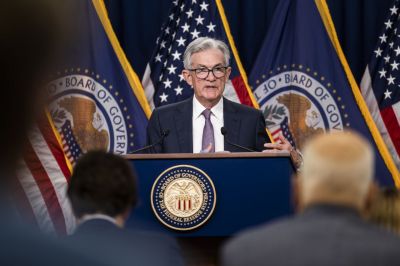
The decline in the domestic stock market on the day appears to have been influenced by the U.S. interest rate hike decision and hawkish remarks by Fed Chair Jerome Powell. On the 21st (local time), the Fed held its Federal Open Market Committee (FOMC) regular meeting and announced a 0.75 percentage point increase in the benchmark interest rate. As inflation remained stubbornly high, the Fed took the unusual step of implementing three consecutive giant steps. At the same time, the U.S. benchmark interest rate once again surpassed Korea's, causing a reoccurrence of the interest rate inversion phenomenon.
The strong dollar also seems to have affected foreign investor flows. In the Seoul foreign exchange market on the day, the won-dollar exchange rate closed at 1,409.7 won per dollar, up 15.5 won from the previous day. The exchange rate rose as high as 1,413.5 won during the session. The 1,410 won level was last recorded on March 31, 2009, during the financial crisis, marking the first time in 13 years and 6 months.
Regarding this, researcher Kim said, "The U.S. confirmed a more aggressive rate hike stance through a higher-than-expected rate outlook," diagnosing that "the won-dollar exchange rate hitting the 1,400 won level for the first time in 13 years and 6 months acted as a burden on foreign investor flows."
© The Asia Business Daily(www.asiae.co.kr). All rights reserved.
![Clutching a Stolen Dior Bag, Saying "I Hate Being Poor but Real"... The Grotesque Con of a "Human Knockoff" [Slate]](https://cwcontent.asiae.co.kr/asiaresize/183/2026021902243444107_1771435474.jpg)

















