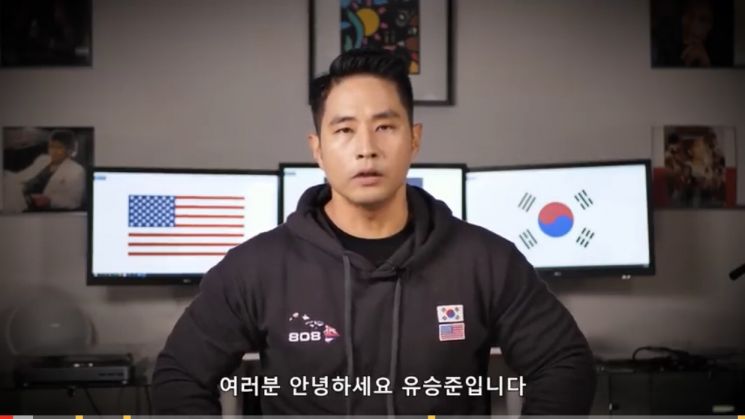
[Asia Economy Reporter Kim Hyung-min] The court presiding over the second trial of the administrative lawsuit concerning singer Yoo Seung-jun (45, U.S. name Steve Seung-jun Yoo)'s issuance of a Korean entry visa has requested clarification on Yoo's "national identity."
The Seoul High Court Administrative Division 9-3 (Presiding Judges Cho Chan-young, Kang Moon-kyung, Kim Seung-joo) held the first hearing on the appeal filed by Yoo against the Los Angeles (LA) Consulate General's refusal to issue a passport and visa on the 22nd.
On that day, the court asked Yoo's side, "Please review whether the plaintiff is a 'foreigner' as stated in Article 6, Paragraph 2 of the Constitution, a 'Korean national residing abroad' as defined in Article 2, Paragraph 2, or both." The court intends to gather opinions from both sides because the application of the Overseas Koreans Act may differ depending on whether Yoo is legally considered a foreigner or a Korean national residing abroad.
Article 6, Paragraph 2 of the Constitution states, "Foreigners shall have their status guaranteed in accordance with international law and treaties." Article 2, Paragraph 2 states, "The State shall have the obligation to protect Korean nationals residing abroad as prescribed by law." Yoo's side mentioned "fundamental rights of foreigners" in their appeal brief. In response, the court pointed out, "Although the wording is somewhat strange in this case, isn't the plaintiff not a 'complete foreigner'?"
The court also requested the defendant's side to "provide a legal interpretation of the differences and similarities in legal regulations between 'foreigners' under the Immigration Control Act and 'overseas Koreans' under the Overseas Koreans Act."
Yoo, who acquired U.S. citizenship to avoid military service and was restricted from entering Korea in 2002, attempted to enter with an Overseas Korean visa but was denied issuance. He filed his first administrative lawsuit in 2015. In March 2020, the Supreme Court ruled in favor of the plaintiff, stating that the LA Consulate General's refusal to issue the visa without exercising discretion was illegal.
Afterwards, Yoo applied for a visa again but was refused once more. Claiming that the refusal was contrary to the Supreme Court ruling, he filed a second administrative lawsuit in October 2020. The first trial court dismissed Yoo's claim, stating that the Supreme Court ruling meant there was a procedural illegality in refusing the visa issuance, not that Yoo must be issued a visa.
© The Asia Business Daily(www.asiae.co.kr). All rights reserved.

















