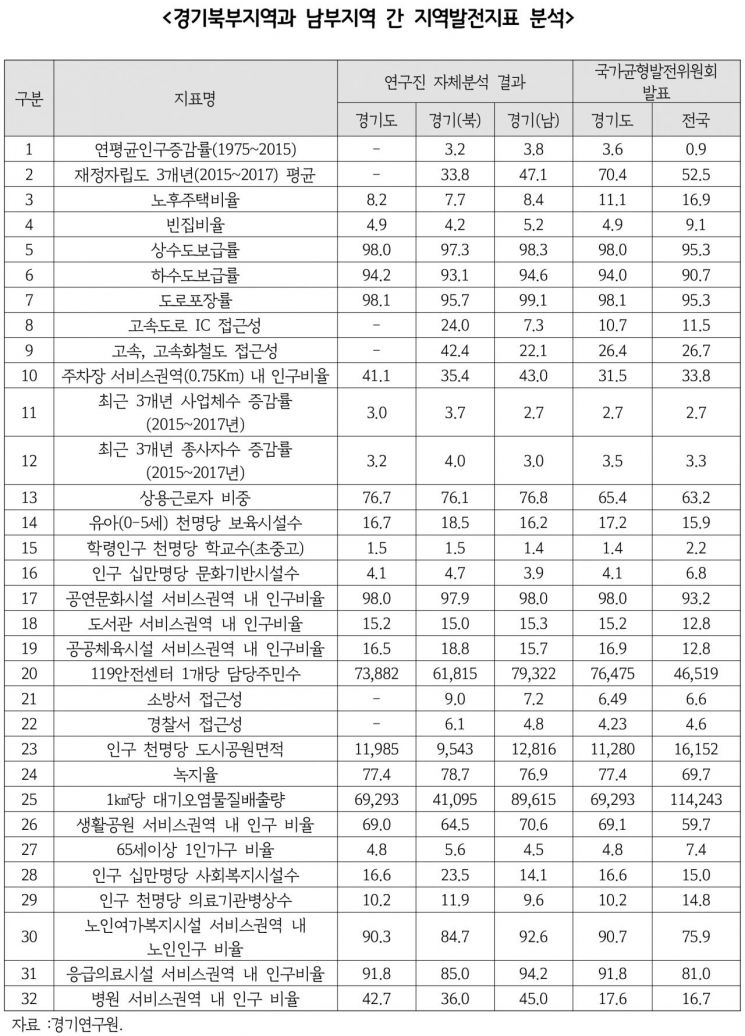
[Asia Economy (Suwon) = Reporter Lee Young-gyu] It has been revealed that the regional gross domestic product (GRDP) ratio between the southern and northern parts of Gyeonggi Province shows a gap of 4.8 times, and the average monthly wage of workers differs by 310,000 KRW.
According to the report titled 'Development Strategy for Northern Gyeonggi Region for Quantum Jump' published by the Gyeonggi Research Institute on the 22nd, as of 2019, the GRDP of the northern Gyeonggi region accounted for 17.3% of the entire province, falling short of the population ratio (26%).
Per capita GRDP was generally lower in northern areas such as Namyangju (15.34 million KRW), Uijeongbu (15.49 million KRW), and Guri City (16.98 million KRW) compared to the southern region.
The average monthly wage of workers, indicating regional productivity and employee income (as of 2021), was 2.63 million KRW in northern Gyeonggi, which is 92.1% of the provincial average (2.856 million KRW) and 89.4% of southern Gyeonggi (2.942 million KRW).
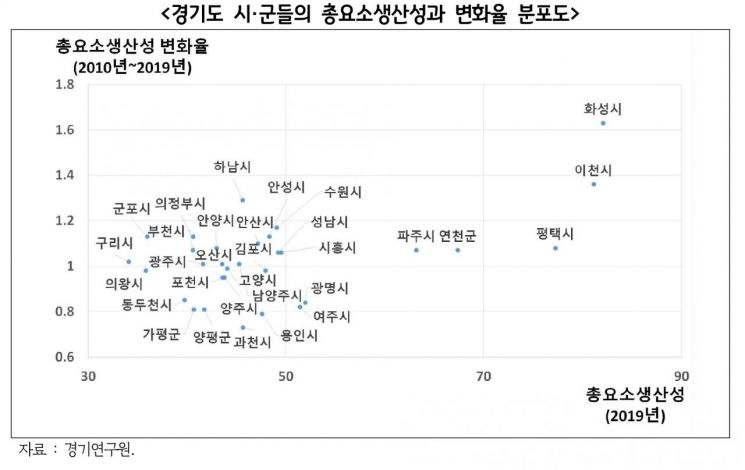
According to the total factor productivity analysis, which reflects the technical efficiency of regional growth, improvements from 2010 to 2019 were observed in Hwaseong, Icheon, Hanam, Suwon, and Gunpo, all located in the southern region.
In the analysis of innovation growth capabilities, there was little difference between the two regions in human and educational capacity indicators; however, northern Gyeonggi was relatively weaker than the south in research and development (R&D) and startup capability indicators.
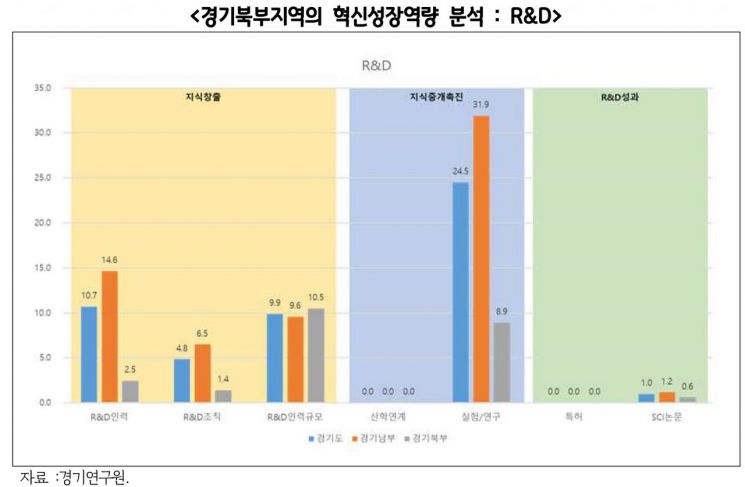
The Gyeonggi Research Institute analyzed that the underdevelopment and stagnation in the northern region are caused by factors related to industrial innovation, infrastructure, and regulations.
Compared to Seoul, Incheon, and southern Gyeonggi, the northern region lacks development in specialized industries and technologies, as well as industrial innovation hubs such as enterprises, universities, and R&D centers. It is also vulnerable in terms of metropolitan transportation infrastructure and public transit accessibility. Additionally, regulations related to the metropolitan area, Paldang water source, and military facilities have acted as obstacles to growth, according to the institute's diagnosis.
Accordingly, the Gyeonggi Research Institute proposed a solution to achieve regional development through a 'quantum jump' approach that bypasses the existing growth equation by enhancing the technical efficiency of regional production (improving total factor productivity) and increasing regional and corporate innovation through scientific technology and industrial advancement (enhancing innovation capacity).
The strategy includes selecting six new growth industries?high-tech textiles, biomedical, medifood, renewable energy, leisure sports, and military supply industries?and establishing six corporate attraction zones to restructure the industrial framework.
Senior Research Fellow Lee Sang-dae of the Gyeonggi Research Institute stated, "Despite over 30 years of industrial complex development, transportation infrastructure construction, and the establishment of new towns such as Ilsan, Yangju, and Dasan, the northern Gyeonggi region has not escaped underdevelopment and backwardness. To reduce the persistent development gap, a quantum jump strategy must be pursued."
© The Asia Business Daily(www.asiae.co.kr). All rights reserved.



















