Dyson Launches New Cordless Vacuum 'Gen5 Detect'... First Introduction in Korea
Samsung and LG Electronics Enhance Design and Convenience... Dyson Emphasizes Motor Technology
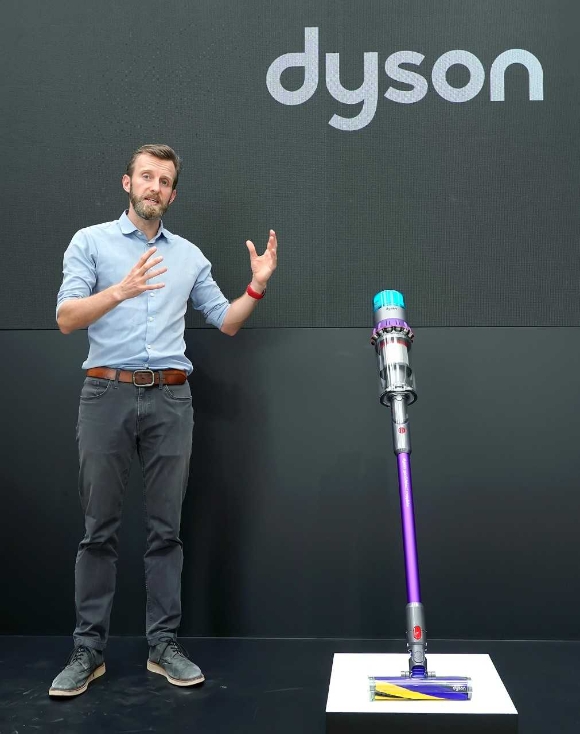 Charlie Park, Vice President of Dyson's Cordless Vacuum Cleaner Division, is introducing the Dyson 'Gen5 Detect'. [Photo by Dyson]
[Asia Economy Reporter Han Ye-joo] Competition in the domestic cordless vacuum cleaner market is intensifying. Market leader LG Electronics, challenger Samsung, and the original Dyson are all focusing on expanding the market based on new technologies.
According to the industry on the 22nd, Dyson launched a new cordless vacuum cleaner model, the 'Dyson Gen5 Detect,' equipped with a 5th generation Hyperdymium motor that delivers powerful suction of 262 air watts (AW). Dyson's previously released stick-type cordless vacuum cleaners have been part of the V series, ranging from V6 to V15. This time, the new model uses a next-generation motor that is faster and more powerful than the existing motor and is introduced under the new name Gen5.
It is significant that Dyson's new product was first launched in Korea. Charlie Park, Vice President and Head of Dyson's Cordless Vacuum Cleaner Division, said, "As we understand it, Koreans place great importance on cleaning and hygiene and have a considerably higher level of technological understanding compared to other countries. Korea is especially important to us because through the Korean market, we can often understand what aspects might be important in other markets."
Dyson is aiming to expand its presence in the domestic market by making changes not only in suction power but also in various other aspects. Dyson once held an overwhelming market share of 70-80% in the domestic cordless vacuum cleaner market, but currently, its share has dropped to around 10-20%, trailing behind Samsung Electronics and LG Electronics.
Industry experts analyze that while interior appliances have recently become a trend and designs that harmonize with any space have emerged as an important factor, Dyson has failed to maintain its domestic market share because it focused solely on cleaning performance. In fact, Samsung Electronics and LG Electronics are leading the trend of customized and interior appliances with their 'Bespoke' and 'Objet Collection' lines, respectively. On the other hand, Dyson vacuum cleaners are criticized for having limited overall design and color options, which narrows consumer choice. Dyson also has not introduced the 'automatic dustbin emptying function.' This contrasts with Samsung and LG, which emphasize convenience by featuring this function. Recently, robot vacuum cleaner companies have also been focusing on enhancing convenience by gradually incorporating this feature.
According to market research firm ReportLinker, the global cordless vacuum cleaner market is expected to grow from $6.73 billion last year to $9.43 billion by 2026. As the market grows, competition is expected to become fiercer. Just as Dyson is focusing on the Korean market, our companies are also expanding their influence in overseas markets.
LG Electronics began exporting its 'CordZero' products in 2015. They are currently sold in 18 countries, including the United States, Canada, Australia, and Taiwan. Samsung Electronics exports its 'Jet' products to more than 50 countries. Last year, its global sales grew by more than 50% compared to the previous year. Particularly, it has received a good response in Poland and Kazakhstan, and in Poland, Samsung achieved the number one market share in the cordless stick vacuum cleaner market in February.
Meanwhile, aside from the three companies, Shinil Electronics, Electrolux, and Xiaomi are active in the cordless vacuum cleaner market. The participation of rental companies remains a constant point of interest. Cuckoo Homesys launched its first premium cordless vacuum cleaner, the 'Inspure Powerclone,' last year but is still selling it only as a lump-sum purchase, not as a rental.
© The Asia Business Daily(www.asiae.co.kr). All rights reserved.

















