Corporate Loan Competition Intensifies, Rates Previously Lower Than Household Loans
Soar Significantly from August
High Exchange Rates Increase Foreign Currency Loans, Raising Soundness Concerns
Corporate Loan Capacity Diminishes
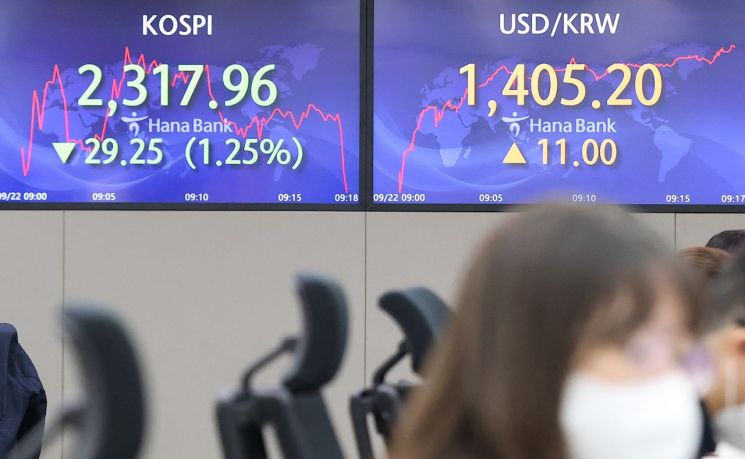
[Asia Economy Reporter Sim Nayoung] An unusual trend has been detected where corporate loan interest rates at commercial banks have surged past household loan interest rates. Banks had kept corporate loan rates lower than household loan rates to expand corporate lending through the first half of this year, but this has now reversed. Expanding corporate credit was a key theme for banks this year, as reflected in the New Year's messages of the heads of the five major commercial banks.
Banks have been intensifying competition in corporate business, and unlike household loans, corporate loans at the five major banks have steadily increased in scale for this reason.
KB, Hana, NongHyup: Corporate Loan Rates Surpass Household Loan Rates
According to the August interest rates disclosed on the Consumer Portal of the Korea Federation of Banks on the 22nd, among the five major banks, those where corporate loan rates exceeded household loan rates were KB Kookmin Bank (corporate 4.45% · household 4.42%), Hana Bank (corporate 4.47% · household 4.33%), and NH NongHyup (corporate 4.26% · household 4.21%). In July, except for Hana Bank, all four other banks had corporate loan rates lower than household loan rates, but this reversed in August.
This trend is also reflected in the Bank of Korea's Economic Statistics System. As of July, the interest rate on small and medium enterprise loans at deposit banks in Korea was 4.36%, surpassing the mortgage loan rate (4.16%), which accounts for the largest portion of household loans. As household loan capacity tightened, banks fiercely competed in corporate lending, and from September last year, SME loan rates were lower than mortgage loan rates, but this trend has now ended.
High Exchange Rate, Rising Demand, and Financial Bonds as Causes
Why have corporate loan rates risen above household loan rates? Commercial banks analyze that the high exchange rate has a significant impact. As of the 22nd, the won-dollar exchange rate exceeded 1,400 won. When the exchange rate rises, foreign currency loans increase, especially for export companies. This worsens the bank's core soundness indicator, the capital adequacy ratio (BIS ratio).
A representative from a commercial bank explained, "From the bank's perspective, to maintain the BIS ratio, lending capacity in other areas must be reduced," adding, "This is why corporate loan rates have increased." This situation is similar to last year when financial authorities implemented total household loan regulations to curb household loan growth, leading commercial banks to raise household loan interest rates.
Increased corporate loan demand compared to early this year also fueled the interest rate hike. Nowadays, even when companies issue corporate bonds, there is no purchasing demand, so loans have clearly shifted more towards banks than at the beginning of the year. This is why interest rates have risen. Another bank official said, "Even the corporate bond borrowing rates for companies with high credit ratings have risen from the 2% range to the 5% range within a year," adding, "It has become difficult for SMEs to issue corporate bonds, so many companies are turning to banks."
The rapid rise in financial bond interest rates, which serve as the benchmark for corporate loan rates, in August also pushed corporate loan rates higher. Based on the 6-month financial bond, the rate jumped 0.26 percentage points (from 3.09% to 3.35%) during August.
Rising Loan Rates Make Things Harder for Companies
As corporate loan interest rates rise, companies, whether large or small, inevitably face greater difficulties. According to a survey conducted earlier this month by the Korea Chamber of Commerce and Industry targeting 307 domestic manufacturing companies on the 'Impact of Recent Interest Rate Hikes and Corporate Response Status,' 61.2% of respondents said they are "actually experiencing difficulties due to high interest rates."
The most common difficulty companies face was "deterioration of financial conditions due to interest burden," at 67.6%. Regarding support measures they hope for from financial authorities amid the recent interest rate situation, companies most frequently cited "support for switching to fixed interest rates" (34.9%).
© The Asia Business Daily(www.asiae.co.kr). All rights reserved.
![Clutching a Stolen Dior Bag, Saying "I Hate Being Poor but Real"... The Grotesque Con of a "Human Knockoff" [Slate]](https://cwcontent.asiae.co.kr/asiaresize/183/2026021902243444107_1771435474.jpg)
















