Discussion on Practical Measures to Strengthen 'Victim Protection and Safety'... Frontline Council in Operation
Legal Community: "Courts Should Also Participate in Discussions... No Results Without Detention for High-Risk Offenders"
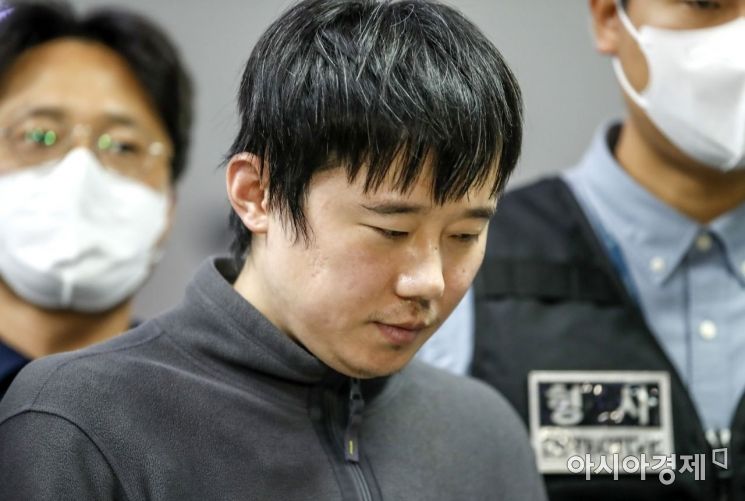 Suspect Jeon Juhwan in the 'Sindang Station Stalking Murder' case is being transferred from the Namdaemun Police Station detention center in Jung-gu, Seoul to the prosecution on the 21st. Photo by Moon Honam munonam@
[Asia Economy Reporter Heo Kyung-jun] The prosecution and police, which have formed a council to respond to stalking crimes, will hold their first meeting on the 22nd. Since Prosecutor General Lee Won-seok took office, the prosecution and police appear to be cooperating, but some criticize that after the Stalking Punishment Act was enforced in October last year, time was spent without meaningful consultation, and only after stalking murder crimes occurred did they form the council, taking a reactive approach.
The prosecution and police will hold the "Prosecution-Police Stalking Crime Response Council" at 3 p.m. on the 15th floor meeting room of the Supreme Prosecutors' Office. Attendees are expected to include the head of the Criminal Department (Chief Prosecutor) and the head of the Criminal Division 3 (Senior Prosecutor) from the Supreme Prosecutors' Office, the Director of the Criminal Bureau of the National Police Agency, and the head of the Women and Juvenile Investigation Division of the National Police Agency.
At this meeting, the prosecution and police are expected to discuss ▲strict response and enhanced punishment for stalking crime suspects ▲practical measures to strengthen victim protection and safety ▲information sharing related to stalking crimes ▲sharing investigative materials that may influence provisional measures or detention of suspects and court rulings.
Earlier, Prosecutor General Lee and National Police Agency Commissioner Yoon Hee-geun met at the National Police Agency on the 19th and agreed to establish a prosecution-police consultative body to respond to stalking murder cases. It is reported that local prosecution offices and police have already been operating stalking crime councils.
Upon taking office, Prosecutor General Lee issued his first directive to "actively utilize arrest warrants and separation measures for victims and perpetrators to respond to stalking crimes."
In an emergency video conference involving 89 dedicated stalking prosecutors from 60 prosecution offices nationwide, Prosecutor General Lee ordered, "Place the safety of victims at the center of all judgments and decisions." The number of stalking cases received by the prosecution in the second quarter of this year averaged 649 per month, more than four times the number since the Stalking Punishment Act was enacted.
Accordingly, the prosecution has established a plan to meticulously investigate risk factors such as the suspect's obsessive tendencies toward the victim, proximity to the victim’s workplace or residence, and the circumstances and duration of the crime.
Also, if there is concern that the victim may be harmed, the prosecution will prioritize separating the perpetrator and victim through detention and provisional measures. Provisional measures include ▲written warnings to stop stalking ▲prohibition of approaching within 100 meters of the victim or their residence ▲prohibition of communication access to the victim ▲detention in a jail or detention center, which the court can impose upon the prosecutor's request or on its own authority.
The court has also expressed the need for alternatives such as requiring stalking crime suspects under non-custodial investigation to wear electronic location tracking devices (electronic anklets) or issuing restraining orders against approaching the victim.
However, despite the enforcement of the Stalking Punishment Act, which includes emergency provisional measures such as prohibiting approach within 100 meters of the victim or their residence, stalking crimes continue to occur persistently. In the legal community, while cooperation between prosecution and police is important, it is analyzed that without detention of the perpetrator, it is difficult to achieve the desired results, so courts deciding on detention should also be involved in discussions.
Attorney Lee Eun-ui, a specialist in sex crimes, said, "In cases where dating violence escalates to stalking, many incidents lead to retaliatory murder or injury after reporting," adding, "It is difficult to manage high-risk provisional perpetrators, and such criminals can only be deterred by detention, so there is no other way than physical detention."
She continued, "The police face dangerous situations first on the front lines, but if arrest warrants are not changed together by the prosecution and courts, there is no solution," emphasizing, "Improvement measures involving the courts are necessary, and objective criteria based on data showing high risk of retaliation should be established to judge detention. It is like locking the barn after the horse is stolen, but many horses still remain."
© The Asia Business Daily(www.asiae.co.kr). All rights reserved.
![Clutching a Stolen Dior Bag, Saying "I Hate Being Poor but Real"... The Grotesque Con of a "Human Knockoff" [Slate]](https://cwcontent.asiae.co.kr/asiaresize/183/2026021902243444107_1771435474.jpg)
















