Domestic Top 3 Battery Companies
8 out of 12 North American Factories Are Joint Ventures
Battery Material Company L&F
Denied Approval for U.S. Factory Construction
Industrial Technology Protection Committee Cites "Insufficient Security Measures" for Advanced Technology
Automakers Demand Battery Technology Sharing Over Safety Concerns
Domestic Companies Increasingly Worried About Technology Leakage
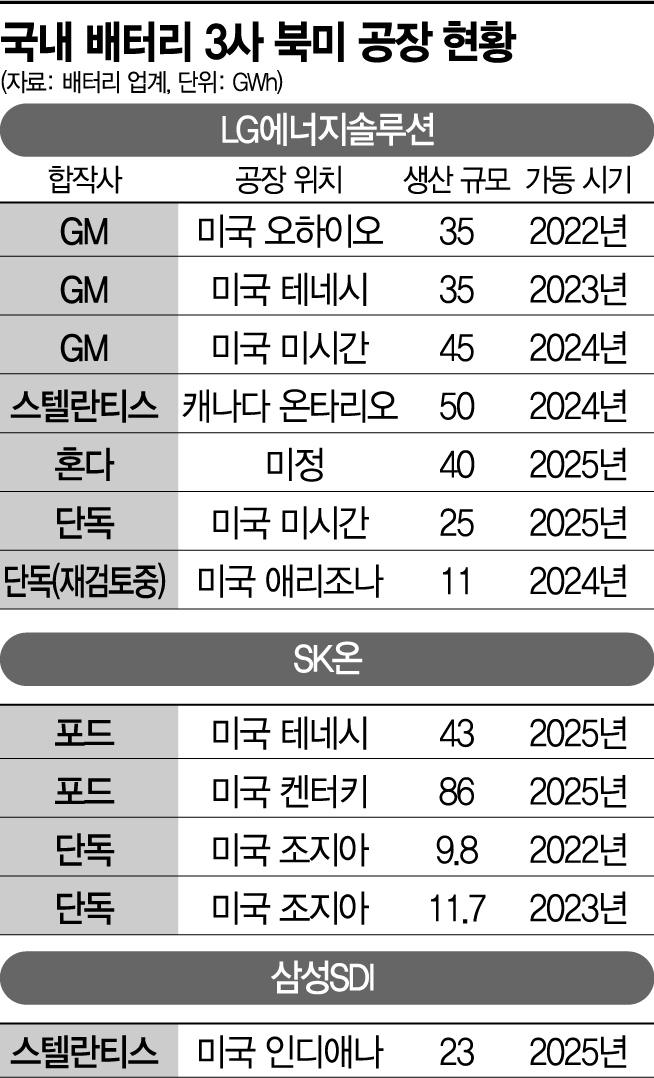
As the North American electric vehicle market blossoms, domestic battery companies are consecutively building factories in the region in the form of joint ventures, raising concerns about technology leakage. Since there is a high possibility of technology leaking through joint ventures or mergers and acquisitions, experts point out the need for solid measures to protect technology.
According to the industry on the 22nd, currently, the three major domestic battery cell manufacturers?LG Energy Solution, SK On, and Samsung SDI?are either constructing or operating 12 factories in North America, including the United States and Canada. Among these, eight are joint venture factories co-invested with automakers, and four are standalone factories. Additionally, battery material companies such as POSCO Chemical, Lotte Chemical, and EcoPro BM have planned five local factories, two of which are joint ventures.
With the North American electric vehicle market expected to experience explosive growth, domestic battery companies are continuously building joint venture factories in partnership with global automakers. According to the Biden administration’s policy to expand electric vehicle adoption, the U.S. electric vehicle market is projected to grow from 750,000 units this year to 2.03 million units by 2025 and 6.02 million units by 2030.
Amid this, the construction of a U.S. factory by domestic battery cathode material company L&F was disapproved by the Industrial Technology Protection Committee under the Ministry of Trade, Industry and Energy. The committee reportedly made the disapproval decision citing "insufficient security measures for the advanced cathode material manufacturing technology." The Industrial Technology Protection Act requires companies to obtain approval from the Minister of Trade, Industry and Energy when exporting or undergoing mergers and acquisitions involving national core technologies such as semiconductors, batteries, and displays.
L&F is a company with the technological capability to produce ‘high-nickel battery cathode materials’ containing over 80% nickel, known for excellent driving range and stability. This is the first time the Korean government has denied the establishment of a U.S. factory by a domestic battery company, reflecting the judgment that security for core battery technology is necessary at this point.
Joint ventures that build factories and produce batteries together inevitably face pressure to share technology. Automakers have consistently maintained the position that battery technology should be shared due to safety and recall risk concerns. On the other hand, as automakers are pushing for internalization of electric vehicle batteries, domestic companies cannot help but worry about technology leakage. This issue has been consistently raised since domestic battery companies began establishing joint ventures with automakers.
Professor Kim Pil-su of Daelim University’s Department of Automotive Engineering said, "When operating a joint venture factory, there is increased human interaction and some technology or processes inevitably have to be shown. Joint ventures or mergers and acquisitions can all be seen as processes where some technology leakage occurs, so careful consideration of battery technology protection is necessary."
There are also calls for enhanced security of technologies such as batteries, which are next-generation advanced industries, at the level of the National Intelligence Service. According to the National Intelligence Service, from January 2017 to February this year, there were a total of 99 detected attempts to leak domestic industrial technology. Among these, 17 cases involved the electric and electronics industries, including batteries. Professor Park Cheol-wan of Seojeong University’s Department of Automotive Engineering said, "Considering global industrial hegemony competition and trends, industrial technology protection is also linked to national security. It is time for the National Intelligence Service to take charge as the main agency for industrial technology protection to ensure more reliable technology security."
© The Asia Business Daily(www.asiae.co.kr). All rights reserved.
![Clutching a Stolen Dior Bag, Saying "I Hate Being Poor but Real"... The Grotesque Con of a "Human Knockoff" [Slate]](https://cwcontent.asiae.co.kr/asiaresize/183/2026021902243444107_1771435474.jpg)
















