FKI to Survey 'Trade Balance and Exchange Rate Outlook' on 21st
40% Expect Trade Deficit Over 30 Billion USD
KRW-USD Exchange Rate Forecasted at 1423 Won on Average
'Exchange Rate Stability and Financial Market Risk Prevention' Most Urgent
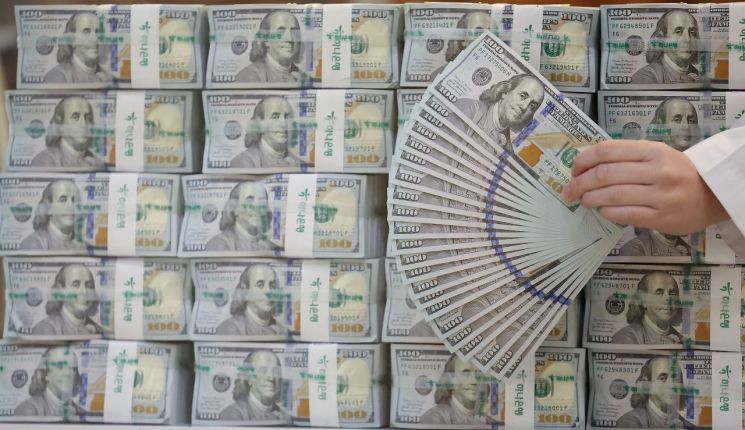
[Asia Economy Reporter Han Yeju] This year, the annual trade balance is projected to record a deficit of $28.17 billion, and the exchange rate is expected to rise to the 1,400 won level. Analysts say this signals an emergency for the South Korean economy, which is highly dependent on external factors.
On the 21st, the Federation of Korean Industries (FKI) surveyed heads of research centers from 15 securities firms on the "Trade Balance and Exchange Rate Outlook." The results forecast an annual trade deficit of $28.17 billion for this year. This surpasses the levels seen during the global financial crisis and just before the foreign exchange crisis, marking the largest deficit since statistics began in 1956. Notably, 40.0% of respondents predicted the trade deficit would exceed $30 billion.
About half of the experts (53.3%) identified August this year as the peak of the deficit, and 9 out of 10 (86.7%) expected it to occur by November, suggesting that the worst phase has passed or will end soon. However, the average forecast for the end of the deficit trend is early February next year, indicating that the deficit phase experienced over the past five months is likely to continue for another five to six months. Sixty percent of respondents viewed the deficit trend ending next year.
Many experts expect the trade deficit to improve in the fourth quarter, but the deficit trend is projected to continue into next year. On the import side, although international raw material prices have declined from their peak since July, raw material and energy prices remain high, and the strong dollar is expected to add significant pressure on import prices.
On the export side, the semiconductor industry?South Korea’s main export item?is deteriorating, exports to China are sluggish, and the global tightening and worldwide inflation are expected to trigger a global economic downturn in the second half of the year. Many experts predict that export conditions will weaken going forward. Some expressed concerns that the export growth rate could turn negative, leading to a sharp cooling of the export market.
Experts forecast that, buoyed by strong exports in the first half, this year’s annual export value will reach $695 billion, surpassing the previous record high of $644.4 billion set in 2021. However, export growth is expected to slow in the second half, so even the record-high forecast cannot be taken for granted. When asked about the biggest threats to the domestic export industry, 60.0% of respondents cited "global economic slowdown," followed by "supply chain difficulties due to US-China hegemonic competition" (26.7%) and "rising raw material prices" (13.3%).
Among the top 15 export items, the three expected to see the largest export declines in the second half are computers, semiconductors, and wireless communication devices, all concentrated in IT products. The three items expected to see the largest export increases in the second half are automobiles, secondary batteries, and petroleum products.
Regarding the won-dollar exchange rate, which continues to soar daily, experts forecast an average peak of 1,422.7 won. When asked about the impact of sustained high exchange rates on companies, two-thirds of experts (66.7%) said that "cost burdens from exchange rates, such as rising raw material prices, will offset export growth." A significant 26.7% responded that "cost burdens are even greater." Only 6.7% believed that it would "help increase exports and profits." Meanwhile, experts added that a high exchange rate could push up import prices, becoming a hidden threat that worsens the trade balance.
Regarding the most important economic measures the government should focus on in the current situation, "stabilizing the exchange rate and preventing financial market instability" (28.9%) was the most cited, followed by "improving the business environment through deregulation and tax support" (17.8%) and "resolving raw material supply and logistics difficulties" (17.8%).
Yoo Hwan-ik, head of the Industry Division at the FKI, said, "The trade deficit is expected to continue until early next year, and the exchange rate is projected to rise to the 1,400 won level, signaling an emergency in trade and exchange rates. This is a significant threat, especially to the South Korean economy, which is highly dependent on external factors." He emphasized, "Financial authorities should strengthen monitoring to prevent the spread of financial market instability, and since a global economic downturn is expected, efforts should be made to improve the business environment through regulatory reforms and tax support to help companies overcome difficulties."
© The Asia Business Daily(www.asiae.co.kr). All rights reserved.
![Clutching a Stolen Dior Bag, Saying "I Hate Being Poor but Real"... The Grotesque Con of a "Human Knockoff" [Slate]](https://cwcontent.asiae.co.kr/asiaresize/183/2026021902243444107_1771435474.jpg)











