Detention Application Denied
Prosecutors and Police Differ in Interpreting 'Repeated Risk' under Stalking Law
Temporary Measures Require 3 Steps: Police-Prosecutors-Court
"Urgent Improvement Needed for On-Site Judgment"

[Asia Economy Reporter Oh Gyumin] An incident occurred where the police requested the prosecution to detain a stalking perpetrator in a detention center, but the request was dismissed, resulting in the perpetrator being investigated without detention for 12 days. The issue of issuing an arrest warrant for the perpetrator was revealed in the Sindang Station stalking station worker murder case, but there are also criticisms that there are loopholes in the provisional measures under the Stalking Punishment Act.
The Seoul Western District Prosecutors' Office indicted a man in his 30s, A, on charges of violating the Stalking Punishment Act, special threats, and property damage on the 30th of last month. A is accused of visiting the victim B's house multiple times over five months since March and threatening with a weapon. On the 4th of last month, when B did not open the front door, A is known to have damaged the door with a weapon and inserted the weapon into the gap.
The Eunpyeong Police Station, which received the case, applied to the prosecution on the 5th of last month for provisional measure No. 4 (detention in a detention center) to separate the perpetrator from the victim. Provisional measure No. 4 is a system that allows detaining a perpetrator who poses a risk of stalking recurrence in a detention center for up to one month by court decision without an arrest warrant.
However, the prosecution dismissed the application for provisional measures against A. Regarding the reason for dismissal, the prosecution explained that the police application did not demonstrate the 'risk of repetition' required under the Stalking Punishment Act. They judged that applying for the measure to the court based only on the incident on the 4th of last month was insufficient. On the other hand, the police viewed A's stalking behavior as repetitive. The police explained that they applied for the provisional measure including three criminal facts to which stalking law violation charges were applied on the day of the incident.
Although A was effectively 'free' for 12 days, according to the police, the victim stayed in a temporary protection facility after the provisional measure was dismissed and did not suffer further harm.
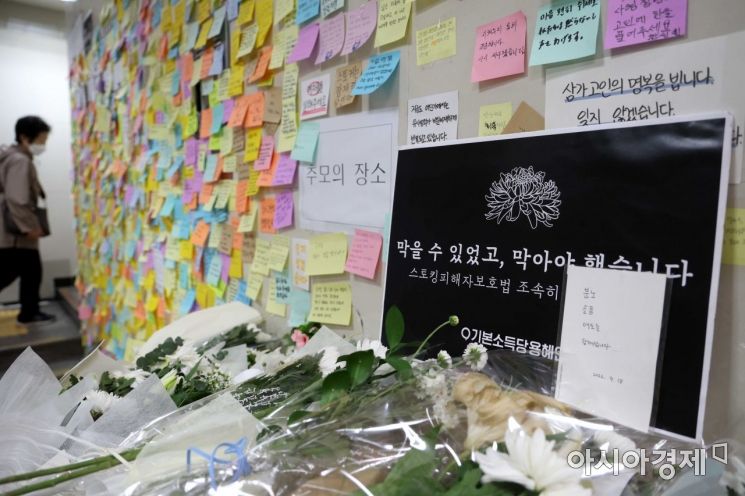 A memorial procession of citizens continues on the 19th at the women's restroom of Sindang Station on Seoul Subway Line 2, where a 20-year-old station attendant was murdered after stalking. Photo by Moon Honam munonam@
There are criticisms that the prosecution and police interpreted the legal provisions differently, and the ambiguous wording inevitably leads to different interpretations. Professor Lee Woonghyuk of the Department of Police Science at Konkuk University said, "For stalking crimes to be recognized, there must be continuity and repetition, and the victim must feel threatened and anxious," adding, "There is a problem of whose standard to use to evaluate continuity because the concept of continuity and repetition, which is the premise, is interpreted differently by each party."
There is also a problem that the steps to be taken before provisional measures are complicated. Like the process of issuing an arrest warrant, it goes through three stages: the police's warrant application, the prosecution's request, and the court's issuance. In particular, detention in a detention center, which is provisional measure No. 4, is not included in emergency urgent measures. Unlike provisional measures, emergency urgent measures can be taken by the police ex officio. Ultimately, when urgent detention of the perpetrator is necessary, the three-step process must still be followed.
Since the purpose of provisional measures is to protect the victim and prevent the recurrence of stalking, there are opinions that the system needs improvement to ensure that measures are taken promptly. Professor Lee said, "The police are excluded as the main agent in the provisional measures," and added, "It is necessary to have a method where the police, who directly see the victim and receive the case, can make decisions on the spot and take measures ex officio (like emergency urgent measures)."
© The Asia Business Daily(www.asiae.co.kr). All rights reserved.
![Clutching a Stolen Dior Bag, Saying "I Hate Being Poor but Real"... The Grotesque Con of a "Human Knockoff" [Slate]](https://cwcontent.asiae.co.kr/asiaresize/183/2026021902243444107_1771435474.jpg)

















