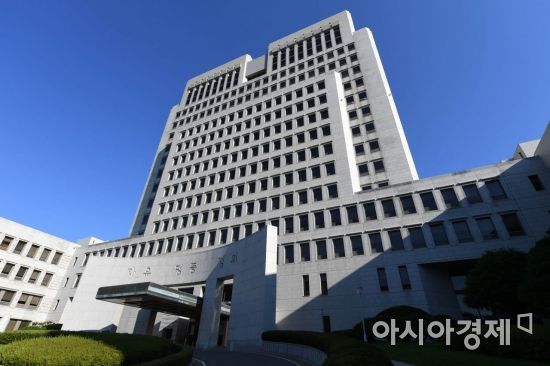
[Asia Economy Reporter Choi Seok-jin, Legal Affairs Specialist] The Supreme Court has ruled that whether an employee whose promotion was invalidated must return the wage increase received depends on whether there is a substantial difference in the duties performed before and after the promotion.
If the employee performed duties that were substantially different from their previous rank after promotion, the increased wages can be considered compensation for the labor provided. However, if the wage increase was solely due to the promotion in rank without any change in duties, the wages were received without a legal basis and must be returned as unjust enrichment.
The Supreme Court's Third Division (Presiding Justice Ahn Cheol-sang) announced on the 20th that it overturned the lower court ruling, which had dismissed the claim by the Korea Rural Community Corporation against 24 former employees for the return of unjust enrichment, and remanded the case to the Gwangju High Court.
The court stated, "The lower court erred in its understanding of the law regarding unjust enrichment and failed to conduct necessary hearings, which affected the judgment," as the reason for the reversal and remand.
Employees including Mr. A, who worked at the corporation, passed promotion exams conducted by the corporation between 2003 and 2011, advancing to grades 5 through 3.
However, in 2013, it was revealed that some employees bribed an external company responsible for creating and grading the promotion exams to obtain exam questions and answers in advance, enabling them to pass the exams. In January 2014, the police notified the corporation that 62 employees were involved in this corruption.
After the corporation canceled the promotions of the implicated employees and dismissed them, the dismissed employees challenged the validity of the promotion cancellations and dismissals in court, but the courts upheld the corporation's actions.
The remaining issue was whether the employees who passed the promotion exams by bribery and received wage increases should return the increased wages to the company.
The corporation argued that since the promotions were invalid, the wage increases received due to the promotions were unjust enrichment without legal grounds and must be returned.
On the other hand, the dismissed employees contended that even if the promotions were invalid, they performed work corresponding to the promoted rank until their dismissal, so the wage increases they received were not unjust enrichment.
For example, Mr. B, who worked as a driver at a branch in Chungnam and passed the promotion exam in 2006, working as a grade 5 employee from 2007, argued that the corporation's claim for return of unjust enrichment was groundless because the court had ruled that there was insufficient evidence to prove misconduct in his promotion exam, thus invalidating the corporation's cancellation of his promotion and dismissal.
The lower courts in the first and second trials sided with these dismissed employees.
The first and second trial courts, following existing Supreme Court precedents, held that the corporation's cancellation of promotions for Mr. A and others merely confirmed that the promotion orders were invalid from the start, and that these employees never acquired the status of grade 3 or 5 employees from the beginning.
However, these courts concluded, "Even if the defendants were promoted by fraudulent means and the promotion orders are invalid, since the defendants performed duties as grade 3 or 5 employees and received salaries from the plaintiff, it cannot be said that the defendants obtained unjust benefits from the plaintiff's property 'without legal grounds' or caused any damage to the plaintiff," and thus ruled that the corporation did not need to recover the wage increases.
In Mr. B's case, since the court had confirmed that both the cancellation of his promotion and dismissal were invalid, the claim for return of unjust enrichment based on the invalidity of the promotion order was dismissed.
However, the Supreme Court's judgment differed.
At the time of the defendants' dismissal, the corporation classified employee ranks into grade 3 (deputy general manager), grade 4 (manager or assistant manager), and grade 5, considering the importance and difficulty of duties, and paid differentiated job allowances accordingly.
Meanwhile, the corporation's annual salary system stipulated that an employee's basic annual salary is calculated by summing the basic salary before the occurrence of the annual salary recalculation reason, the standard additional allowance, amounts adjusted through wage negotiations, and job allowances.
Also, when an employee was promoted to a higher rank, the standard additional allowance and promotion additional allowance corresponding to the promoted rank were added to the basic annual salary paid immediately before the promotion date.
The standard additional allowance is an amount added for each year of service, reflecting the contribution of the employee's length of service. The representative standard additional allowances by rank were 660,000 KRW for grade 3, 612,000 KRW for grade 4, 456,000 KRW for grade 5, and 408,000 KRW for grade 6.
The 'promotion additional allowance' is an amount added to the basic annual salary either as a fixed amount or a percentage each time an employee is promoted. Before December 31, 2013, the basic salary increase rate for a grade 4 employee promoted to grade 3 was 10%.
The defendants received from the corporation the increased standard additional allowance and promotion additional allowance due to their promotions, as well as the base salary, annual leave allowance, incentive increases, and job allowances calculated based on these, until their promotions were canceled.
The Supreme Court stated, "According to the plaintiff's annual salary system, the standard additional allowance is a wage added considering the contribution of an employee's one year of service," and added, "If the defendants performed the same duties after promotion as they did before, despite their promotion, then the increase in salary related to the standard additional allowance was solely due to the promotion in rank, and the same applies to the promotion additional allowance."
It continued, "Therefore, in this case where the promotions were canceled due to serious defects and retroactively invalidated, the defendants should receive the standard additional allowance corresponding to their rank before promotion and are not entitled to the promotion additional allowance. Consequently, the wage increases received by the defendants after promotion (the increase in standard additional allowance, promotion additional allowance, and the base salary, annual leave allowance, and incentive increases calculated based on these) were unjust enrichment received without legal grounds and must be returned to the plaintiff."
The court pointed out, "The lower court should have examined whether there was a distinction in duties according to the ranks before and after the defendants' promotions, and whether the value of labor provided differed substantially due to performing duties different from those at the previous rank, and based on that, determined whether the wage increases constituted unjust enrichment."
It added, "Nevertheless, the lower court failed to properly consider this and ruled that the wage increases were compensation for performing duties corresponding to the promotion and thus belonged to the defendants, concluding that the plaintiff could not claim their return as unjust enrichment. This judgment reflects a misunderstanding of the law on unjust enrichment and a failure to conduct necessary hearings, which affected the judgment."
© The Asia Business Daily(www.asiae.co.kr). All rights reserved.

















