Ongoing Crimes Against Women Such as Illegal Filming and Stalking
Women Express Anxiety... Politicians Make Statements Detached from Reality
Stalking Victims Neglected by the State... "System Change Needed"
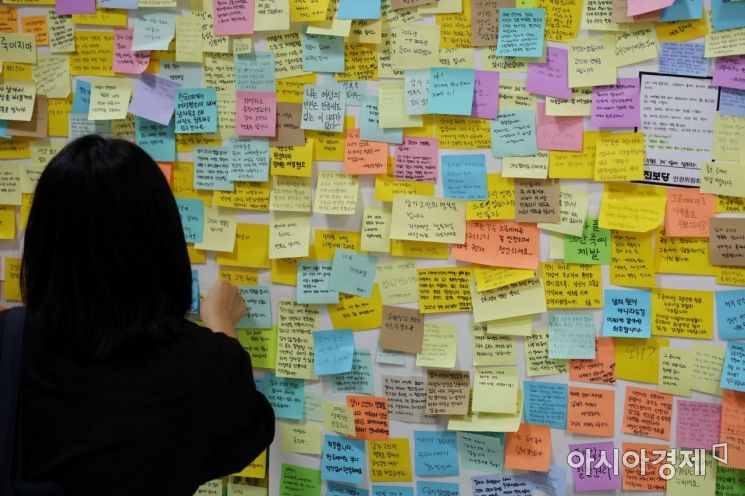 A memorial procession of citizens continues on the 19th at the women's restroom of Sindang Station on Seoul Subway Line 2, where a 20-year-old station attendant was murdered after stalking. Photo by Moon Honam munonam@
The stalking murder case at Sindang Station has reignited anger among women. On the 17th, women's organizations including 'Bulkkot FeminAction' held an emergency memorial service in front of Exit 10 of Sindang Station, demanding, "The government must acknowledge and apologize for the structural violence behind the death of a female worker."
People are gathering in front of the women's restroom at Sindang Station, where a memorial space has been set up. They posted notes on the wall with messages of mourning and anger about the incident, such as "I want to go home alive" and "We will not stop at anger but take action." Some people lingered while reading the notes or expressed anger.
Too many to be seen as the crime of just one or two strange individuals
The stalking murder case at Sindang Station can be seen as a comprehensive example of the 'crimes against women' that women have consistently pointed out. The suspect, Mr. A (31), had been previously accused by the victim for illegal filming and stalking before committing murder. Regardless of the victim, Mr. A is also known to have been fined in the past for distributing obscene materials.
Because such crimes occur everywhere, women are expressing anxiety. According to the Korea Communications Commission, last year internet service providers like Naver and Kakao deleted or blocked access to 27,587 cases of illegal filming, false videos, and child and adolescent sexual exploitation materials based on user reports. The number of 112 emergency calls related to stalking crimes last year was 14,509, a 3.2-fold increase compared to the previous year.
Professor Jang Pil-hwa, emeritus professor at Ewha Womans University, said, "This case shows that illegal filming, stalking, and physical violence are all related crimes," adding, "Even if we consider these crimes as acts committed by bad or strange people, I want to question why these crimes are uniquely directed at women."
Feeling unsafe... but politicians continue to make disconnected remarks
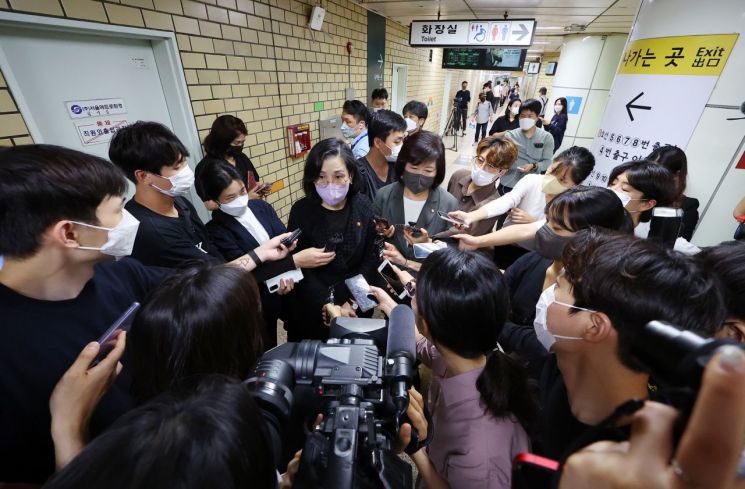
While women feel real threats, politicians made remarks disconnected from reality, leading to an outburst of dissatisfaction. Lee Sang-hoon, a Seoul city council member from the Democratic Party of Korea, angered women with comments that seemed to empathize with the male perpetrator. On the 16th, during a city administration question session, he said, "It seems he responded with various violent acts because (the suspect) liked the victim but was rejected," and "He was probably a Seoul citizen who worked hard socially and prepared for employment to enter Seoul Metro."
Kim Hyun-sook, Minister of Gender Equality and Family, who should protect women's rights, also made remarks that women could not relate to. On the 16th, during a visit to Sindang Station to pay respects to the deceased, she stated, "I do not see this incident as a misogynistic crime," and "I do not agree with viewing it through a male-female dual frame."
Bae Jin-kyung, representative of the Korean Women Workers Association, said, "This is an example of misogynistic ideas that had been confined to the internet permeating public discourse," adding, "If we cannot empathize with the fear women feel and fail to grasp the essence of the issue, problem-solving will remain stagnant."
State neglected victims amid violence... no place to trust
There is also rising anger over the state's failure to protect the victim despite multiple opportunities. Mr. A was sentenced to nine years in prison by the prosecution for illegal filming and stalking charges, but the court dismissed the arrest warrant citing no flight risk. Additionally, the police stopped safety measures after one month because the victim did not want to extend them.
In both cases, neither the court nor the police legally violated any rules. However, women's organizations point out that the system reveals a tendency to downplay the fear of female crime victims. Professor Jang said, "It seems the judiciary, which dismissed the arrest warrant, did not take this matter seriously," adding, "Besides this victim, how many women are suffering various harms under the state's neglect?" Representative Bae explained, "If the system changes, public awareness will slowly follow, but if the state continues to treat women's issues lightly, institutional solutions will be difficult to expect."
© The Asia Business Daily(www.asiae.co.kr). All rights reserved.


















