Bottled Water Market Expected to Grow to 2.3 Trillion KRW Next Year
Demand Expands with Increase in Single-Person Households
'No-Label' Trend Spreads Following Eco-Friendly Movement
Diversification in Bottled Water Market Centered on 'Yeonsu'
Industry Competition Intensifies Amid Market Expansion
[Asia Economy Reporter Song Seung-yoon] Competition among companies to dominate the bottled water market is becoming increasingly fierce. With steady demand growth driven by factors such as the rise of single-person households and convenience, the bottled water market has experienced an average annual growth rate of over 10% in the past five years.
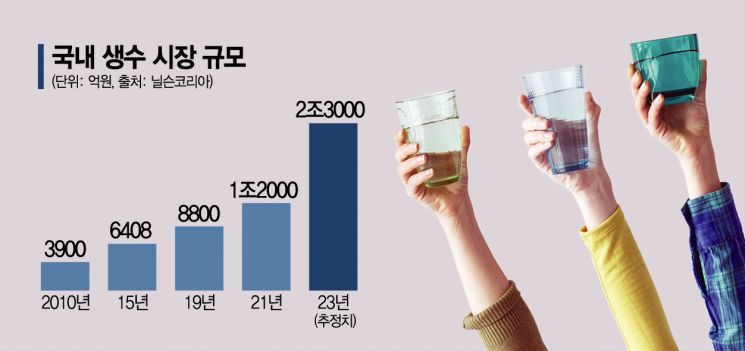
According to Nielsen Korea on the 19th, the bottled water market size, which was around 390 billion KRW in 2010, rapidly expanded to 640.8 billion KRW in 2015, 880 billion KRW in 2019, and reached 1.2 trillion KRW last year. It is expected to grow further to 2.3 trillion KRW next year.
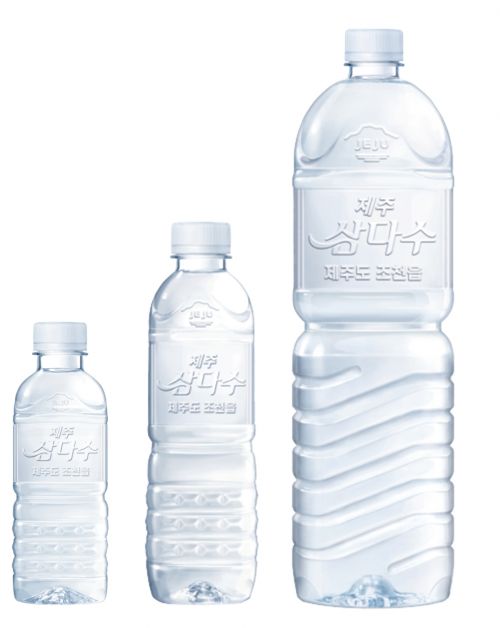
In the bottled water market, Jeju Samdasoo maintains an unshakable first place. As of the first quarter of this year, Jeju Samdasoo held the largest market share among bottled water brands at 43.1%, followed by Icis (12.5%), Baeksansu (7.4%), and Gangwon Pyeongchang Water (3.8%). While there were about 10 bottled water brands until the late 1990s, the number has surged to 394 products from 60 manufacturers as of last year, increasing more than 30 times in about 20 years.
This growth is largely due to the steady increase in single-person households. Typically, single-person households tend to consume bottled water rather than using water purifiers, and with the proportion of single-person households exceeding 40% of the total, demand for bottled water is expected to remain steady. The industry anticipates sales growth centered on small-capacity bottled water, which is convenient for storage and portability at home. Online purchasing demand is also on the rise. Since COVID-19, the trend toward value-based consumption has expanded, and eco-friendly bottled water such as label-free bottles that are easy to recycle is gaining popularity.
The bottled water market, which had been focused on soft water, is also diversifying. Bottled water is classified into soft water and hard water based on the calcium and magnesium content per liter. In the domestic bottled water market, soft water, which has no distinctive taste, has made up most of the bottled water. Hard water, which contains higher levels of calcium and magnesium and has a relatively strong bitter and sweet taste, had not attracted much attention until recently but is now expanding its market by promoting a healthy image.
As bottled water brands and varieties diversify, competition within the industry is intensifying. Externally, competition with the water purifier industry is also inevitable. Jeju Development Corporation, which produces Jeju Samdasoo, has set a sales target of 309 billion KRW for bottled water this year. They are also investing 150 billion KRW to build the Jeju Samdasoo Smart Factory, which will use eco-friendly materials such as recycled PET, bio-PET, and nitrogen filling, aiming to further solidify their market share. Lotte Chilsung Beverage plans to expand its market share by increasing its growth rate to the mid-teens percentage this year, adding to last year's total bottled water sales of 252.8 billion KRW, including private brand (PB) products. Nongshim aims for sales in the 90 billion KRW range by increasing the proportion of online channels and strengthening the premium image of Baeksansu, which contains spring water from Baekdusan Naeducheon.
An industry insider said, "The bottled water market is expected to grow sustainably with the expansion of the online market and a focus on eco-friendly products." They added, "We anticipate a polarization of products into premium products emphasizing water sources and brand power, and PB products prioritizing price competitiveness."
© The Asia Business Daily(www.asiae.co.kr). All rights reserved.


















