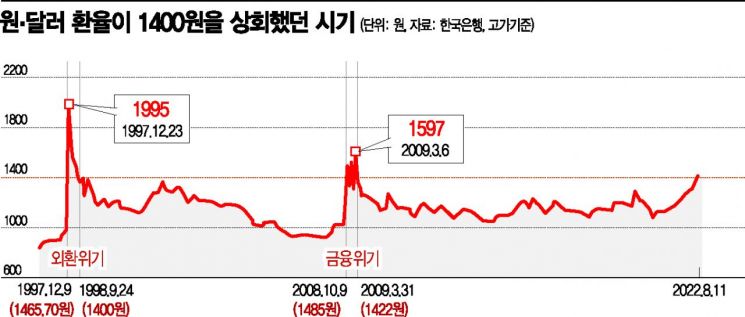
[Asia Economy Reporter Seo So-jeong] As the won-dollar exchange rate enters the final countdown to reaching the 1,400-won level, tension is spreading in the market. The exchange rate has only surpassed 1,400 won twice before?in the 1997 Asian financial crisis and the 2008 global financial crisis?raising fears that a past economic crisis might be repeating itself.
According to the Seoul foreign exchange market on the 18th, the won-dollar exchange rate opened at 1,399.0 won on the 16th, soaring to its highest level in 13 years and 5 months, breaking its previous record again. The Chinese yuan, which moves in tandem with the won, surpassed the psychologically significant resistance level of 7 yuan per dollar, fueling the won’s depreciation. The exchange rate, which threatened to reach just below 1,400 won, reversed to a downward trend in the latter part of the trading session due to presumed intervention by authorities, closing at 1,388.0 won per dollar, down 5.7 won from the previous day’s closing price.
Although the government barely succeeded in defending the 1,400-won level through verbal and actual intervention, the market expects volatility to increase ahead of the U.S. Federal Reserve’s Federal Open Market Committee (FOMC) meeting scheduled for the 20th and 21st. This is because the U.S. August Consumer Price Index (CPI) exceeded expectations, raising concerns about the possibility of an 'ultra-step' rate hike of 1.00 percentage point at once by the Fed.
While the won-dollar exchange rate is approaching 1,400 won, increasing the sense of crisis, the government and the Bank of Korea maintain that the situation is clearly different from the past as the global 'king dollar' trend is causing not only the won but also other currencies such as the euro, yuan, and yen to decline simultaneously. Another basis for this view is that the fundamentals of the Korean economy show clear differences from those during the previous foreign exchange crises. The credit default swap (CDS) premium, an indicator of national credit risk, has been declining since July, and the current account balance, which plummeted by more than 80% year-on-year during the 2008 financial crisis, recorded a surplus of $24.8 billion in the first half of this year.
Foreign exchange reserves also differ from those during past crises. During the 1997 financial crisis, domestic foreign exchange reserves shrank from a peak of $33.67 billion in July to $20.41 billion in December?just five months later?a decrease of $13.27 billion or 39.4%. During the 2008 global financial crisis, reserves fell from a peak of $264.25 billion in March to $200.51 billion in November, eight months later, a decrease of $63.74 billion or 24.1%. According to the Bank of Korea, as of the end of August this year, foreign exchange reserves stood at $436.43 billion, down $2.18 billion from the end of July but still at a sufficient level compared to 1997 and 2008.
Joo Won, head of the Hyundai Research Institute, said, "During the 2008 financial crisis, the exchange rate jumped immediately around November after the Lehman Brothers shock in the second half of the year, but at that time, major central banks did not raise interest rates." He added, "Now, as the world is somewhat overcoming and recovering from COVID-19, major central banks are raising interest rates to respond to inflation, so the exchange rate will rise more gradually than it did back then."
Joo added, "The recent high exchange rate is the result of a combination of factors including fears of U.S. monetary tightening, U.S.-China conflicts over semiconductor exports, and the impact on our export-dependent economy during a recession." He continued, "Although the high exchange rate is increasing burdens on households and businesses due to rising import prices, it is clearly different from past high exchange rate crises."
© The Asia Business Daily(www.asiae.co.kr). All rights reserved.

















