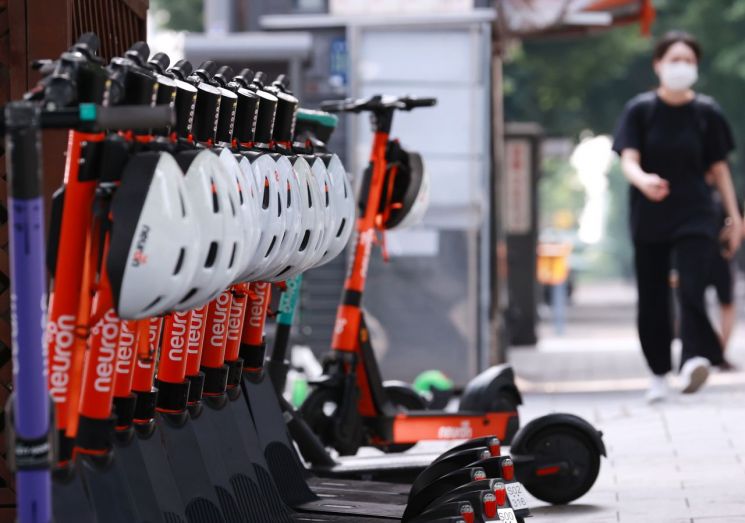
[Asia Economy Reporter Kang Nahum] Domestic electric scooter sharing service platforms are increasingly targeting overseas markets. Facing setbacks in expanding their domestic business due to various regulations, they are turning their attention globally to seek new opportunities.
According to the industry on the 18th, J-Bike, which operates 'G-Cooter,' signed a Memorandum of Understanding (MOU) with Kasetsart University in Thailand on the 15th and officially entered the Thai market. As the number one shared scooter company in Korea with abundant experience, the company aims to strengthen its status as a global mobility enterprise.
Kasetsart University is one of the top three prestigious national universities in Thailand, with over 86,000 students enrolled across seven campuses nationwide, including Bangkok, making it one of the largest universities in Thailand.
G-Cooter plans to launch its services starting with Kasetsart University and closely cooperate with major national universities in Thailand such as Chiang Mai University after completing local market analysis. G-Cooter will soon complete the establishment of a local corporation and plans to operate around 2,000 electric scooters and electric bicycles within the year.
Thailand has a tropical climate with hot temperatures year-round, so the majority of the population uses mobility, especially motorcycles, as their main mode of transportation rather than walking. Therefore, the mobility culture is familiar, and driving and parking order are well established.
Currently, the Thai government is transitioning its industrial structure focusing on green growth and the tourism industry, with the electric vehicle industry playing a significant role in overall mobility. The use of shared mobility is expected to become more active to prevent environmental pollution and promote the development of eco-friendly mobility industries.
Earlier, electric mobility sharing startup Swing entered Japan in July and began operating 500 electric scooters. After establishing a subsidiary composed of local Japanese personnel last year, the company has been dedicating efforts to provide services optimized for the Japanese mobility environment.
In Japan, half of the population uses bicycles as their primary mode of transportation, and since COVID-19, demand for personal mobility such as electric scooters, electric bicycles, and motorcycles has surged. Recently, with the revision of the Road Traffic Act removing the mandatory license requirement for electric scooters, shared service usage is expected to increase further.
Swing plans to expand its service area by securing more than 6,000 electric scooters within the year, starting from Tokyo. The company aims to establish itself as Japan's largest micro-mobility company by sequentially launching shared services for electric bicycles and electric motorcycles.
The reason domestic electric scooter sharing service companies are intensifying their global expansion efforts is due to excessive regulations by authorities causing setbacks in domestic business growth. Since the enforcement of the 'Road Traffic Act Amendment' in May last year, shared scooter users cannot operate without a license, two-person riding is prohibited, and helmets must be worn at all times.
As these regulations worsened the domestic shared scooter market, more companies have shut down their businesses. In September last year, German scooter company Wind and Singapore-based Neuron Mobility withdrew from the Korean market, and recently, the world's largest shared scooter company Lime decided to exit the Korean market after about two years and eight months of operation.
An industry insider said, "Even the top global companies are throwing in the towel and withdrawing, so domestic companies have no chance to survive," adding, "Global expansion is no longer an option but a necessity for corporate survival."
© The Asia Business Daily(www.asiae.co.kr). All rights reserved.

















