"Must uniformly reduce to within 4th-degree blood relatives and 3rd-degree in-laws without exception"
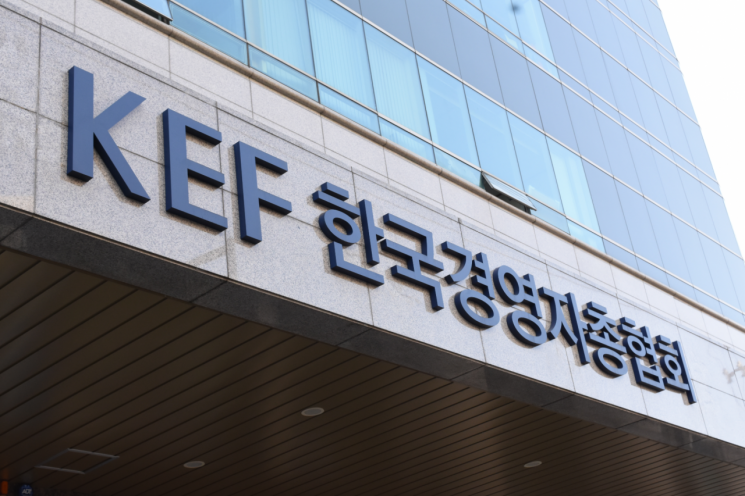
[Asia Economy Reporter Kiho Sung] The Korea Employers Federation (KEF) announced on the 18th that it has submitted the business community's opinions to the Fair Trade Commission (FTC) regarding the proposed amendment to the Enforcement Decree of the Fair Trade Act, which the FTC has announced for legislative notice.
Currently, the FTC imposes an obligation on the same person (the individual or corporation that effectively controls a business group) to submit data on relatives (blood relatives within the sixth degree, relatives by marriage within the fourth degree), such as stock ownership status, every year. Violation of this obligation can result in criminal penalties including imprisonment for up to two years or fines up to 150 million KRW.
However, the scope of relatives defined in the Fair Trade Act as blood relatives within the sixth degree and relatives by marriage within the fourth degree has been continuously criticized for being excessively broad and outdated, imposing an excessive burden on the same person compared to global standards. Accordingly, the FTC has proposed an amendment to revise the scope to blood relatives within the fourth degree and relatives by marriage within the third degree. Nonetheless, blood relatives in the fifth and sixth degrees and relatives by marriage in the fourth degree will not be uniformly excluded from regulation but will be included as relatives under certain conditions.
The KEF commented on the amendment, stating, "It is desirable that the FTC has accepted the continuous suggestions from the business community, including KEF, to reduce the scope of relatives of the same person to reflect changes in the times (blood relatives within the fourth degree, relatives by marriage within the third degree). However, there are still aspects where unreasonable and excessive obligations are imposed on the same person, so more progressive institutional improvements are necessary."
First, the KEF emphasized that the current system, which allows criminal penalties to be imposed on the same person if there are issues with data submission despite the same person being an individual without the authority to compel their relatives to submit data such as 'stock ownership status,' is unreasonable. Furthermore, under the amendment, the same person would still need to identify and manage data on blood relatives within the sixth degree and relatives by marriage within the fourth degree in practice, raising concerns about the effectiveness of the reduction in the scope of relatives.
Additionally, some provisions of the amendment may actually increase the data investigation obligations of the same person compared to the current system, raising concerns that this could contradict the purpose of the amendment to the Enforcement Decree, which aims to ease compliance obligations for business groups.
The KEF stressed that major foreign countries' competition laws (such as fair trade laws) do not have regulations on large business groups based on relatives like Korea. While company laws (such as the Commercial Act) may exceptionally include certain family members within a limited scope, this scope is mostly limited to blood relatives and relatives by marriage within the second degree.
Therefore, the business community's opinion is that it is desirable to uniformly reduce the scope of relatives of the same person to 'blood relatives within the fourth degree and relatives by marriage within the third degree' without exceptions.
Ha Sang-woo, Head of the Economic Research Department at KEF, said regarding the amendment to the Enforcement Decree, "While the reduction of the scope of relatives is desirable, there are regrets regarding its effectiveness. Fundamentally, it is necessary to improve the law enforcement approach that requires the same person to have the obligation to submit designated data of relatives and bear legal responsibility (criminal liability) accordingly." He emphasized, "It is necessary to rationalize the system by uniformly reducing the scope of relatives of the same person to blood relatives within the fourth degree and relatives by marriage within the third degree without exceptions, and to ease the large business group regulatory policies that do not exist overseas."
© The Asia Business Daily(www.asiae.co.kr). All rights reserved.
![Clutching a Stolen Dior Bag, Saying "I Hate Being Poor but Real"... The Grotesque Con of a "Human Knockoff" [Slate]](https://cwcontent.asiae.co.kr/asiaresize/183/2026021902243444107_1771435474.jpg)
















