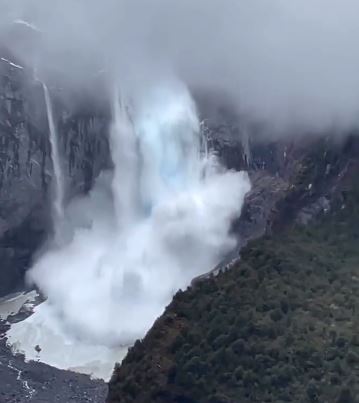
[Asia Economy Reporter Hwang Sumi] A glacier collapse occurred in the Patagonia region of Chile. It is analyzed to be due to climate change effects such as heatwaves and extreme rainfall.
According to recent major foreign media reports, part of the glacier on the mountain peak in Chile's Queulat National Park melted and poured into the Ventisquero Colgante waterfall. This was captured in a video taken by a tourist visiting the park at the time.
Experts view this as a phenomenon caused by climate change. They explain that the glacier collapsed as the ice wall weakened due to high temperatures and extreme rainfall. According to Raul Cordero, a climatologist at Santiago University, before the glacier collapse, an unusual heatwave occurred in Patagonia along with the so-called 'Atmospheric River' phenomenon, which formed massive clouds and caused heavy rainfall. An atmospheric river refers to a long, narrow band of water vapor formed in the atmosphere. It moves like a river in the air and can cause heavy rain or snow when it encounters barriers such as mountain ranges.
Cordero expressed concern, saying, "It is normal for chunks of glacier to separate, but this is happening frequently." He added, "Similar glacier collapses that occurred recently in the Himalayas and the Alps have also taken place in Patagonia over the past few days," warning that "glacier collapses caused by high temperatures and heavy rain are increasingly occurring not only in Chile but around the world."
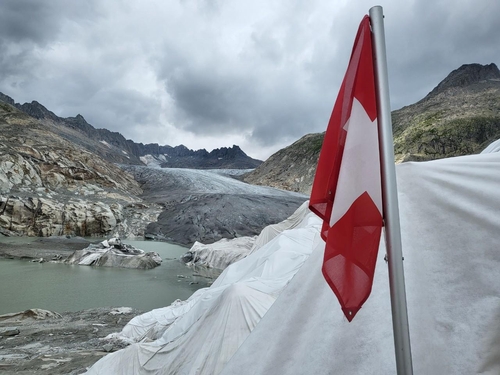 On July 30th (local time), a white tarp was covering the Rhone Glacier in the Valais region of the Swiss Alps to reflect sunlight and prevent ice loss. [Image source=Yonhap News]
In fact, the glaciers in the Alps are melting rapidly. According to the US CNN, a recent study by a Swiss university team comparing photos of Swiss glaciers found that about half of the glacier melted over 85 years from 1931 to 2016. Areas that were mostly covered by glaciers in 1935 have recently lost almost all ice, exposing bare ground.
Especially, from 2016 to the present, an additional 12% of the Swiss glaciers disappeared in just six years. The research team warned that climate change is accelerating the rate of glacier melting. They also predicted that even if countries worldwide comply with the 2015 Paris Agreement to drastically reduce carbon emissions, about 60% of the current glaciers could disappear by the end of this century.
As glaciers melt rapidly, access to representative climbing routes in the Alps has been restricted earlier than usual. According to the UK Guardian, some popular trails to the Alps' most famous peaks, Matterhorn and Mont Blanc, have been controlled, and tours to another popular peak, Jungfrau, have significantly decreased. Pierre Matei, president of the Swiss Mountain Guides Association, said, "Currently, access bans have been issued for about 12 peaks in the Alps, including iconic peaks like Matterhorn and Mont Blanc. Usually, closures occur in August, when temperatures are highest, but this year, due to an early heatwave, closures have continued from late June through July."
© The Asia Business Daily(www.asiae.co.kr). All rights reserved.
![Clutching a Stolen Dior Bag, Saying "I Hate Being Poor but Real"... The Grotesque Con of a "Human Knockoff" [Slate]](https://cwcontent.asiae.co.kr/asiaresize/183/2026021902243444107_1771435474.jpg)

















