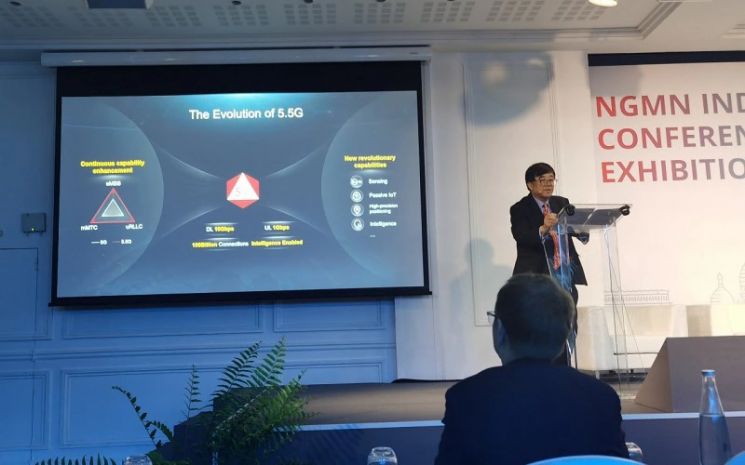
 Wen Tong, Huawei Fellow and Chief Technology Officer (CTO) of the Wireless Network Division. Photo by Huawei
[Asia Economy Reporter Suyeon Oh] Huawei announced on the 16th that it participated in the ’IC&E 2022 (Industry Conference & Exhibition 2022)’ event hosted by the international standardization organization NGMN (Next Generation Mobile Networks) Alliance, held in Paris, France, from the 7th to the 9th (local time).
At the event, Wen Tong, Huawei Fellow and Chief Technology Officer (CTO) of the Wireless Network Division, delivered a keynote speech on the theme of ‘Bridging 5G to 6G.’ In his keynote, CTO Wen Tong explained the driving forces and plans for the evolution from 5G to 6G, emphasizing the necessity of 5.5G to accelerate progress.
CTO Wen Tong stated, "In China, 5G supports more than 30 vertical industries and has created an economic value of $1.3 trillion (approximately 1815 trillion KRW) as of 2021," adding, "New consumer (2C) and enterprise (2B) applications require enhanced 5G performance, and this demand is driving the evolution toward 5.5G."
He defined the evolution to 5.5G as improvements in ▲Enhanced Mobile Broadband (eMBB) ▲Ultra-Reliable Low-latency Communication (URLLC) ▲massive Machine-Type Communications (mMTC) services, along with new features for sensing, passive IoT, positioning, and intelligence. Through these capabilities, 5.5G is expected to support 10Gbps downlink, 1Gbps uplink, 100 billion connections, and native intelligence.
Furthermore, CTO Wen Tong said, "To achieve ultra-high bandwidth, which is only possible with sufficient spectrum, more spectrum resources below 100GHz must be utilized," and added, "By adding 200~400MHz bandwidth in the 6GHz band and 800MHz ultra-high frequency (mmWave) bandwidth to the existing 100MHz FDD and 100MHz TDD spectrum pools, the industry is expected to provide a 10Gbps experience to all users anytime and anywhere."
He particularly emphasized that much stronger uplink than downlink is necessary for industrial digitalization. By decoupling uplink and downlink and flexibly combining uplink and downlink spectrum from different bands, including existing FDD spectrum and newly defined uplink-only spectrum, enterprise applications can be supported. This also enables spectrum convergence, making it possible to guarantee 1Gbps uplink.
So far, uplink and downlink decoupling technology has been commercialized in various industries including mining and steel. It guarantees 1Gbps uplink for simultaneous transmission of 100 channels of HD video, 360-degree remote control, and other enterprise applications.
CTO Wen Tong said, "5.5G will bridge 5G and 6G, and 5.5G and 6G will be the foundation connecting the physical world with the digital and intelligent worlds," adding, "The success of the mobile industry depends on integrated standardization and cross-industry collaboration. We look forward to advancing with Huawei toward 5.5G, strengthening cooperation, and accelerating technology maturity for a sustainable future."
© The Asia Business Daily(www.asiae.co.kr). All rights reserved.

















