[Asia Economy Reporter Yujin Cho] The restructuring of the U.S. online video service (OTT) industry has begun. OTT companies that rapidly expanded during the COVID-19 pandemic are now entering a growth stagnation phase due to decreased demand and intensified competition, leading to fierce survival battles such as downsizing or merging services.
Industry leader Netflix has cut nearly 500 employees this year. On the 14th (local time), Netflix sent layoff notification emails to 30 employees of its subsidiary animation studio. Following two rounds of layoffs involving about 450 employees in May and June, the total workforce reduction has reached approximately 480. The U.S. economic media outlet Business Insider reported, "Netflix, which replaced its vice president of animation content and production earlier this year, appears to have conducted layoffs as part of organizational restructuring."
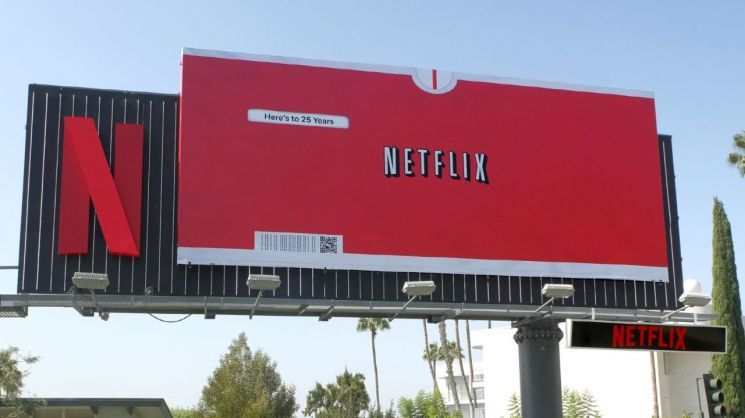
Earlier, Warner Bros. Discovery (WBD) cut 100 employees, and HBO Max, operated by WBD, announced plans to reduce its workforce by 14%, which amounts to about 70 employees. WBD was formed in April through the merger of Warner Bros. and Discovery, but concerns are growing as the second-quarter earnings, the first report card after the merger, fell short of market expectations.
Walt Disney is planning to launch a new product that combines multiple OTT platforms, including Disney Plus and Hulu. Hulu is a subsidiary in which Walt Disney holds a 67% stake.
Bob Chapek, CEO of Walt Disney, stated at the Goldman Sachs Communications & Media Conference on the 15th, "We are considering merging Disney Plus and Hulu, which are currently offered as separate platforms." He also hinted at plans to acquire Comcast's remaining 33% stake in Hulu as soon as possible to unify the services.
 Brian Roberts, Chairman and CEO of Comcast, stated at the Goldman Sachs-hosted Telecommunications and Media Conference on the 15th, "The Hulu brand, with a subscriber base of 46 million, is worth paying a premium for," adding, "Hulu is an extraordinary business, and if it were to be sold in the market, it could attract multiple bidders." This is interpreted as suggesting the possibility of terminating the acquisition option agreement between the two companies if price negotiations with Walt Disney do not go smoothly. The photo shows CEO Roberts speaking at an event announcing the strategic partnership between Alibaba and Universal Beijing Resort on October 17, 2019. (Photo by Reuters)
There are forecasts that the market landscape could change dramatically if Walt Disney, which acquired 21st Century Fox for $71.3 billion four years ago, also gains control of Hulu. Foreign media reported that the behind-the-scenes battle between Walt Disney and Comcast over Hulu's stake sale will be intense until the very end.
Hulu was established in 2007 as a joint venture by Walt Disney, 21st Century Fox, Comcast, and Warner Bros., who felt threatened by Netflix's rapid growth. Two years after its founding, Walt Disney acquired 21st Century Fox and secured a 60% stake in Hulu. AT&T, which acquired Warner Bros., sold its 10% stake in Hulu, resulting in Walt Disney and Comcast currently holding 67% and 33% of Hulu's shares, respectively.
Netflix is also set to launch a low-cost subscription service that includes advertisements soon. This service will be introduced first in about ten countries, including South Korea, and is scheduled to launch on November 1.
The Wall Street Journal (WSJ) reported that Netflix and its advertising partner Microsoft (MS) executives recently met with advertisers to discuss the service launch. According to WSJ, Netflix estimated in documents provided to advertising companies that the service will reach 4.4 million average viewers by the end of this year (1.1 million in the U.S.) and 40 million by the third quarter of next year (13.3 million in the U.S.).
OTT companies that rapidly expanded due to the COVID-19 boom are now facing decreased demand and excessive competition, prompting a series of self-help measures to secure competitiveness. They are differentiating themselves by reducing business units and workforce or by combining major platforms and products to cut costs. Deadline analyzed, "Cost reduction has become a major concern for OTT companies. Workforce reduction is one way to achieve this."
Currently, there are nine OTT services launched globally, including in the U.S., such as Netflix, Amazon Prime Video, Disney Plus, Apple TV, HBO Max, Hulu, and Peacock.
© The Asia Business Daily(www.asiae.co.kr). All rights reserved.


















