Creation and Production, the Heated Debate of 'Art vs Technology'... What Is Art? A Fundamental Question
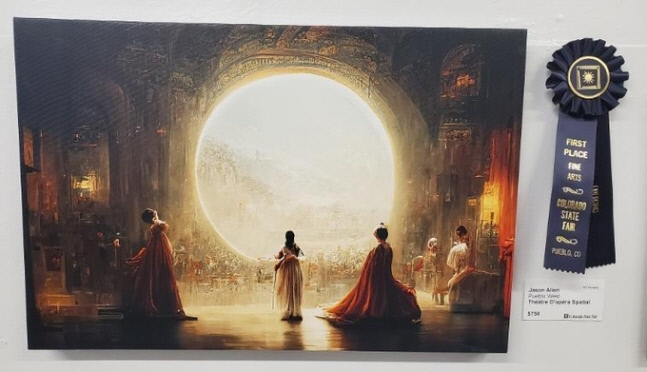 Jason M. Allen (39), who won the digital art category at the Colorado State Fair Art Competition in the United States, with his work "Space Opera Theater." This piece was created using the AI program "Midjourney," which sparked controversy. Photo by Twitter
[Asia Economy Reporter Kim Heeyoon] A painting created by an artificial intelligence (AI) program has taken first place in a U.S. art competition, surpassing human works, sparking heated debates over the definition of art. There is a complex mix of bewilderment and curiosity about AI encroaching on a domain once considered exclusive to humans.
On the 26th of last month (local time), the Colorado State Fair Art Competition in the U.S. selected Jason M. Allen (39)’s “Space Opera Theater” as the winner in the digital art category. Allen, a game planner, shared his thoughts via Discord after winning, saying, “AI won, and humans lost.”
In a recent interview with The New York Times (NYT), Allen revealed that the winning piece “Space Opera Theater” was created using the AI program Midjourney. This program generates images within seconds when text prompts are entered. Allen created and submitted three works using this program, one of which won first place.
Allen explained, “When submitting the works, I clearly stated that they were created by ‘Jason M. Allen through Midjourney,’ so I never concealed the source and did not violate any rules in winning.”
The competition rules also explicitly allow the use of digital technology for image editing during the creative process, so the organizers maintain that there is no issue. The Colorado Department of Agriculture, which hosted the competition, stated, “The judges did not know that Midjourney was AI,” but added, “Even if they had known, this work would have still won.”
As AI technology in various artistic fields becomes increasingly sophisticated, there is a sharp divide between those who advocate it as an excellent creative tool and those who raise ethical concerns.
In 2019, the U.S. nonprofit AI research organization OpenAI announced that it had decided to retire its AI system ‘GPT-2’ after much deliberation. Developed as a writing program, GPT-2 boasted the ability to search 800,000 internet pages and learn 1.5 billion words to arrange sentences logically and handle various genres of writing.
GPT-2, which writes autonomously when given words or sentences, was highly anticipated for use in students’ assignments, speeches, and other fields.
However, after researchers confirmed GPT-2’s capability to generate fake news such as “A train carrying nuclear material was stolen in Cincinnati, USA, and its whereabouts are still unknown,” they decided to retire the system after discussion. An OpenAI official stated, “We judged that the confusion caused by logically perfect fake news generated by GPT-2 and the resulting social costs outweighed the benefits of keeping the system, leading to this decision.”
As controversy over the Colorado art competition grew, moves to ban AI-generated artworks emerged, especially within online art communities. The U.S. content site NewsRounds banned AI-generated works, stating, “We will focus on art made by humans and operate this space so that it does not become flooded with AI-generated images.”
The creative community site FurAffinity also pointed out ethical issues arising from AI image programs learning from existing artists’ works, emphasizing, “Since our goal is to support artists and their content, we do not believe allowing AI-generated content on our site is in the best interest of the community.”
In response, the art world is calling for more refined classifications and regulations distinguishing pure creative works from AI-generated images.
Kim Bora, director of the Seongbuk District Art Museum, noted, “Fundamentally, an artwork’s most important creative source is the artist’s life and experiential factors, and the meaning of a work cannot be separated from the artist and the historical context and environment in which they lived.”
Director Kim expressed the view that “Artists rely on momentary inspiration and emotions, which cannot exist in AI work, so AI-generated works should be classified as a different category, not within the artistic domain.”
With technological advancement and changing times, AI is evolving and penetrating the realm of art, so how AI works should be defined within the art domain must be addressed through in-depth discussions among experts from humanities, social sciences, arts, and sciences.
Director Kim predicted, “The case of the Colorado art competition, where AI-generated works entered the public domain of art without any filtering, will serve as a catalyst for such diverse discussions.”
© The Asia Business Daily(www.asiae.co.kr). All rights reserved.
![Clutching a Stolen Dior Bag, Saying "I Hate Being Poor but Real"... The Grotesque Con of a "Human Knockoff" [Slate]](https://cwcontent.asiae.co.kr/asiaresize/183/2026021902243444107_1771435474.jpg)

















