Development of Region-Specific Chlorine Injection 'Residual Chlorine Concentration Precision Control System'... Improved Water Quality Safety & Reduced Chlorine Odor
Precise Residual Chlorine Control Across Seoul
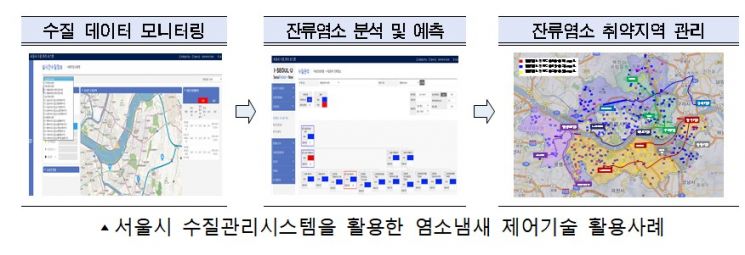
[Asia Economy Reporter Lim Cheol-young] The Seoul Water Institute announced on the 16th that it has independently developed and completed patent registration for a big data-based "chlorine odor control technology" that can precisely control the residual chlorine concentration at faucets to safely supply tap water with excellent water quality safety and no chlorine odor to each household.
The "chlorine odor control technology" developed by the Seoul Metropolitan Government calculates the real-time chlorine consumption in "residual chlorine vulnerable areas," where the residual chlorine decreases due to long residence time in water pipes or temperature changes, enabling customized chlorine injection and control. When the tap water produced at the water purification center stays longer in the water pipes during the supply process, chlorine volatilizes, causing the residual chlorine level to fall below the appropriate level, which may pose water quality safety issues. Conversely, excessive chlorine injection deteriorates the taste of tap water.
Until now, the city has adjusted the amount of chlorine injected based on the experience of water purification center operators to maintain a constant amount of chlorine that decreases for various reasons during the tap water supply process. Therefore, areas close to the purification center had high chlorine concentrations causing strong chlorine odors, while distant areas experienced a sharp decrease in chlorine concentration.
In response, the Seoul Water Institute developed a system that calculates real-time chlorine consumption and injection amounts by analyzing water quality big data to maintain a constant residual chlorine value without relying on the empirical judgment of field workers.
By collecting real-time water quality big data such as water temperature, residual chlorine, and electrical conductivity through 525 automatic water quality measuring devices installed at purification centers and throughout Seoul's water distribution system, the system analyzes and calculates chlorine consumption by region. This enables chlorine injection control tailored to the characteristics of each area in Seoul.
The Seoul Water Institute began technology development research in 2017 and conducted a pilot application of the system in the supply process of tap water produced at the Yeongdeungpo Arisu Water Purification Center until 2018. Based on successful operational results, the system was expanded citywide from March 2020 to verify its effectiveness. As a result of system operation, the fluctuation range of residual chlorine at faucets decreased by about 60%, allowing stable and precise real-time control of residual chlorine at faucets.
Son Jeong-su, Director of the Seoul Water Institute, said, "Our institute is researching and developing smart technologies applicable to various fields from tap water production to supply and metering, not only this technology development," adding, "We will secure various technologies necessary for building a Seoul-type future smart water supply system."
© The Asia Business Daily(www.asiae.co.kr). All rights reserved.
![Clutching a Stolen Dior Bag, Saying "I Hate Being Poor but Real"... The Grotesque Con of a "Human Knockoff" [Slate]](https://cwcontent.asiae.co.kr/asiaresize/183/2026021902243444107_1771435474.jpg)











