Per Capita Rice Consumption Expected to Be Surpassed by Meat This Year
Meat Consumption Forecasted at 56.5kg, Rice at 54.8kg
Last Year Also a 1kg Difference: Meat 55.9kg, Rice 56.9kg
Dietary and Household Changes Are Major Causes
Reversal Trend Expected to Accelerate
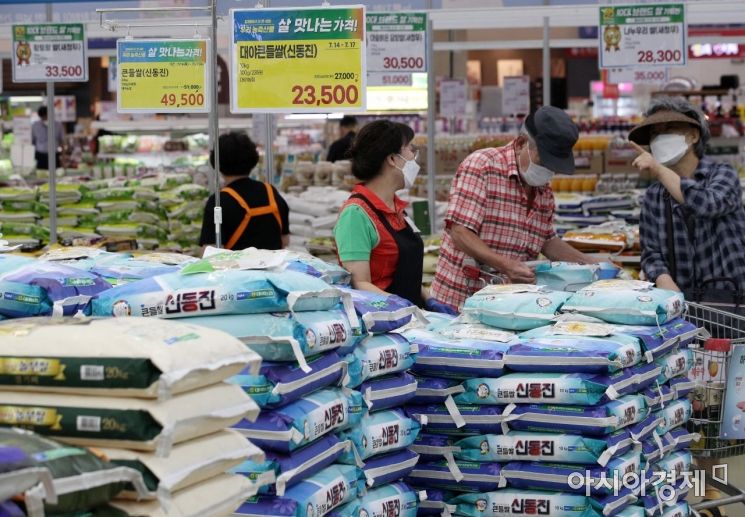
[Asia Economy Reporter Song Seung-yoon] The saying "Koreans live on rice power" has now become a thing of the past. With the westernization of eating habits such as increased consumption of wheat and meat, and changes in household structures, rice consumption is steadily decreasing, while meat consumption is gradually increasing, and meat is poised to surpass rice consumption in the near future.
According to the Korea Beef Association on the 15th, the per capita meat consumption this year is expected to reach about 56.5kg, surpassing the per capita rice consumption for the first time. The per capita rice consumption is predicted to be around 54.8kg this year, but it could be even lower. The Korea Beef Association, Korea Pork Producers Association, and Korea Broiler Association anticipated this situation from early this year. Although exact statistics are not yet available, last year's estimated annual per capita meat consumption (beef, pork, chicken) was about 55.9kg. (Refer to Asia Economy front page article on July 25 titled 'Koreans' Rice Power is a Thing of the Past... Meat Consumption Surpasses Rice') This means meat consumption nearly overtook rice consumption last year, which was 56.9kg per capita, with only a 1kg difference. Among meats, pork consumption was the highest at 27.6kg, followed by chicken at 14.7kg, and beef at 13.6kg.
Meat consumption has increased by about 3% annually since the 2000s. It was 46.9kg in 2015, rose to 53.8kg in 2018, surpassing the 50kg mark, and has continued to rise since then. Due to the impact of COVID-19, it slightly dropped to 52.5kg in 2020 compared to the previous year but has since recovered to previous levels.
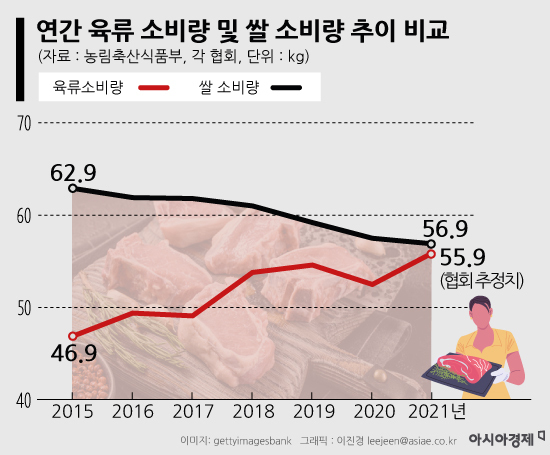
On the other hand, rice consumption has been continuously declining. In 1970, the annual rice consumption per capita was 136kg, which was 26 times the meat consumption of 5.2kg. At that time, the number of livestock raised for meat such as cattle, pigs, and chickens was not large, making meat scarce, while agricultural technology development gradually increased production, marking the heyday of rice. However, this trend reversed over the years.
Meat consumption first exceeded 10kg in 1980 at 11.3kg, then increased annually to 14.4kg in 1985, 19.9kg in 1990, and 27.4kg in 1995. Conversely, rice consumption during this period decreased from 132.4kg to 128.1kg, then 119.6kg, and 106.5kg. Entering the 2000s, meat consumption reached 32.9kg, entering the 30kg range, while rice consumption dropped to 93.6kg, remaining in double digits. Rice consumption, which was 69.8kg in 2012, declined annually to 59.2kg in 2019, falling below 60kg for the first time, and further decreased by 1.4% to 56.9kg last year from 57.5kg the previous year. This figure has been showing a downward trend every year. Experts predict that rice consumption will fall below 50kg within a few years.
The background to this is the change in eating habits centered on processed foods and dining out, leading to reduced home-cooked meals and a shift away from the culture of setting a full table. A generation accustomed to Western-style diets has increased, and the development of various food industries that can satisfy this has also influenced the trend. Since the 2000s, interest in health management has risen, and carbohydrates including rice have been identified as causes of obesity, with diets such as low-carb high-fat (LCHF) becoming popular. Skipping breakfast, especially among younger generations, has also contributed.
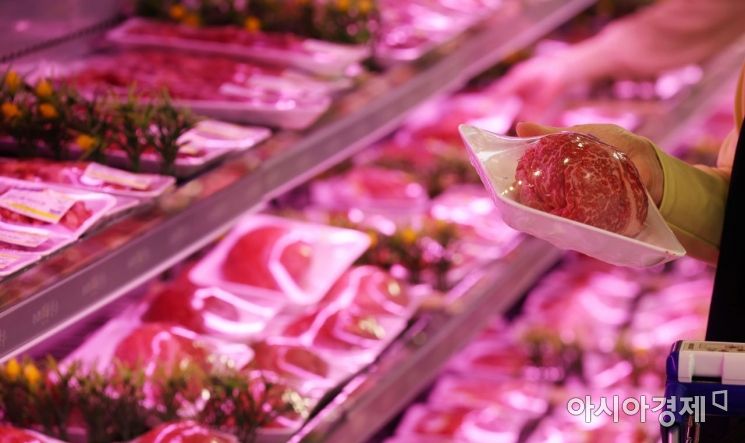 As imported meat prices soar, the price of imported frozen beef has surged by more than 55% compared to last year, increasing the burden of food costs on ordinary citizens. On the 29th, a customer visiting the meat section of a large supermarket in Seoul is checking the prices. Photo by Dongju Yoon doso7@
Changes in eating habits have significantly altered the landscape of related industries. A representative beneficiary industry is home meal replacements (HMR) such as ready-to-eat foods. The offline retail market for ready-to-eat foods in Korea has been growing by 10% annually since 2020. Industries utilizing surplus rice are also becoming active. The government enacted the Rice Processing Industry Act in 2011 to strengthen the foundation for the growth of the rice processing industry and has been implementing the first and second five-year basic plans since 2014. As meat consumption has increased over several decades, the health status of Koreans has also changed noticeably. Although multiple factors are involved, analyses suggest that sufficient meat intake has been a major cause of improved adolescent physique and increased obesity rates. Additionally, diseases such as colorectal cancer, which previously had lower prevalence compared to Westerners, have become more common in Korea, which can be understood in this context.
Experts expect this trend to accelerate further. Professor Lee Young-eun of the Department of Food and Nutrition at Wonkwang University said, "The trend of decreasing rice consumption and increasing meat consumption is expected to continue, and especially among younger age groups, meat intake is excessive, while the elderly, who need to consume protein, fall short of the standard. Although it is not easy to change the overall trend, the current eating habits are difficult to consider nutritionally balanced."
Professor Kim Yong-hwi of the Department of Food and Biotechnology at Sejong University also advised, "Especially with the influx of alternative meats, efforts such as developing menus that diversify the use of these products beyond traditional food consumption patterns are necessary for rice consumption to recover."
© The Asia Business Daily(www.asiae.co.kr). All rights reserved.



















