Provisional Agreement Reached at 9 of 13 Universities in Seoul
Issues Remain Over Lounge and Shower Facility Improvements
“Legalization Needed for Obligation to Engage in Negotiations”
[Asia Economy Reporter Oh Gyumin] "Install shower rooms to prevent industrial accidents!"
On the afternoon of the 14th at around 2:30 PM, cleaning and security workers shouted slogans at the main gate of Sookmyung Women's University located in Yongsan-gu, Seoul. The Seoul Regional Public Service Branch of the Korean Confederation of Trade Unions Public Transport Workers' Union is holding a 'University Workplace Collective Bargaining Struggle Resolution Rally' every week at different universities. The reason for holding it at Sookmyung Women's University this day was due to the school's indifferent attitude.
Since November last year, they have demanded a 440 won hourly wage increase, improvement of rest areas, and installation of shower rooms from the school. Since March, they have also conducted publicity campaigns on the Sookmyung Women's University campus during lunch hours together with supportive students. Kim Sunyoung, the organization director of the Seoul Regional Public Service Branch, said, "We sent an official letter requesting a meeting to the principal contractor (school headquarters), but we have not received a response yet."
Although many universities in Seoul have tentatively agreed to improve the treatment of cleaning and security workers, some schools are still in negotiation or have not started negotiations. Even in schools where agreements have been reached, issues remain regarding the installation of rest areas and shower facilities.
According to the Korean Confederation of Trade Unions Public Transport Workers' Union, out of 13 university workplaces in Seoul, 9 workplaces have agreed with the school or service companies to improve the treatment of cleaning and facility workers. Starting with the Hongik University branch in June, Dongduk Women's University, Ewha Womans University, and others are included. Korea University, which had even started a sit-in protest at the main building, tentatively agreed in July and August on matters including a 400 won hourly wage increase. Yonsei University, which was controversial due to students filing damage claims against cleaning workers, also agreed last month on the 26th to improve the treatment of cleaning, security, and facility staff.
The universities where agreements have not been reached are Sogang University, Sungshin Women's University, Duksung Women's University, and Sookmyung Women's University. Sogang University and Sungshin Women's University are in ongoing discussions related to negotiations, but Duksung Women's University is known to maintain a position of wage freeze. In the case of Sookmyung Women's University, the service company informed the union on the 7th that it is not conducting service-related negotiations with the school.
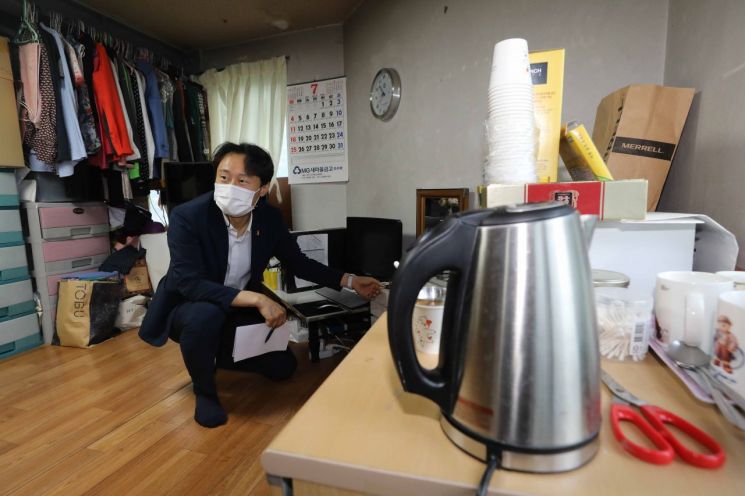
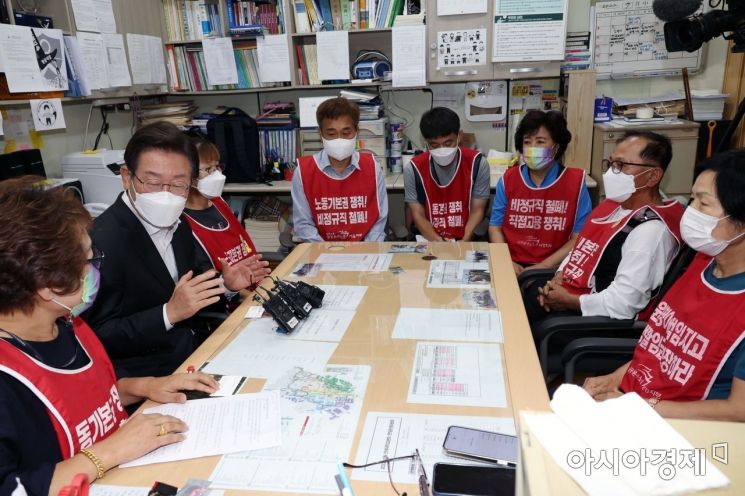 Lee Jae-myung, a member of the Democratic Party of Korea who declared his candidacy for party leader, held an on-site meeting with cleaning workers at Yonsei University in the storage room of the outdoor theater at Yonsei University, Seodaemun-gu, Seoul, on the 18th. Photo by the National Assembly Press Photographers Group
Even in places where agreements have been made, issues with rest areas remain. With the enforcement of the revised Industrial Safety and Health Act on the 18th of last month, it became mandatory to install rest facilities of at least 6㎡ in all workplaces. Accordingly, cleaning and security workers demanded the Ministry of Employment and Labor to include improvements of rest areas and shower rooms for indirectly employed university workers in the treatment improvement plans. However, in the case of Yonsei University, although an agreement was reached on wage increases and staffing, no agreement was made regarding rest area improvements and shower room installations. The school reportedly stated in meetings with workers that "we will gradually improve the working environment."
Cleaning workers argue that shower rooms are necessary considering the nature of their work, which involves sweating or handling contaminants. According to the Regulations on Industrial Safety and Health Standards, if the work involves the risk of contamination of the body or clothing, such as environmental cleaning, washroom and bathing facilities must be installed.
However, the actual number of universities with shower rooms is small. According to a survey conducted by the Seoul branch of the Korean Confederation of Trade Unions Public Transport Workers' Union on 148 rest areas in 11 universities, only 16 places have shower rooms (including facilities shared by students and staff). This accounts for 10.6% of all rest areas.
Professor Ha Jonggang of the Labor Academy at Sungkonghoe University said that the subcontracted employment contract structure is the problem behind the lack of such treatment improvements. He added, "Because workers have to negotiate with subcontractors who have no real authority, there is little progress in installing rest areas and shower rooms in school buildings owned by the principal contractor (the school)." He further stated, "If returning to direct employment is difficult, legal measures such as mandating the school to participate in negotiations are necessary."
© The Asia Business Daily(www.asiae.co.kr). All rights reserved.
![Clutching a Stolen Dior Bag, Saying "I Hate Being Poor but Real"... The Grotesque Con of a "Human Knockoff" [Slate]](https://cwcontent.asiae.co.kr/asiaresize/183/2026021902243444107_1771435474.jpg)

















