US Inflation Shock... What Will Happen to the KOSPI Bottom?
Government "Thoroughly Reviewing Financial and Foreign Exchange Market Response Measures"
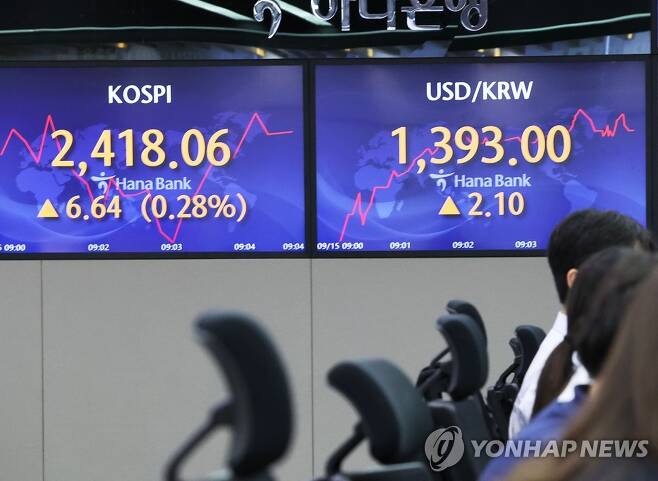 On the morning of the 15th, the monitors in the dealing room of Hana Bank in Jung-gu, Seoul display the KOSPI, the won/dollar exchange rate, and the KOSDAQ index, which started trading that day.
 [Image source=Yonhap News]
[Asia Economy Reporter Han Seung-gon] "It's plunging again.", "My heart is burning.", "Should I just sell everything?"
The sighs of individual investors, commonly called "ants," are deepening. The downward trend of domestic and international stocks and cryptocurrencies (coins), which were thought to have hit bottom, continues, and with no positive situations expected to revive the market for the time being, uncertainty in the financial market is increasing.
The domestic stock market is experiencing sharp fluctuations due to the impact of the U.S. August Consumer Price Index (CPI). The CPI rose 8.3% compared to the same month last year. Although this figure is 0.8 percentage points lower than the peak in June (9.1%), it is higher than the market expectation (8.0%), suggesting that the U.S. Federal Reserve will continue raising interest rates and maintaining a tightening stance.
In this regard, on the 14th, the KOSPI closed at 2,411.42, down 38.12 points (1.56%) from the previous day. The KOSPI fell as much as 2.78% to 2,381.50 early in the session. However, it rebounded in the afternoon due to individual investors' buying. Institutions and foreigners sold net amounts of 239.4 billion KRW and 164.1 billion KRW, respectively, while individuals bought a net 388.9 billion KRW.
Major indices in the U.S. stock market also plunged. The Dow Jones Industrial Average dropped 1,276.37 points (3.94%) to 31,104.97. The Standard & Poor's (S&P) 500 fell 177.72 points (4.32%) to 3,932.69, and the Nasdaq Composite dropped 632.84 points (5.16%) to 11,633.57.
The cryptocurrency market is in a similar situation. On the same day, Bitcoin's price plunged nearly 10% in one day, falling to the $20,000 range. On the 13th (local time), CNBC reported, "Following the release of the U.S. August CPI, the risk of Federal Reserve tightening increased, causing major cryptocurrencies to plummet simultaneously," adding, "Bitcoin also fell more than 10%, breaking the $20,000 support level."
Experts predict an additional decline of around 10% from the current price. Katie Stockton of the U.S. investment advisory firm Fairlead Strategies said, "It could fall as low as $18,300." Mark Newton of Fundstrat also forecasted, "It could drop below $18,000."
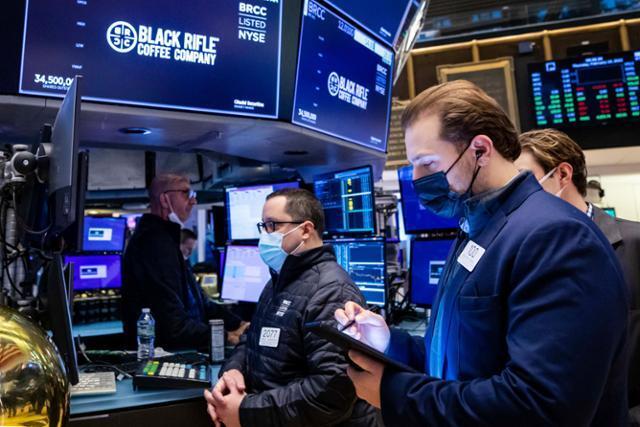 Traders are looking at monitors at the New York Stock Exchange (NYSE) in the United States. New York= AP Photo by Yonhap News
◆ "Really exhausted... Should I cash out?" Ants sigh deeply
As a result, among individual investors, there is a weakened investment sentiment, with some expressing fatigue from watching and a desire to cash out. Kim, a company employee in his 30s, said, "I've experienced many frozen markets, but this is the first time I've seen a market like this. It seems to be an unprecedented market where multiple adverse factors like the Ukraine war and tightening coincide," expressing dissatisfaction. He added, "It's practically a 'forced watch.' I don't need anything; I just want to cash out."
Another individual investor, Park, a worker in his 40s, also lamented, "Even blue-chip stocks are suffering significant losses," and said, "Among investors, there's talk that avoiding losses this year is considered a success."
Blue-chip stocks heavily bought by ants are also struggling in the market. According to the status of minority shareholders in major companies' semi-annual business reports, as of the end of June, Samsung Electronics had about 5.92 million minority shareholders. This is an increase of about 860,000 from the end of last year (approximately 5.06 million), reaching an all-time high. Kakao, which has the second-largest number of minority shareholders after Samsung Electronics, also saw its minority shareholders increase by about 120,000 over six months to 2.04 million, compared to 1.92 million at the end of last year.
However, stock prices are declining. Samsung Electronics' stock price fluctuated around the 60,000 KRW level until early last month but has not risen above the "50,000 KRW electronics" level since the 29th of last month. Kakao also saw individuals buy shares at an average price of 303,494 KRW this year but has recorded a 25% loss.
Given this situation, KOSPI trading volume is also decreasing. According to the Korea Financial Investment Association, the average daily trading volume approached 1.7 trillion KRW in early last year. However, it has been declining since the second half of the year, and this month, it has dropped to an average of 395.4 billion KRW per day. Some express concern that ants' panic selling might be intensifying.
Meanwhile, the government has begun preparations for the volatile financial market. On the morning of the 14th, Bang Ki-seon, First Vice Minister of Strategy and Finance, held an emergency economic task force (TF) meeting involving macroeconomic and financial departments within the Ministry of Strategy and Finance. He said, "We must pay close attention to the global inflation and monetary policy normalization schedule and keep a vigilant eye on the financial and foreign exchange market situation." He added, "Uncertainty about the magnitude and speed of interest rate hikes in major countries is increasing, raising volatility in domestic and international financial markets. Please thoroughly review all available countermeasures to stabilize the market."
© The Asia Business Daily(www.asiae.co.kr). All rights reserved.
![Clutching a Stolen Dior Bag, Saying "I Hate Being Poor but Real"... The Grotesque Con of a "Human Knockoff" [Slate]](https://cwcontent.asiae.co.kr/asiaresize/183/2026021902243444107_1771435474.jpg)












