"Concerns Over Crime Thrillers Damaging National and Regional Images"
'Midnight Runners' Producer Apologizes to Chinese Residents Feeling Discomfort and Alienation'
Film 'Gokseong' Resolves Conflicts with Locals Through Measures Like Including Chinese Characters
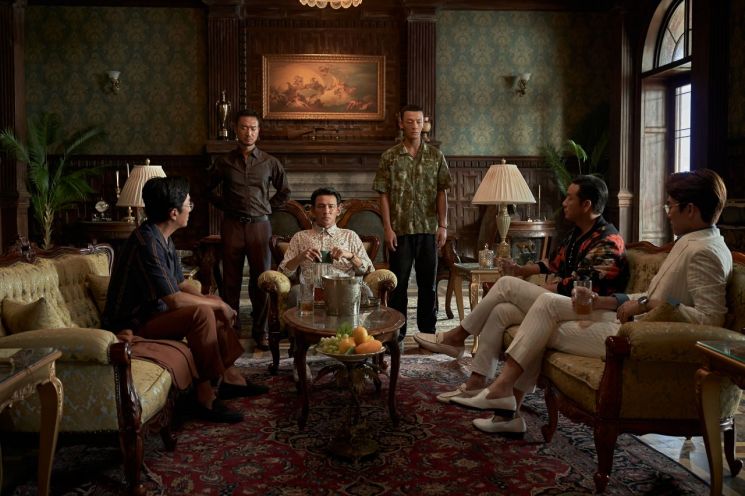
[Asia Economy Reporter Park Hyun-joo] There have been cases where countries or regions negatively portrayed in films such as the Netflix series Suriname and the movie Youth Police have expressed dissatisfaction. Critics argue that such portrayals can solidify negative images of the countries or regions and promote regional discrimination.
Recently, the South American country Suriname announced legal action against the production company of Suriname. The drama depicts a Korean drug lord who controlled Suriname, inspired by Jo Bong-haeng, the so-called "drug king," who operated a large-scale drug trafficking organization in Suriname from the late 1990s to the early 2000s before being arrested. Due to this content, there are concerns that Suriname might be perceived as a "drug country."
Albert Ramdin, Suriname’s Minister of Foreign Affairs and International Cooperation, stated at a press conference on the 13th, "Suriname has long had a negative image as a drug transit country, but it no longer holds that image." He added, "We have been working to improve the country's image, but Suriname has put us in a disadvantageous situation again." He further pointed out, "While the producer's freedom of expression must be considered, this is an issue concerning negative perceptions of our country."
There have been similar controversies in South Korea regarding negative portrayals of specific regions. The 2017 film Youth Police was criticized for depicting Daerim-dong in Yeongdeungpo-gu, Seoul?a neighborhood with a large Chinese-Korean population?as a den of human trafficking and violent crime, thereby promoting regional discrimination. At that time, 61 Chinese-Korean residents filed a lawsuit against the film’s production company. They criticized Youth Police as "racially discriminatory hate content that exceeds the limits of general freedom of expression."
In response, the appellate court recommended reconciliation, noting that the depiction of Chinese-Koreans in the film could cause discomfort and alienation. The court pointed out, "Some parts of Youth Police contain fictional facts with negative portrayals of the Joseonjok (ethnic Koreans in China)." It also explained, "Considering the director’s apology to those who felt discomfort unintentionally and the need to express apologies to those affected, the court decided to recommend reconciliation."
Ultimately, in April 2020, the film’s production company officially apologized to the plaintiffs through a press release and promised to prevent recurrence. The company stated, "We apologize to those who felt discomfort and alienation due to the negative portrayal of Chinese-Koreans," and promised, "We will thoroughly review our films to ensure no hate speech is included in the future."
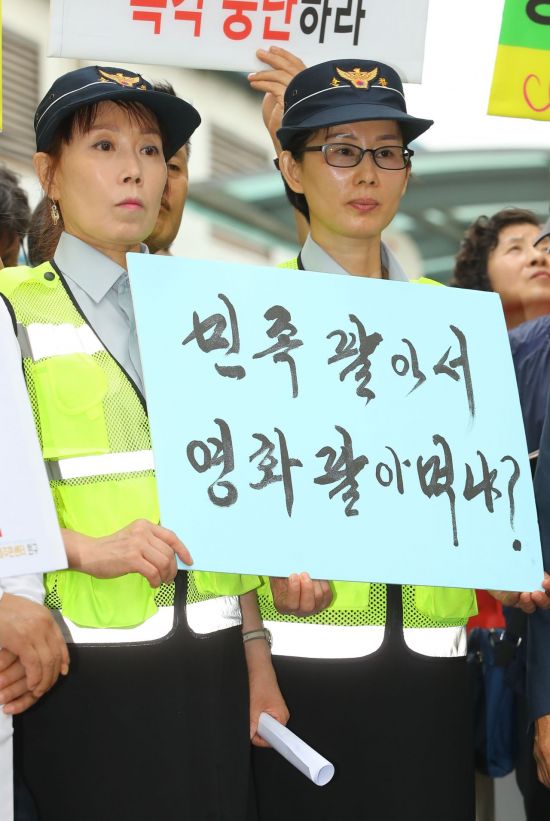 Members of domestic Chinese-Korean organizations, including the Jungin Chinese-Korean Association and the Precious Chinese-Korean Rights Promotion Committee, demanded the suspension of the screening and an apology on the afternoon of August 28, 2017, in front of Daerim Station in Yeongdeungpo-gu, Seoul, stating that the movie "Midnight Runners" frequently contains scenes that disparage Chinese-Koreans and their residential area, Daerim-dong.
 [Image source=Yonhap News]
The crime thriller film Gokseong, set in Gokseong County, Jeollanam-do, also faced similar controversy. Local residents expressed concerns about the negative impact on the region’s image and a potential decrease in tourists. At the time, Yoo Geun-gi, the county governor of Gokseong, appeared on CBS’s Kim Hyun-jung’s News Show in May 2016 and shared, "Residents and hometown friends worried, saying, ‘What if the image of Gokseong worsens and agricultural products don’t sell?’ ‘What if our children stop coming back to their hometown?’ ‘What if tourists decrease?’"
He added that this led him to rethink the situation positively and consider raising awareness of Gokseong. Governor Yoo explained, "Those who have visited Gokseong know it is not like that at all, so there is no problem. Those who haven’t visited might become curious and want to visit." Additionally, Governor Yoo requested the production company to include subtitles stating "This film is unrelated to the Gokseong region" and to add Chinese characters alongside the film’s title to distinguish it from the actual Gokseong County.
© The Asia Business Daily(www.asiae.co.kr). All rights reserved.
![Clutching a Stolen Dior Bag, Saying "I Hate Being Poor but Real"... The Grotesque Con of a "Human Knockoff" [Slate]](https://cwcontent.asiae.co.kr/asiaresize/183/2026021902243444107_1771435474.jpg)
















