Asteroid Exploration and Satellite Development... Hanwha to Invest 2.6 Trillion Won Over 5 Years
Also Eyeing Small Satellite Launch Market... 10 Global Companies Occupy 25 Trillion Won Market
About 40 Domestic Small Satellite Launch Vehicle Startups
"Must Focus on Nurturing Technical Talent"
[Asia Economy Yang Nak-gyu, Military Specialist Reporter] Following the successful launch of Korea's first Korean-type launch vehicle Nuriho earlier this year, the domestic defense industry is expanding its business scope into space with the successful launch of the country's first lunar probe, 'Danuri.' After achieving record-breaking results this year, including arms exports to Poland, full-scale competition to dominate the space market appears to be underway. Hanwha plans to invest more than 2.6 trillion won over five years in the aerospace sector, and Korea Aerospace Industries (KAI) has also declared its transformation into a space-specialized company.
◆ Defense Big 3 Racing to Transform into ‘Space Companies’ = The first domestic company to enter the space market is Hanwha Group. Hanwha consolidated its defense divisions, including Hanwha Corporation, Hanwha Defense, and Hanwha Aerospace, under Hanwha Aerospace. This company is the only domestic engine manufacturer that assembled the six engines at the heart of Nuriho. Leading with Hanwha Aerospace, Hanwha established a space business council within the group called the ‘Space Hub.’ The Space Hub plans to focus research and investment on manufacturing sectors such as launch vehicles and satellites, as well as service sectors like communications.
Based on this, they are turning their attention to space exploration. First, they are promoting an asteroid Apophis exploration project. The asteroid Apophis, about 370 meters long?approximately 1.5 times the height of the 63 Building?will pass 31,600 km above Earth in April 2029, seven years from now. The purpose of the Apophis exploration is to launch a probe and launch vehicle using purely domestic technology to observe and photograph the Korean Peninsula. This is why they established a space research center with the Korea Advanced Institute of Science and Technology (KAIST) and developed the low Earth orbit satellite communication technology ‘ISL’ (Inter-Satellite Link). ISL is used for low Earth orbit satellites and is a communication service that transmits data between satellites via ‘laser.’
Korea Aerospace Industries (KAI) is transforming into a satellite company. After producing fighter jets and helicopters, it aims to find future growth engines in ‘space’ and develop it as a specialized business. Although 161.2 billion won was invested in the development of the 500 kg-class precision Earth observation satellite, the Next-Generation Medium Satellite 1, led by the Korea Aerospace Research Institute, KAI is accelerating commercialization by reducing the production cost of the 2nd satellite to half (82.2 billion won) based on the know-how from the 1st satellite development. Based on this, KAI has also started additional development of Next-Generation Medium Satellites to be used in environmental fields. The Next-Generation Medium Satellite series plans to develop a total of 40 satellites by 2040. The multipurpose practical satellites are similar. Although they have been developed under the leadership of the Korea Aerospace Research Institute (KARI), the policy has shifted to ‘company-led space development,’ and from the 8th satellite onward, KAI is expected to take charge.
LIG Nex1 is embarking on the development of the Korean Positioning System (KPS). The KPS project consists of a total of eight satellites: three geostationary satellites orbiting Earth at an altitude of 36,000 km and five inclined geosynchronous satellites. If KPS development succeeds, Korea will become the seventh country after the United States, Russia, the European Union (EU), China, India, and Japan to possess its own satellite navigation system. LIG Nex1 plans to invest 20 billion won to secure core technologies in the space industry. Additionally, it will invest 240 billion won by 2025 to acquire independent satellite development capabilities.
Hanwha Group forms ‘Space Hub’ space business council led by Hanwha Aerospace
KAI aims to launch a total of 40 satellites by 2040 following the production of the 2nd Next-Generation Medium Satellite
LIG Nex1 targets development of Korean GPS system ‘KPS’... challenging to become the world’s 7th satellite navigation system
◆ Global Space Industry to Reach 1,320 Trillion Won by 2040 = Domestic defense companies are turning their eyes to the space industry because of its market size and growth potential. While space industry was previously led by governments, the paradigm is now shifting to private sector leadership. Foreign private companies have already recognized the space market. Starting with SpaceX, founded by Elon Musk in 2002, Amazon announced the Kuiper Project to deploy about 1,500 small satellites in 2026 and 2029 respectively. Korea also executed about 1.5 trillion won, 77% of the total Nuriho project cost, through private companies.
According to a report published last month by the Space Foundation, a U.S. nonprofit space industry organization, the global space industry market size reached $469 billion last year, equivalent to 616.2 trillion won. Morgan Stanley forecasts that the global space industry will grow from $350 billion (about 420 trillion won) in 2018 to $1.1 trillion (1,320 trillion won) by 2040.
The U.S. lunar exploration project ‘Artemis I,’ whose launch was postponed to the 27th of this month, is expected to present new opportunities for domestic companies as well. Through the Artemis Accords, launched under NASA’s leadership in May 2019, 20 countries including Korea, the UK, France, Canada, and Japan agreed to participate. The accords also present specific plans on how private companies can promote space development. This means domestic defense companies can use this as a stepping stone to enter the future space industry.
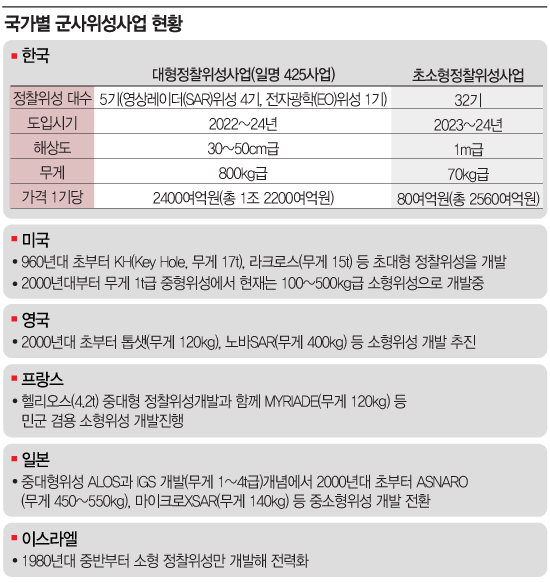
Domestic defense companies are currently focusing on the small satellite business. There are many Earth observation and communication satellites. Since 2,962 small satellites were launched in the 10 years before 2020, about 14,000 are expected to be launched by 2030. Especially, the small satellite launch market size reaches 25 trillion won, but there are only about 10 companies worldwide capable of launching satellites. In Korea, about 40 startups have entered the small satellite launch vehicle development field.
◆ Need to Foster Future Technical Talent = Experts view space development as an opportunity to elevate domestic industry to the next level and call for nurturing talent and budget support. Professor Kim Jong-ha of Hannam University said, "NASA has over 18,000 employees, most of whom are engineers," adding, "It is most important to establish related departments in universities to nurture future talent."
Professor Jang Young-geun of the Department of Aerospace Mechanical Engineering at Korea Aerospace University emphasized, "To grow space industry governance, engineers must be concentrated in the Space and Aeronautics Agency," while researcher Jeong Jae-ho of the Korea Institute for Industrial Economics and Trade argued, "Increased budget investment is necessary for private-led development."
© The Asia Business Daily(www.asiae.co.kr). All rights reserved.
![Clutching a Stolen Dior Bag, Saying "I Hate Being Poor but Real"... The Grotesque Con of a "Human Knockoff" [Slate]](https://cwcontent.asiae.co.kr/asiaresize/183/2026021902243444107_1771435474.jpg)
















