Possessing deadly poison in teeth and salivary glands... Death possible with just 1mg
Symptoms upon contact include paralysis, vomiting, respiratory distress, and cardiac arrest
Third discovery this year already in Jeju
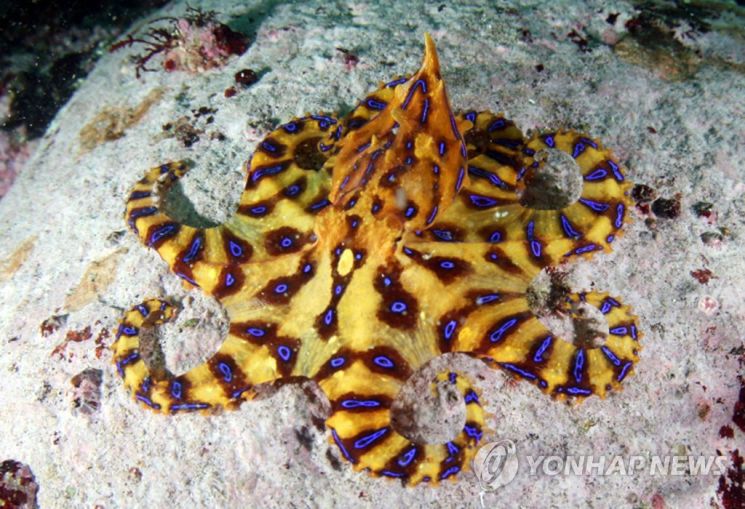 According to the Jeju Seogwipo Maritime Police Station, a blue-ringed octopus was found on the rocky shore of Soesokkak in Seogwipo City on the afternoon of the 13th. Photo by Yonhap News
[Asia Economy Reporter Kim Juri] A highly venomous "Parangori Octopus" has been found in Seogwipo City, Jeju Island, raising alarms.
According to the Jeju Seogwipo Maritime Police Station, on the afternoon of the 13th, a Parangori Octopus was discovered on the rocky shore of Soesokkak in Seogwipo City.
The Parangori Octopus, known to have venom more than 10 times stronger than cyanide, has a reddish-brown base color with blue stripes. It possesses a deadly toxin called tetrodotoxin in its teeth and salivary glands, and contact with just 1mg of this toxin can be fatal.
Tetrodotoxin is a type of neurotoxin that disrupts nerve sodium channels, causing interference with action potentials and exerting its toxic effects.
Therefore, being bitten or stung by the Parangori Octopus can cause symptoms such as paralysis, vomiting, difficulty breathing, and cardiac arrest. It is also dangerous to touch it with bare hands.
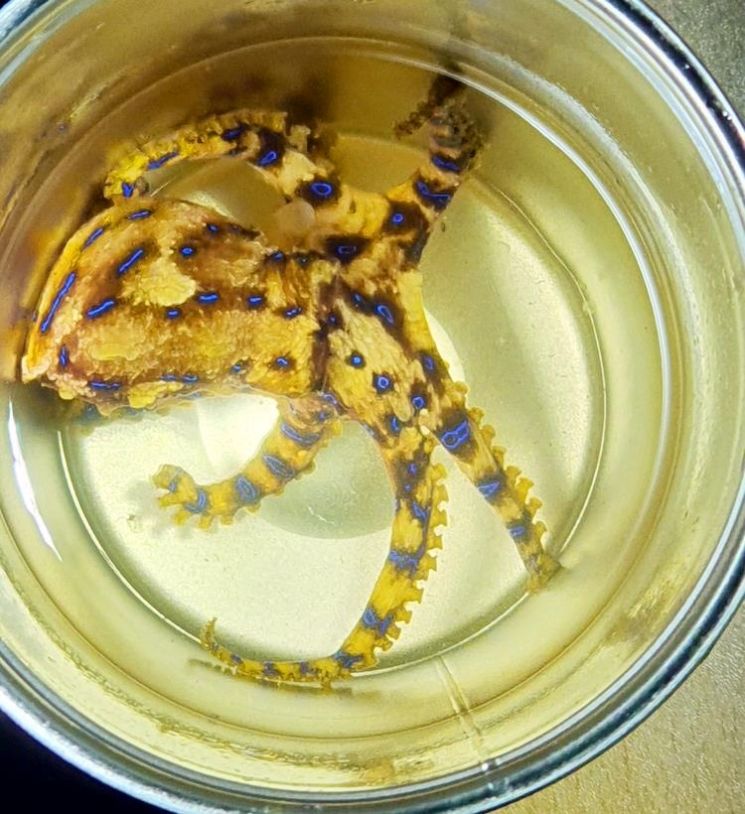 The blue-ringed octopus possesses a deadly toxin called tetrodotoxin in its teeth and salivary glands, and contact with just 1mg of this toxin can be fatal. Photo by Yonhap News
The Parangori Octopus mainly inhabits subtropical seas such as the South Pacific, but due to global warming and rising sea temperatures, it is occasionally found in Jeju and some parts of the southern coast of Korea.
It is also found in Japan, Australia, Indonesia, the Philippines, Sri Lanka, Papua New Guinea, and other regions.
Domestically, it was first found off the northern coast of Jeju in 2012, and in 2014, it was discovered near the reefs of Aewol-eup. In 2015, it was found on the rocky shore of Hyeopjae Beach in Jeju, and in 2017, near the breakwater in Geoje City.
The National Institute of Fisheries Science has warned that since the Parangori Octopus was first discovered in Jeju in 2012, it has been found along the southern coast and the southern East Sea coast, urging caution.
© The Asia Business Daily(www.asiae.co.kr). All rights reserved.


















