Domestic Experts' Stock Market Outlook
US Inflation Easing Is Illusory
Impact Less Than in the US
Volatility Expansion Phase Continues
Holding More Rational Than Panic Selling
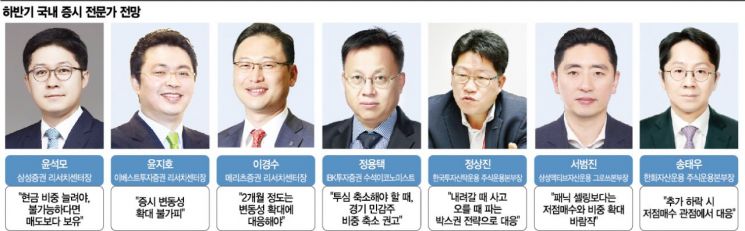
[Asia Economy Reporters Junho Hwang, Seonae Lee, Yoonju Hwang, Minji Lee, Myunghwan Lee] Despite the US's high-intensity tightening stance, inflation has not eased, leading to forecasts that the KOSPI bottom will break in the fourth quarter of this year. In a situation where a short-term adjustment phase is followed by an expected expansion of volatility, securities firms and asset management companies analyzed that a ‘buy-the-dip’ strategy is more useful than ‘panic selling.’
Heads of research centers at securities firms recently noted that expectations for the inflation peak and subsequent easing of tightening were too high, and they anticipate significant shocks to the stock market ahead. Yoon Seok-mo, Head of Samsung Securities Research Center, said on the 14th, "So far, the inflation peak theory and expectations for easing tightening have driven the stock market, but this has been shattered," adding, "On the contrary, the Federal Reserve's tightening intensity has increased, and corporate earnings revisions downward continue, so the KOSPI is expected to fall to the previous low point in the fourth quarter of this year."
The short-term adjustment is expected to continue until the 21st of this month, when the US interest rate hike decision will be made. Yoon Ji-ho, Head of Ebest Investment & Securities Research Center, said, "In the short term, market uncertainty will increase until the Federal Open Market Committee (FOMC) meeting on the 20th-21st." However, he added, "If energy prices stabilize, concerns about the Eurozone economy will ease, and the unilateral dollar strength is expected to weaken," concluding, "In that case, it does not seem likely to lead to a catastrophe."
The FOMC is expected to conclude with a giant step (75 basis points hike). Jung Yong-taek, Chief Economist at IBK Investment & Securities, said, "Currently, the US futures market reflects about a 20% chance of a 100 basis points hike, but economic slowdown must also be considered," and analyzed, "With the Fed recently doubling the scale of mortgage-backed securities (MBS) sales and expanding quantitative tightening, it is unlikely to raise rates by 100 basis points to the extent that it burdens the economy."
However, the general consensus is that even after the FOMC, a period of about two months of increased volatility rather than a rebound is reasonable to expect. Lee Kyung-soo, Head of Meritz Securities Research Center, said, "There were concerns about core inflation drivers, which materialized in the US August Consumer Price Index (CPI) release," and observed, "Index volatility is inevitable, so a conservative response is necessary." Unlike other center heads, he did not expect the KOSPI to fall below the previous low. He analyzed, "Significant declines in core inflation drivers such as housing costs and new car prices need to be observed, so about two months of noise (volatility) is inevitable."
Heads of equity fund management at various asset management companies offered similar forecasts. Jung Sang-jin, Head of Equity Management at Korea Investment Trust Management, said, "The influence of dollar strength will increasingly engulf the domestic stock market," and predicted, "The US stock market, which had high expectations, will see a larger drop, while the domestic stock market, which had relatively lower expectations, will experience a smaller decline compared to the US market." Seo Beom-jin, Head of Growth at Samsung Active Asset Management, also pointed out that expectations for inflation peak and interest rate cuts in the market were premature.
Experts judged that in this situation, a ‘conservative response’ rather than ‘panic selling’ is rational. Seo Beom-jin said, "We plan to maintain a low proportion of technology and growth stocks vulnerable to rate hikes and increase liquidity," adding, "Since stock prices have already adjusted more than 20% compared to the beginning of the year, it is a desirable time to confirm that inflation is easing and consider buying at the bottom and increasing weights rather than panic selling."
Song Tae-woo, Head of Equity Management at Hanwha Asset Management, also stated, "The effect of current stock selling is not expected to be significant, and a strategy of buying at the bottom in case of further declines is necessary." Jung Sang-jin added, "It is unlikely that institutions are selling stocks; rather, they are likely to respond with a box range strategy of buying when prices fall and selling when they rise," advising, "Individual investors should also take this into account."
Chief Economist Jung Yong-taek advised, "Investor sentiment for growth stocks has quickly cooled, shifting to cyclical stocks, but now is the time to reduce exposure," and recommended, "It is better to increase exposure to growth stocks or respond by buying safe assets like bonds." Yoon Seok-mo said, "If possible, increase cash holdings, and if you must hold stocks, you need to take a long-term view until a turnaround after the first half of next year," adding, "Now is the time to carefully watch downside risks."
© The Asia Business Daily(www.asiae.co.kr). All rights reserved.
![Clutching a Stolen Dior Bag, Saying "I Hate Being Poor but Real"... The Grotesque Con of a "Human Knockoff" [Slate]](https://cwcontent.asiae.co.kr/asiaresize/183/2026021902243444107_1771435474.jpg)
















