Development of System to Aid Early Diagnosis of Melanoma
Improvement in Cause Analysis of Rare Infant Eye Diseases
Prediction of Knee Osteoarthritis Progression Prognosis
Continuous Research Achievements by Domestic Medical Professionals
Provision of Medical Services Utilizing AI
Expected Shortcut to Conquering Various Diseases

[Asia Economy Reporter Lee Gwanju] Domestic medical professionals are gaining attention by consecutively producing research results that use artificial intelligence (AI) to find clues for treating rare and intractable diseases and predict patient prognosis. The convergence of AI and medicine is expected to be a shortcut not only to providing high-quality medical services but also to conquering various diseases.
Finding Hope for Treating Intractable and Rare Diseases
Research on medical solutions using AI is actively being conducted across all specialties. Professor Han Juhee’s research team from the Department of Dermatology at Seoul St. Mary’s Hospital developed an AI-based tissue biopsy site recommendation system to assist in the early diagnosis of melanoma, a highly fatal skin cancer, and reported it in the international journal Journal of the European Academy of Dermatology and Venereology. Malignant melanoma has a 5-year survival rate of less than 20% when it metastasizes to other organs, making early detection crucial. Typically, a 3mm punch biopsy is used to extract a small tissue sample for examination, but if the biopsy site is incorrectly selected, diagnosis can be delayed, worsening the prognosis. The system developed by Professor Han’s team recommends biopsy sites with 98% accuracy, aiding early diagnosis. Professor Han said, “If the AI model is further improved through additional research, it could assist in early melanoma diagnosis and ultimately improve prognosis.”
Methods to identify the causes of rare diseases using AI are also being explored. Professors Han Jinwoo and Lee Junwon from the Department of Ophthalmology at Gangnam Severance Hospital applied AI deep learning to genetic testing techniques analyzing the cause of infantile nystagmus syndrome, a rare eye disease, significantly improving existing analysis methods. Infantile nystagmus syndrome is characterized by involuntary eye movements in infants before six months of age and occurs in approximately 1 in 2,000 infants. Recently, next-generation sequencing (NGS) has been used for cause identification, diagnosis, and treatment, but about half of the cases still fail to find causative mutations using this method. Accordingly, the research team performed whole-genome sequencing of 3 billion base pairs using deep learning. Through this, they confirmed the presence or absence of genetic mutations in infantile nystagmus syndrome patients whose causes were not identified by conventional methods. This study is significant as it suggests the use of AI deep learning and whole-genome analysis for rare disease patients whose causes remain unknown.

Predicting Patient Prognosis Using AI
Just as finding the cause of a disease and treating it is important, managing recovery and prognosis after treatment is also a critical process. Especially, if prognosis can be predicted in advance, treatment efficiency can be improved and patients’ quality of life enhanced. For this reason, research on predicting prognosis using AI is actively underway.
Professor Lee Yongseok’s team from the Department of Orthopedics at Seoul National University Bundang Hospital developed a model using AI machine learning to predict the progression speed and prognosis of knee osteoarthritis. Osteoarthritis patients experience limited movement due to pain, and if it persists, structural changes in the body can occur, making systematic treatment necessary. Using demographic, occupational, comorbidity, and radiological data from about 83,000 knee osteoarthritis patients, Professor Lee’s team developed and analyzed a prediction model that showed 71% and 88% accuracy in predicting disease progression speed and prognosis, respectively. Notably, this model can analyze based on individual patient conditions without complicated procedures, making it easy to use even in primary care settings. Professor Lee explained, “Consistent management is necessary for osteoarthritis treatment, and this model can predict treatment methods and prognosis more conveniently and affordably than existing methods.”
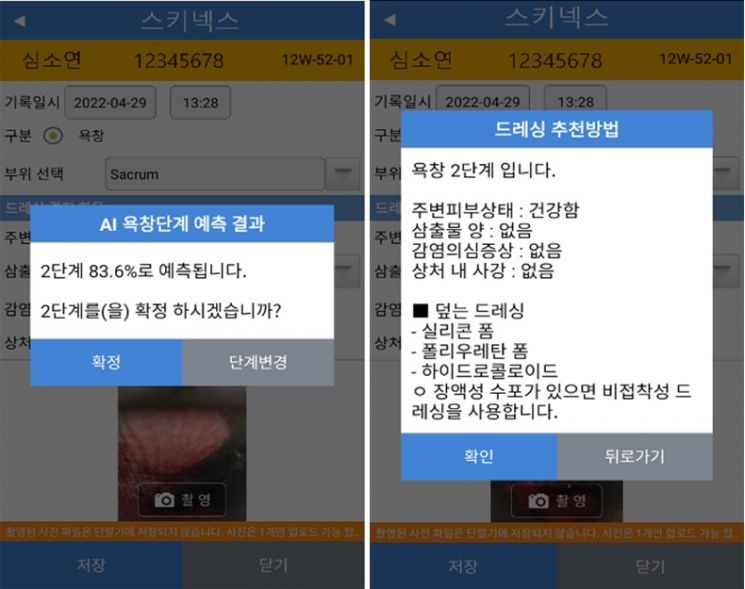 AI pressure ulcer stage prediction solution system Skinex jointly developed by Samsung Seoul Hospital and Fine Healthcare.
There is also a case where a digital healthcare company and hospital medical staff collaborated to develop an AI solution necessary for patient management. Samsung Medical Center and Fine Healthcare jointly developed the AI pressure ulcer stage prediction solution system called ‘Skinex.’ When a camera captures the pressure ulcer area, the system predicts the current stage of the ulcer in real time and recommends appropriate dressings according to the treatment direction. This solution is expected to actively manage pressure ulcers that may occur in hospitalized patients and significantly improve the quality of nursing services.
© The Asia Business Daily(www.asiae.co.kr). All rights reserved.
![Clutching a Stolen Dior Bag, Saying "I Hate Being Poor but Real"... The Grotesque Con of a "Human Knockoff" [Slate]](https://cwcontent.asiae.co.kr/asiaresize/183/2026021902243444107_1771435474.jpg)

















