Bloomberg News "Foreign Exchange Reserves in India Decreased by $81 Billion This Year"
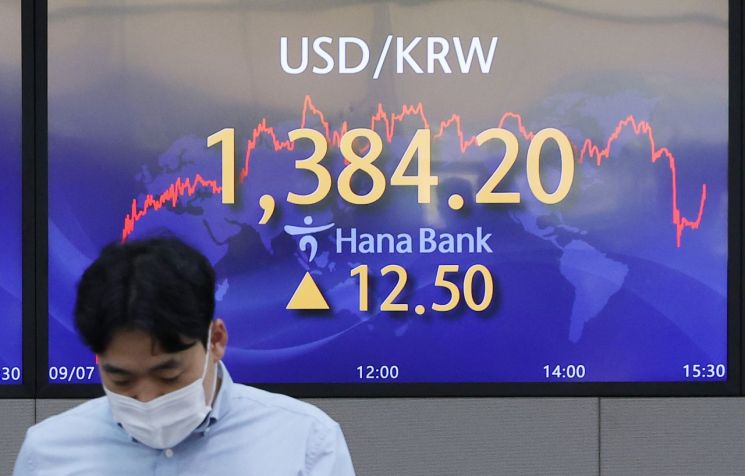
[Asia Economy Reporter Yoo Je-hoon] Concerns have arisen that the strong dollar phenomenon has sharply reduced foreign exchange reserves in emerging Asian countries including Korea, India, and Thailand, potentially weakening their ability to defend their exchange rates.
According to a Bloomberg report on the 13th, India's foreign exchange reserves have decreased by $81 billion (approximately 111 trillion KRW) since the beginning of this year. Additionally, foreign exchange reserves have declined in Thailand ($32 billion), Korea ($27 billion), Indonesia ($13 billion), and Malaysia ($9 billion).
Bloomberg's own calculations show that the ratio of foreign exchange reserve decline relative to gross domestic product (GDP) was highest in Thailand, followed by Malaysia and India.
According to Standard Chartered, the period during which countries can cover overseas import payments solely with their foreign exchange reserves has shortened to about seven months (excluding China), the shortest since the 2008 global financial crisis. In August 2020, it was 16 months, and at the beginning of this year, it was 10 months, indicating a further decrease. By country, India can cover nine months of import payments with its foreign exchange reserves, the Philippines eight months, and Korea about seven months.
Divya Debeshi, Head of ASEAN and South Asia Currency Analysis at Standard Chartered, stated, "Due to the decline in foreign exchange reserves in emerging countries, central banks' market interventions to defend exchange rates may become much more limited in the future," adding, "If export sluggishness continues, central banks' interventions may shift from selling to buying dollars to strengthen export competitiveness."
However, Bloomberg also noted that the depreciation of currencies other than the dollar due to the strong dollar phenomenon has contributed to the decline in foreign exchange reserves, and there is an assessment that the actual situation of emerging countries is relatively better compared to previous crises.
© The Asia Business Daily(www.asiae.co.kr). All rights reserved.
![Clutching a Stolen Dior Bag, Saying "I Hate Being Poor but Real"... The Grotesque Con of a "Human Knockoff" [Slate]](https://cwcontent.asiae.co.kr/asiaresize/183/2026021902243444107_1771435474.jpg)
















