Changed Atmosphere After Introducing 'Connected Work' for Selecting Work Styles
Increased Work Focus and Reduced Childcare Burden... Emphasis on Autonomy and Responsibility-Based Performance
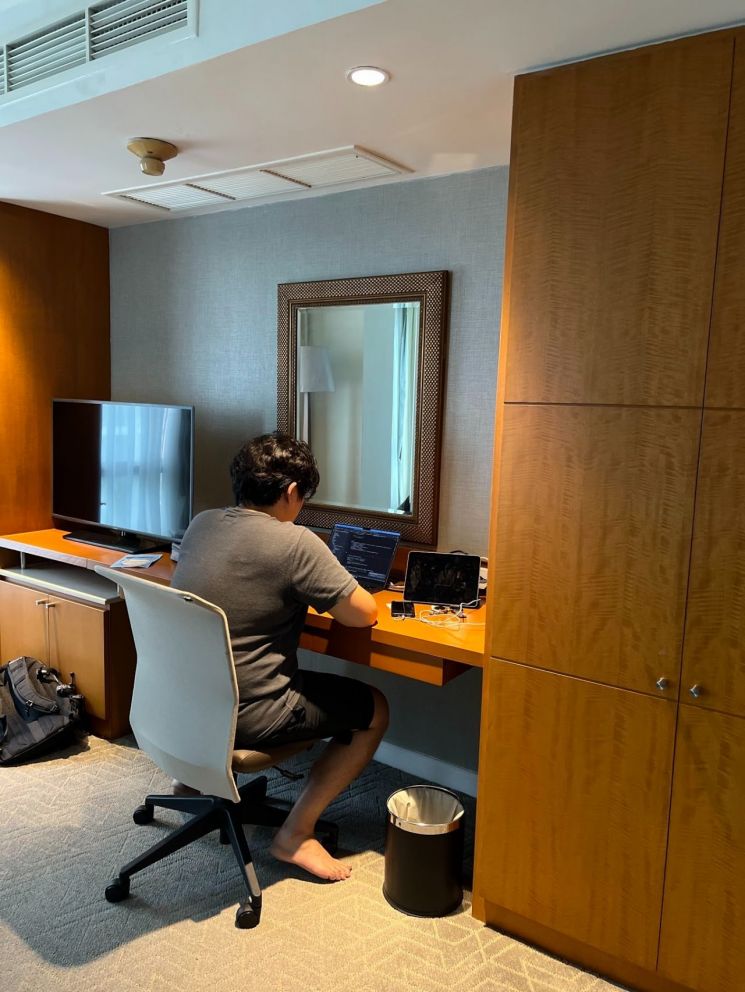 Line developer Taejun Park working at a hotel in Bangkok, Thailand through the workation system
 [Photo by Line Plus]
[Asia Economy Reporter Yuri Choi] # Park Tae-jun, the developer of Naver's global messenger 'Line,' went on a three-week "workation" (a blend of work and vacation) to Bangkok, Thailand, last August. While he used to take a week-long overseas trip every summer, this vacation was different. He was able to fully relax on the Thai beach after work or on weekends without interrupting his workflow. The old days of sneaking in work during vacation due to major projects or suffering from Monday blues for a whole week catching up on backlog after returning from vacation were gone. Especially, the children who had a special break were highly satisfied, and he is planning a longer workation next year.
Two Months of Naver's 'Connected Work' Boosts Productivity
On the 13th, it marked two months since Naver introduced 'Connected Work,' a system allowing employees to autonomously choose their working style. More than half of the employees are working fully remotely, and the number of employees working remotely from overseas has increased. Internal evaluations indicate that focusing on work itself without being constrained by time or place has also increased unit productivity.
Since July, Naver has been implementing a new work system where employees can choose their working style, including remote work and office attendance. It is divided into 'Type R,' based on remote work, and 'Type O,' where employees come to the office at least three days a week. Type R is preferred by developers because, as long as they have a network environment, PC, and collaboration tools, they can work with increased concentration wherever they want. Naver supports equipment for remote work environments separately from the budget allocated for employees to purchase work devices.
Naver developer A said, "Most code reviews that require communication with team members are conducted online," expressing satisfaction, "I can work with concentration without needing to have casual coffee time with colleagues or move between meeting rooms."
Type O employees who come to the office also operate flexibly. Since the number of office days is calculated as a monthly average, they might come to the office five days one week and work fully remotely the next. This flexibility leads to high satisfaction among employees raising children. Naver executive B explained, "When the family of the nanny who takes care of my child caught COVID, I immediately switched to remote work," adding, "Even if I work overtime, I can help my child with homework and prepare meals at home, so the burden is relatively low."
The workation system, combining vacation and work, is also popular. Naver employees can take a workation for up to four nights and five days at company-owned training centers in Chuncheon, Gangwon Province, or the Tokyo base camp in Japan. In the case of Naver affiliate Line Plus, employees can work from anywhere within a four-hour time difference from Korea. Employees choose remote work to visit family living abroad or during their children's school vacations. Previously, long-term overseas trips required considering leave or resignation, but now that is no longer necessary.
A Line Plus official said, "Photos of working while looking at the sea from an outdoor terrace in Bali are posted on the company community, creating an atmosphere where employees enjoy work and rest without hesitation," adding, "Many say that refreshing by looking at the sea or taking a walk during breaks improves efficiency when returning to work."
According to a survey conducted by Naver targeting employees and team leaders who have worked remotely, the majority evaluated productivity, speed, and work quality as the same as before, with many saying it has even improved. Actual project progress shows no difference compared to when everyone used to come to the office. Rather, employee satisfaction has increased, leading to higher work concentration.
As the proportion of remote workers increased, meetings and gatherings shifted to non-face-to-face formats. It is common to have 'online dinners' where everyone orders their preferred menu for delivery and eats together remotely, or 'coffee chats' where employees drink coffee during video meetings. Measures to strengthen teamwork have also been implemented. A representative example is the 'Teamwork Day,' where team members come to the office together once a month. New employees come to the office with a colleague who acts as a mentor to help them adapt.
Naver new developer C said, "I come to the office on the same day as my mentor, the 'buddy,' and have lunch together," evaluating, "I was worried about feeling awkward since I rarely see Type R workers in the team, but I quickly blended in through monthly face-to-face Teamwork Days."
With more flexible and free working styles, the atmosphere has become more focused on work and performance itself. Naver CEO Choi Soo-yeon emphasized when introducing Connected Work, "Rather than focusing on when and where to work, we will focus on the more essential 'intrinsic value of work' to create an autonomous culture and performance."
A Naver official said, "Since this system was designed to enable the best performance without being bound by formalities, the concept itself has high support," adding, "Having experienced remote work during the COVID period helped it settle quickly."
© The Asia Business Daily(www.asiae.co.kr). All rights reserved.

















