[Asia Economy New York=Special Correspondent Seulgina Jo] The Biden administration in the United States has decided to expand and support domestic production in the bioindustry sector, following semiconductors and electric vehicle batteries. The 'Made in America' strategy, which openly targets China, is accelerating, and its impact on the Korean bioindustry, which excels in contract manufacturing, is expected to be inevitable.
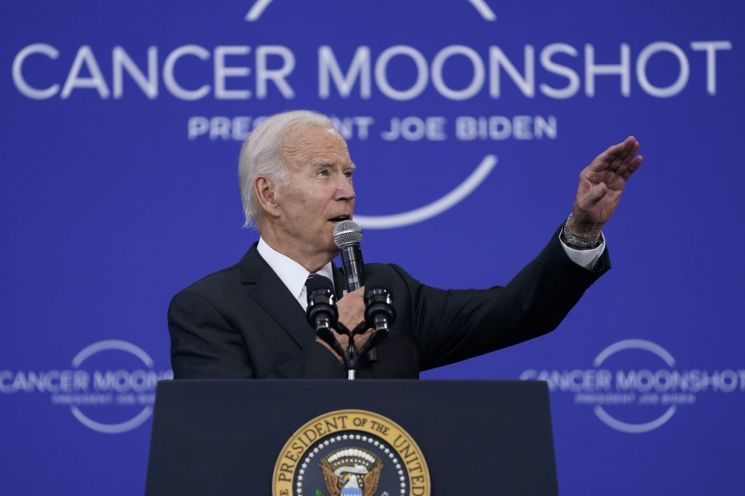
According to the White House, President Biden signed an executive order on the 12th (local time) titled the ‘National Biotechnology and Biomanufacturing Initiative.’ This order focuses on expanding production facilities, workforce, and infrastructure for new drugs and biofuels. It strengthens the system to ensure that everything invented in the U.S. in the bioindustry sector, following semiconductors and electric vehicle batteries, is manufactured domestically.
The Biden administration plans to hold a related meeting on the 14th to announce extensive new investments and resources to specify the executive order. The U.S., which leads the world in bioindustry research and development (R&D), prepared this executive order out of concern over increasing dependence on China for advanced product manufacturing due to the continuous relocation of production facilities overseas. Considering that the bioindustry was included alongside semiconductors, batteries, and rare earths in the supply chain investigation directly ordered by President Biden shortly after his inauguration, this move is seen as a virtually anticipated step.
Accordingly, the impact is expected on South Korea, which is focusing investment on nurturing the biohealth industry as a national core strategic sector. As the U.S. government emphasizes domestic production, it is anticipated that contract manufacturing of pharmaceuticals from U.S. pharmaceutical companies may face disruptions. Currently, Samsung Biologics is contract manufacturing the COVID-19 Moderna vaccine, and SK Bioscience is contract manufacturing the Novavax vaccine domestically.
Additionally, the executive order includes provisions to "involve allies and partners to address national security threats from adversaries," making it highly likely that, similar to the previously announced Chips and Science Act (CSA), guardrail clauses restricting Chinese investments in bioindustry companies receiving U.S. subsidies and support will be included. Furthermore, if Korean bio companies are excluded from various incentives like the Inflation Reduction Act (IRA), which provides subsidies of up to $7,500 per vehicle only for American-made electric vehicles, their global competitiveness will inevitably decline.
The White House stated, "The U.S. has been overly dependent on overseas raw materials and bio production, and past offshoring of key industries such as biotechnology threatens our access to important chemical and pharmaceutical components," adding, "This executive order will create jobs domestically, build supply chains, and help mitigate inflation."
With the midterm elections in November approaching, President Biden has recently emphasized domestic investment by repeatedly mentioning 'Buy American.' On this day, during a speech at Logan International Airport in Boston, Massachusetts, he again referenced Korea's investment in the U.S. and said, "I asked why Korea invests in America, and they said it is because America is the safest country in the world." Desperate for a midterm election victory, President Biden has been stressing 'Buy American' at every official event, stating, "The call to produce in America is no longer just a slogan."
© The Asia Business Daily(www.asiae.co.kr). All rights reserved.
![Clutching a Stolen Dior Bag, Saying "I Hate Being Poor but Real"... The Grotesque Con of a "Human Knockoff" [Slate]](https://cwcontent.asiae.co.kr/asiaresize/183/2026021902243444107_1771435474.jpg)











