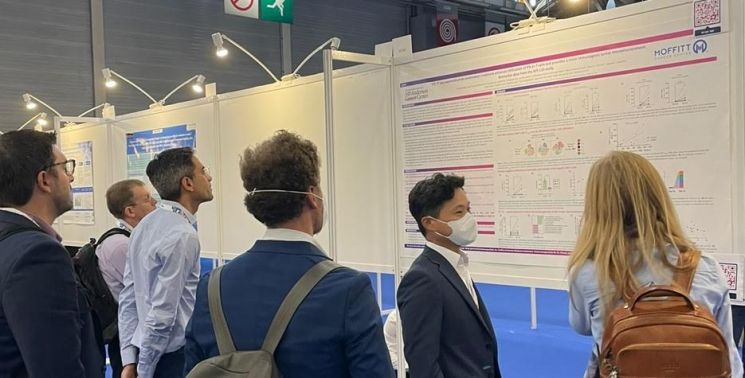
[Asia Economy Reporter Lee Chun-hee] NeoImmuneTech announced on the 13th that it revealed the biomarker analysis results of the NT-I7 (active ingredient epineptakin alpha) and Keytruda (active ingredient pembrolizumab) combination solid tumor clinical trial (NIT-110) at the European Society for Medical Oncology (ESMO 2022).
ESMO, held from the 9th to the 13th of this month in Paris, France, is the largest cancer academic conference in Europe and is considered one of the world's top three cancer societies alongside the American Society of Clinical Oncology (ASCO) and the American Association for Cancer Research (AACR). Being the last major conference of the year, it is also regarded as a precursor to the following year's JP Morgan Healthcare Conference, the world's largest venue for technology transfer and investment attraction.
In this poster presentation, NeoImmuneTech conducted biomarker analysis focusing on the types of tumor-infiltrating T cells and changes in immune responses within the tumor microenvironment (TME). The company stated, "There have been few cases among cytokine-based immuno-oncology drugs that have specifically confirmed such changes," and added, "We expect this to create a significant impact in the industry."
The biomarker study included patients with pancreatic cancer, MSS colorectal cancer, and ovarian cancer enrolled in the NIT-110 clinical trial. More than 80% of the patients showed T cell infiltration within the TME, and 50% exhibited more than a fivefold expansion of CD8 T cells after a single administration of NT-I7. The increase in stem cell-like memory T cells (Tscm), which have the most potent anticancer effects, was found to influence the infiltration of CD8 T cells into the TME.
Notably, patients whose tumor sizes actually decreased had higher levels of T cell infiltration within the TME, and the ratio of CD8 T cells that kill cancer cells increased more than that of regulatory T cells (Treg) that suppress immunity. The company explained, "This indicates that the observed anticancer effect is not a coincidental result but is derived from the T cell expansion mechanism of NT-I7."
Yang Se-hwan, CEO of NeoImmuneTech, evaluated, "This study is an important link that clinically demonstrates that the T cell expansion mechanism of NT-I7 contributes to the anticancer effects in various refractory cancers," and added, "We have taken one step closer to the commercialization stage that can provide new treatment options for patients with refractory cancers."
© The Asia Business Daily(www.asiae.co.kr). All rights reserved.

















