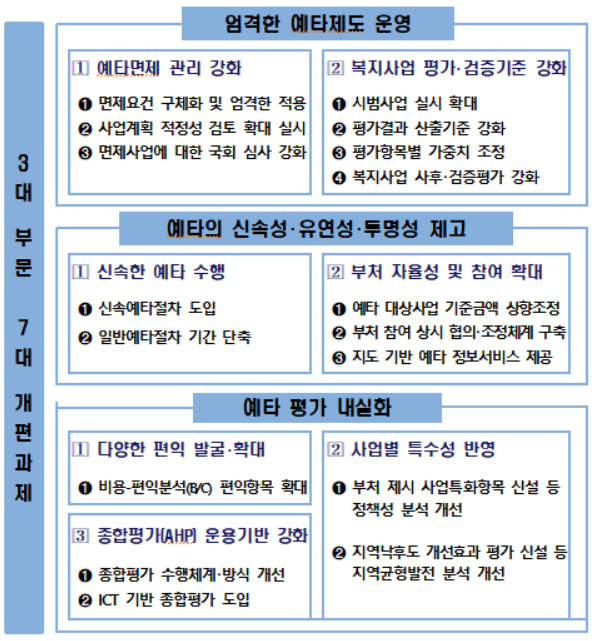
[Asia Economy Sejong=Reporter Son Seon-hee] The government will significantly reform the preliminary feasibility study (PFS) system, which is conducted for new projects involving large-scale fiscal investment, for the first time in 23 years. In response to changes in economic conditions, the threshold for conducting PFS will be doubled (from 50 billion KRW to 100 billion KRW), while exemption criteria and system operations will be applied more strictly.
On the 13th, the government held an emergency economic ministers' meeting at the Government Complex Sejong, chaired by Deputy Prime Minister and Minister of Economy and Finance Choo Kyung-ho, to discuss the reform plan for the PFS system. Deputy Prime Minister Choo explained the purpose of the reform, saying, "The PFS system will faithfully perform its role as the 'gatekeeper of fiscal policy,' while also enhancing the speed, flexibility, and transparency of the PFS."
The PFS system is conducted for new projects in fields such as social overhead capital (SOC) and research and development (R&D) with a total project cost of 50 billion KRW or more and national funding of 30 billion KRW or more. Over approximately 23 years until last month, a total of 975 projects (477.3 trillion KRW) underwent PFS, of which 350 projects (184.1 trillion KRW, 35.9%) were evaluated as lacking feasibility.
However, this standard was set when the system was first introduced in 1999, and there have been consistent opinions that it should be adjusted upward considering the scale of economic growth since then. There have also been criticisms that the PFS evaluation criteria do not reflect various benefits and project-specific characteristics in line with changes over time.
Accordingly, the government plans to raise the PFS eligibility criteria to "total project cost of 100 billion KRW + national funding of 50 billion KRW." For projects with costs between 50 billion KRW and 100 billion KRW, each relevant ministry will conduct its own feasibility verification.
Additionally, for projects recognized as urgent, a "fast-track PFS procedure" will be introduced, shortening the selection period from 2 months to 1 month and the investigation period from 9 months to 6 months. This effectively reduces the total project initiation period by 4 months.
However, exemption conditions for PFS will be specified more concretely and applied as strictly as possible. This is because, in the past, there were many cases where large-scale fiscal investments were made with "blanket" PFS exemptions according to the preferences of past administrations.
During the Moon Jae-in administration (June 2017 to April 2022), 149 projects were exempted from PFS, with a total project cost of 120.1 trillion KRW. This scale is much larger compared to the Lee Myung-bak administration (90 projects, 61.1 trillion KRW) or the Park Geun-hye administration (94 projects, 25 trillion KRW). This means there were many cases where public funds were invested in projects without proven feasibility. This was due to vague exemption criteria, and the government plans to clarify these unclear exemption conditions and apply them as strictly as possible to minimize PFS exemptions.
Furthermore, for welfare projects involving large-scale fiscal investment, the government will operate pilot projects first and then review whether to initiate PFS for the main projects based on performance evaluations.
© The Asia Business Daily(www.asiae.co.kr). All rights reserved.
![Clutching a Stolen Dior Bag, Saying "I Hate Being Poor but Real"... The Grotesque Con of a "Human Knockoff" [Slate]](https://cwcontent.asiae.co.kr/asiaresize/183/2026021902243444107_1771435474.jpg)
















