Seoul Autonomous Private High Schools See Highest Competition Rate in 13 Years
National Science High Schools Competition Rate 3.60:1, Seoul 4.43:1
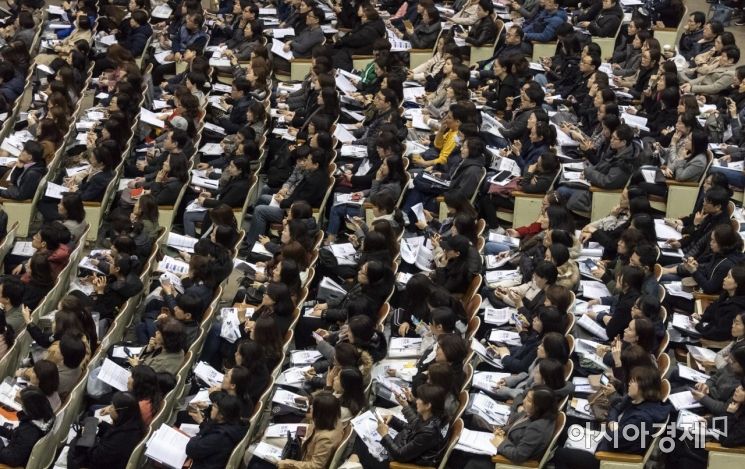 Many parents are attending the "Special High School and College Admission Briefing for Gifted Schools, Science High Schools, Autonomous Private High Schools, Foreign Language High Schools, International High Schools, and General High Schools" held on the 31st at the Hoedang Memorial Hall of Jinseon Girls' High School in Gangnam-gu, Seoul. Photo by Yoon Dong-joo doso7@
The competition rate for science high schools in the Seoul area has reached its highest point in 13 years. As the controversy over the abolition of autonomous private high schools (Jasago) continues, a balloon effect has emerged, increasing the competition rate for science high schools.
According to Jongno Academy, the competition rate for science high schools located in Seoul for the 2023 academic year rose to 4.43 to 1, higher than last year's 3.76 to 1, marking the highest level since the introduction of the self-directed learning admission system in 2011. The competition rates for Seoul-area science high schools are 4.91 to 1 for Hansung Science High School and 4.01 to 1 for Sejong Science High School. Last year, these were 3.78 to 1 and 3.75 to 1, respectively.
The nationwide competition rate for science high schools, as of the morning of the 8th, was 3.60 to 1, up from 3.16 to 1 the previous year. This is the highest since the 2020 academic year. The number of applicants nationwide was 5,389, a 14.0% increase compared to 4,782 the previous year.
By school, Gyeonggi Buk Science High School had the highest competition rate at 8.00 to 1, followed by Hansung Science High School (4.91 to 1), Daejeon Telecommunications Science High School (4.19 to 1), Chungbuk Science High School (3.41 to 1), and Incheon Science High School (3.34 to 1).
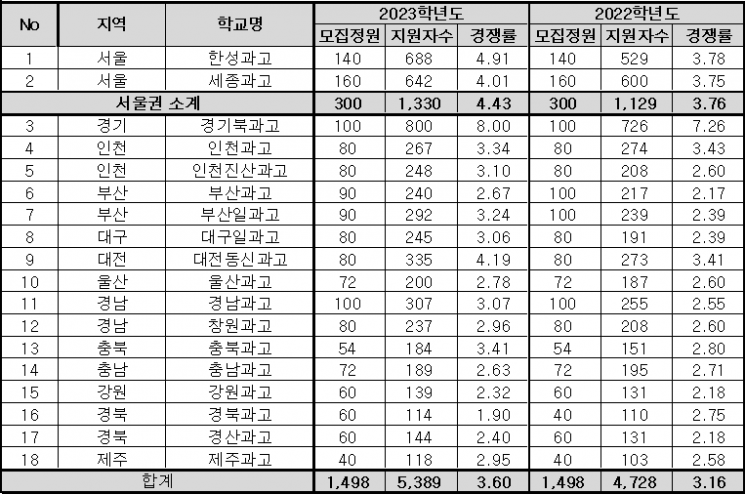 National Science High Schools Competition Rates Status, as of 11 AM on September 8. (Source=Jongro Academy)
Despite restrictions on admission to medical or pharmaceutical schools from science high schools, the unusual sharp rise in competition rates is influenced by policies regarding the conversion of autonomous private high schools. The Ministry of Education plans to announce a high school system reform plan related to autonomous private high schools, foreign language high schools, and international high schools by the end of this year. While autonomous private high schools have faced ongoing debates over their existence with each change of administration, science high schools have maintained a relatively stable stance.
Since last year, all science high schools have clearly stated in their admission guidelines that students who advance to medical or pharmaceutical fields will face disadvantages such as scholarship repayment. If students enter medical fields, recommendation letters will not be written, guidance for admission will not be provided, scholarships awarded during enrollment or for achievements will be reclaimed, and they will be excluded from awards and scholarship recipients at graduation.
Additionally, the government's announcement of policies to foster advanced departments in new industries such as semiconductors has intensified the preference for science and engineering fields, which is also cited as a reason for the rising popularity of science high schools. The increase of 41,998 third-year middle school students compared to the previous year is another factor raising competition rates. Unlike science gifted schools that select students nationwide, science high schools only accept applicants from middle schools located in their respective regions.
Lim Seong-ho, CEO of Jongno Academy, said, "Despite the restrictions on admission to medical fields, the unusually large increase in competition rates is due to the controversy over the abolition of autonomous private high schools, which have been operated mainly for science students, leading these students to perceive science high schools as alternative schools to autonomous private high schools." He added, "Preferences for science high schools may continue for the time being due to the establishment of special contract departments linked to large corporations and top universities."
© The Asia Business Daily(www.asiae.co.kr). All rights reserved.
![Clutching a Stolen Dior Bag, Saying "I Hate Being Poor but Real"... The Grotesque Con of a "Human Knockoff" [Slate]](https://cwcontent.asiae.co.kr/asiaresize/183/2026021902243444107_1771435474.jpg)

















