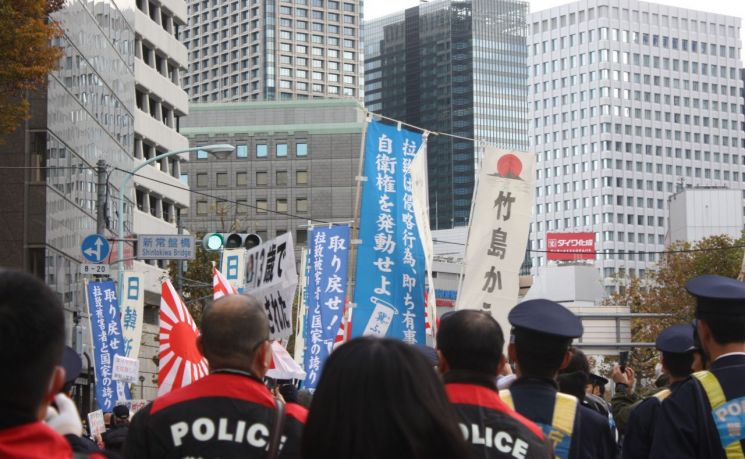
 In 2018, Japanese right-wing groups held an anti-Korean demonstration in downtown Tokyo.
 [Image source=Yonhap News]
[Asia Economy Reporter Hwang Sumi] Recently, a series of incidents revealing prejudice and hatred against Koreans have occurred in Japan, sparking controversy. Following an arson attack deliberately set by a Japanese man in his 20s with anti-Korean sentiment in a village where many Zainichi Koreans reside, a major corporation distributed documents containing content that disparaged Korea. Some voices are calling for the establishment of specific legislation to punish incidents motivated by discriminatory intent.
According to Kyodo News on the 9th, Japan's Supreme Court (Saik? Saibansho) upheld a ruling ordering Fuji J?taku to compensate Zainichi Korean Mr. A 1.32 million yen (approximately 12.81 million KRW) and also prohibited the distribution of the documents containing discriminatory content.
Fuji J?taku is known to have distributed magazine articles and internet posts within the company since 2013 that insulted Koreans and Chinese as "liars" and contained other derogatory content.
At that time, Mr. A, a Zainichi Korean employee, requested the company to stop distributing the documents, but the company refused. Moreover, Fuji J?taku Chairman Imai Mitsuo instructed all employees to distribute parts of the discriminatory documents. Eventually, Mr. A filed a lawsuit against Chairman Imai and others, claiming mental distress caused by the repeated distribution of ethnically discriminatory documents in the workplace.
In the first trial in 2020, the company was ordered to pay 1.1 million yen in damages. However, the hate documents continued to circulate, and in November last year, the Osaka High Court increased the compensation to 1.32 million yen.
Subsequently, on the 9th, the Supreme Court made a final ruling that Fuji J?taku's distribution of discriminatory documents was illegal, confirming the High Court's decision. It explained that this falls under "unjust discriminatory behavior" as defined by Japan's Hate Speech Elimination Act, a law enacted to prevent public discrimination and hate speech against specific groups.
Meanwhile, hate speech and actions against Koreans, mainly by right-wing forces in Japan, continue to be controversial. In a recent cabinet reshuffle, Sugita Mio, a pro-Abe member of the Liberal Democratic Party known for anti-Korean and far-right views, was appointed to the key position of Parliamentary Secretary for the Cabinet Office, sparking debate. This politician is known for numerous sexist remarks and denial of the Japanese military's comfort women victims.
Crimes fueled by anti-Korean sentiment have also occurred. A representative case is the arson incident last August in a village in Uji City, Kyoto Prefecture, where many Zainichi Koreans live.
At that time, Arimoto Shogo, a man in his 20s residing in Sakurai City, Nara Prefecture, set fire with a lighter to a warehouse in the Utoro district, burning down seven houses. Notably, about 50 items stored for exhibition at the Utoro Peace Memorial Hall, which contains the history of Zainichi Koreans during the Japanese colonial period, were lost in the fire. Additionally, Arimoto damaged some buildings of the Zainichi Korean organization Mindan and Korean schools in Nagoya City.
Regarding this, on the 30th of last month, Arimoto was sentenced to four years in prison on charges of arson and property damage. According to the Yomiuri Shimbun, he stated in court that he "harbored hostility toward Koreans."
This has led to criticism that the punishment was too lenient. Although incidents motivated by discriminatory intent continue, there is no legal basis in Japanese law to consider such motives in sentencing.
In fact, although Japan enacted the Hate Speech Countermeasures Act in 2016, it lacks penalty provisions, leading to ongoing criticism that hate speech has not disappeared. In response, the Kyoto Hate Speech Countermeasures Committee held a civic meeting on the 24th of last month to address hate speech and hate crimes by right-wing groups targeting Zainichi Koreans and others.
© The Asia Business Daily(www.asiae.co.kr). All rights reserved.

















