Withdrawal of DNT Chemical Product Expansion
New EVA Expansion for Solar-Related Products
Governance Change in US Solar Corporation
7.617 Trillion KRW New Investment in Domestic Solar Business
Trillion KRW-Scale Active Local Investment in US
"Steps to Clarify Identity as a Solar Company"
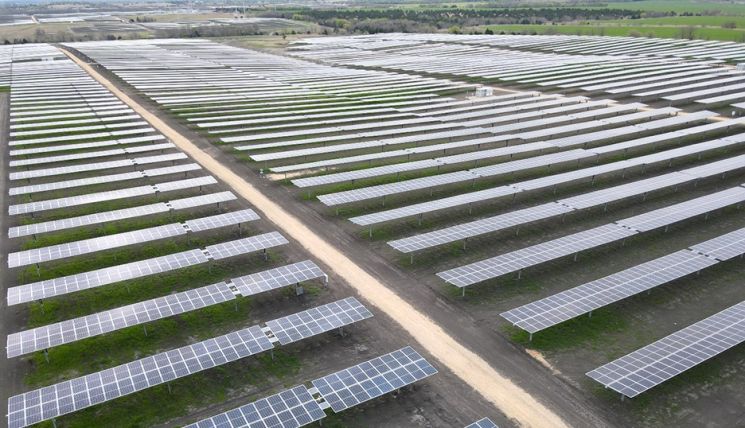
[Asia Economy Reporter Choi Seoyoon] Hanwha Solutions is expanding its domestic and international solar power business investments, riding the "solar power tailwind from the U.S." In line with the expansion of the renewable energy market, the company is increasing its facilities and unifying its solar power subsidiaries in the U.S., indicating a shift in the business focus toward solar power. It is being evaluated as transforming its identity into a solar power company.
According to industry sources on the 9th, Hanwha Solutions recently withdrew plans to expand chemical production facilities but decided to execute new investments worth several hundred billion won in the solar power business.
On the 7th, Hanwha Solutions canceled its plan to invest 160 billion won to build a 180,000-ton scale nitric acid and nitric acid derivative (DNT) production facility in the Yeosu industrial complex. The company had aimed to achieve vertical integration of the Toluene Diisocyanate (TDI) business through self-supply of DNT, but decided to withdraw the investment due to soaring raw material prices, overall inflation, and the Russia-Ukraine war.
On the same day, Hanwha Solutions announced it would invest a total of 761.7 billion won domestically to strengthen its competitiveness in the solar power business. First, together with GS Energy, it plans to invest 590 billion won to establish a solar material joint venture, "H&G Chemical." Starting from September 2025, the company aims to produce 300,000 tons annually of Ethylene Vinyl Acetate (EVA). Global solar component manufacturers producing EVA sheets, including Hanwha Solutions' Advanced Materials division, will use this material to supply products.
EVA sheets are key materials that maintain the performance of solar cells. The Advanced Materials division will also invest about 41.7 billion won in Eumseong, Chungbuk, to expand the EVA sheet production line. Through this joint venture, Hanwha Group's total EVA production capacity, including Hanwha Solutions, will increase to 920,000 tons, surpassing ExxonMobil's 790,000 tons in the U.S., becoming the world's largest EVA producer.
Next, Hanwha Solutions will invest a total of 130 billion won in its Jincheon plant in Chungbuk to install a module production line using high-efficiency TOPCon-based cells and large wafers (M10). To produce high-output products, the company will also convert the existing M6 (16.6 cm x 16.6 cm) wafer line to the larger M10 (18.2 cm x 18.2 cm) wafer line.
Hanwha Solutions is also considering establishing a local production plant in the U.S. According to local media, Hanwha Solutions recently submitted a letter of intent for a project worth $1.829 billion (about 2.5 trillion won) in Texas. The plan includes building solar panel, ingot, wafer, and cell production plants in Dallas County and other areas.
At the module plant in Georgia, U.S., the company plans to invest 200 billion won next year to add 1.4 GW of capacity. Upon completion, the total module production capacity will reach 3.1 GW.
Hanwha Solutions' investment moves in the U.S. align with the Inflation Reduction Act (IRA), which includes renewable energy support measures. According to major foreign media such as Bloomberg, Hanwha Solutions is expected to receive tax benefits exceeding $200 million (about 270 billion won) annually starting next year when the IRA takes effect.
To improve business management efficiency, Hanwha Solutions has also changed the governance structure of its U.S. solar business subsidiaries. It decided to transfer Hanwha Q CELLS America, a 100% subsidiary of Hanwha Solutions, to a subsidiary of Hanwha Global Asset. Hanwha Solutions plans to use Hanwha Global Asset as a control tower to unify its U.S. subsidiaries, including Hanwha Q CELLS America Holdings and Hanwha Q CELLS America, to achieve organizational management efficiency.
Choi Young-kwang, a researcher at NH Investment & Securities, said, "Withdrawing the DNT expansion, a chemical product, while newly expanding EVA, a solar-related product, and changing the governance of the U.S. Q CELLS subsidiaries with Hanwha Global Asset as the control tower clearly shows the intention to define its identity as a solar power company rather than a chemical company and to expand investments accordingly. As U.S. policy support is expected to continue, investment plans for vertical integration of the U.S. solar value chain are expected to be announced soon."
© The Asia Business Daily(www.asiae.co.kr). All rights reserved.

















