Do Not Click Malicious App URLs
Refuse Requests for Financial or Personal Information
Follow Security Guidelines to Prevent Damage

[Asia Economy Reporter Cha Min-young] "You are an additional recipient of the 'Emergency Living Support Fund' provided to low-income and vulnerable groups affected by typhoon damage."
As the Chuseok holiday approaches, text message scams (smishing) using bait such as typhoon damage recovery support funds or livelihood recovery support funds are rampant, requiring increased caution. Delivery notifications, holiday greetings from acquaintances, and impersonation of public institutions are also common tactics. This method involves sending text messages containing malicious app links to induce users to install apps or make calls, thereby stealing financial and personal information.
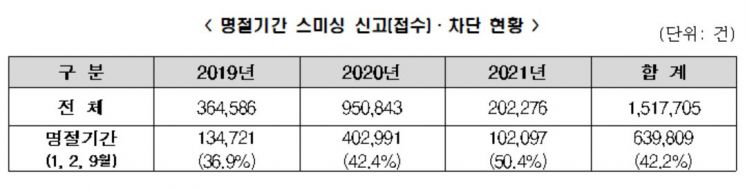
According to the Ministry of Science and ICT, the Korea Communications Commission, the Financial Services Commission, the National Police Agency, the Korea Internet & Security Agency (KISA), and the Financial Supervisory Service on the 9th, smishing crimes during the holiday periods of January, February, and September over the past three years accounted for 42.2% of all cases.
In particular, last year, it was analyzed that over 50% of the total cases occurred during these periods. Most smishing cases are of the delivery impersonation type (94.7%). It is observed that smishing impersonating delivery services surged by exploiting the increase in gift deliveries during the holidays.
There are also smishing cases impersonating public institutions (4.3%), disguised as public services closely related to citizens' lives, such as COVID-19 vaccination reservations, regular health checkup appointments, and traffic violation fine inquiries. Recently, a new type of smishing has emerged, sending texts impersonating government agencies for disaster relief fund applications, inducing the installation of malicious apps to steal personal financial information, requiring caution.
Messenger phishing damage is also continuously increasing, where scammers claim to be family or acquaintances via messenger apps and request money, gift certificates, personal information, or financial transaction information by citing urgent situations (phone malfunction, credit card theft/loss, accident settlement money, proxy purchase of gift certificates, etc.). If a remote control app is installed and control is handed over, property damage may occur, so do not comply with the other party's requests before verifying them accurately through phone or video calls.
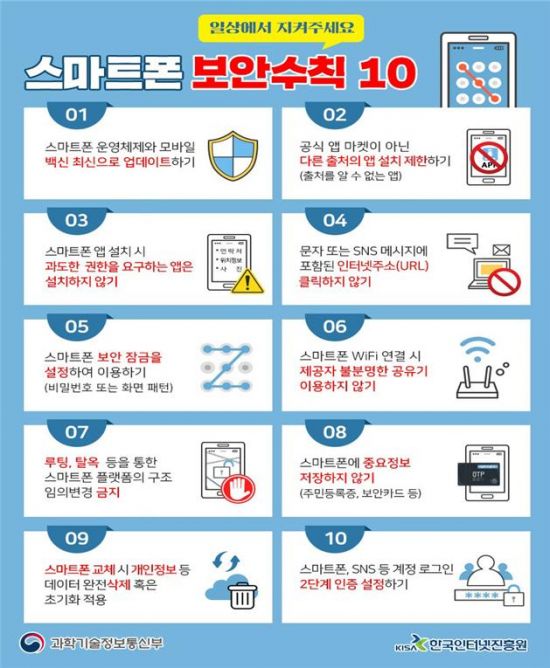
To prevent text message scam damage, it is necessary to follow security guidelines. ▲ First, do not click on unclear internet addresses (URLs) or phone numbers included in delivery inquiries, holiday greetings, mobile gift certificates, transportation tickets, performance tickets, or texts impersonating acquaintances. ▲ Second, strengthen smartphone security settings to prevent careless installation of unknown apps, and install apps through authorized open markets rather than links in received messages. ▲ Third, install antivirus programs and keep them updated with real-time monitoring enabled. ▲ Fourth, do not provide identification or personal/financial information when requested under the pretext of identity verification, disaster relief funds, or vaccine reservation inquiries. ▲ Lastly, if the conversation partner requests personal/financial information, money, or app installation, always verify the person accurately via phone or video call.
The National Police Agency urged that if you experience cybercrime damage, please report it using the Cybercrime Reporting System (ECRM). During the holiday period, if you receive suspicious scam texts or suspect malicious app infection, you can report to the 118 Counseling Center without an area code and receive free 24-hour consultation.
© The Asia Business Daily(www.asiae.co.kr). All rights reserved.



















