Kim Jong-un Declares "Cannot Give Up Nuclear Weapons" in Supreme People's Assembly Speech
Criticizes South Korean Government for "Raising Military Tensions by Boasting of Enhanced Deterrence and Response Capabilities"
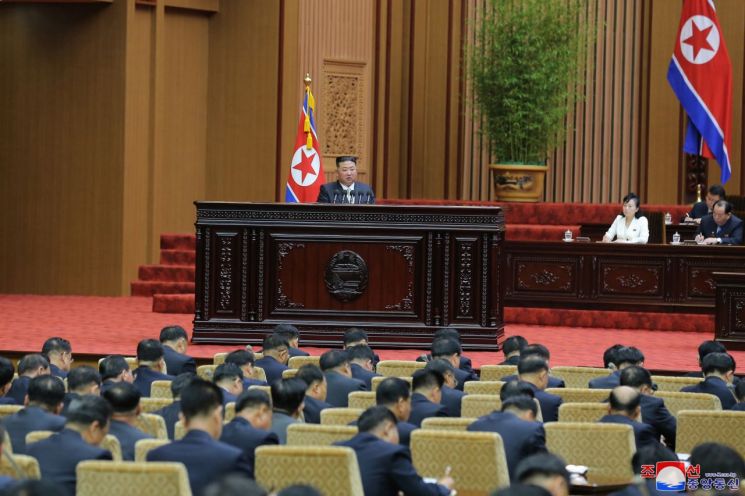
[Asia Economy Reporter Ki-min Lee] Kim Jong-un, General Secretary of the Workers' Party of Korea, strongly stated that there will be no denuclearization, asserting that the sanctions related to denuclearization and the ultimate goal of the United States is regime collapse. In particular, North Korea also clearly expressed its intention to legalize its nuclear weapons force (nuclear force) at the Supreme People's Assembly and to automatically carry out nuclear strikes as the starting point of provocations.
According to the Korean Central News Agency on the 9th, during the policy speech at the 7th session of the 14th Supreme People's Assembly the previous day, General Secretary Kim said, "The purpose the United States aims for is not only to eliminate our nuclear weapons themselves but ultimately to make us lay down our nuclear arms and even give up or weaken our right to self-defense, thereby collapsing our regime at any time."
He continued, pointing out that although the United States is attempting denuclearization through the largest sanctions blockade in history, "No, this is a misjudgment and miscalculation by the enemies," and challenged, "Try imposing sanctions for a hundred days, a thousand days, ten years, or a hundred years."
He emphasized, "We are not a people who will give up the right to self-defense, which is tied to the survival of the country and the safety of the nation's and people's future, and no matter how severe the circumstances, under the political and military situation on the Korean Peninsula created by the United States, especially since we must prospectively check the nuclear-armed enemy, the United States, we can never give up our nuclear weapons."
He claimed that although the hostile policies of the United States toward North Korea have prolonged the time of suffering, their absolute power is rapidly strengthening, and the security threat from the United States is also increasing.
On the same day, North Korea stipulated nuclear force missions, composition, command and control, and other nuclear force policies through a Supreme People's Assembly decree. General Secretary Kim stated, "The significant meaning of legalizing the nuclear force policy lies in drawing an irrevocable line so that our nuclear weapons can no longer be bargained over."
He added, "For nuclear policy to change, the world must change, and the political and military environment on the Korean Peninsula must change," and raised his voice, saying, "There will absolutely be no first denuclearization or nuclear abandonment, and there are no negotiations or bargaining items to exchange for that process." This is analyzed as a repeated declaration of no intention to respond to President Yoon Suk-yeol's denuclearization roadmap for the Korean Peninsula, the 'Bold Initiative.'
In particular, he urged, "Most importantly, we must continuously expand the tactical nuclear operational space to enhance the combat reliability and operational effectiveness of our nuclear force, and realize the diversification of application means at a higher level to comprehensively strengthen the nuclear combat posture." This appears to indicate an intention to develop various tactical nuclear weapons capable of striking U.S. forces and key South Korean facilities in the event of an emergency on the Korean Peninsula.
Through a nearly 20,000-character policy speech, General Secretary Kim explained North Korea's situation regarding nuclear force, economy, and health, but regarding South Korea, he referred to it as the 'current South Korean regime' and only criticized it by saying, "They are making dangerous military actions and military modernization plays that further provoke regional military tensions by boasting about strengthening the ROK-U.S. combined defense posture and establishing the so-called 'Korean-style 3-axis strike system' to enhance 'deterrence' and 'response capability,'" barely mentioning it otherwise.
© The Asia Business Daily(www.asiae.co.kr). All rights reserved.

















