Nation's First Rental Vertical Farm and Open-Field Smart Farm Pilot Complex Established
[Asia Economy Yeongnam Reporting Headquarters, Reporter Kim Gwiyeol] Concerns about climate change and population aging are not new.
Agriculture is also facing the reality of overcoming these challenges, and since it is directly related to survival, the urgency is even greater.
Recently, due to the skyrocketing price of lettuce, major hamburger franchises announced that they would sell hamburgers without lettuce.
The prices of essential vegetables and fruits that cannot be missing from our dining tables are expected to fluctuate even more due to climate change and worsening weather conditions.
In this situation, smart farms, which can achieve maximum harvests with minimal labor and production costs and are less affected by climate or allow cultivation environments to be controlled as desired, have become not a choice but a necessity.
Therefore, the key keywords for the future agriculture of Gyeongbuk are 'youth' and 'smart farm.'
Gyeongbuk Province completed the establishment of the Smart Farm Innovation Valley in Sangju last year to enable youth and smart farms to grow together and has started full-scale operation.
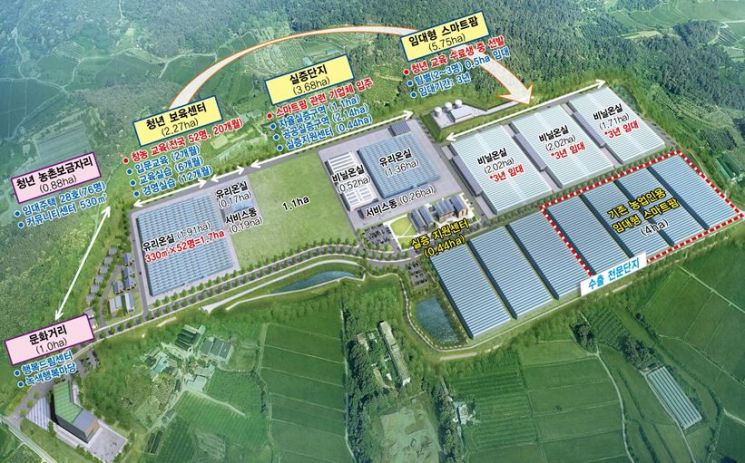
The Smart Farm Innovation Valley, covering 42.7 hectares, is the largest nationwide and houses a youth incubation center, rental-type smart farms, a demonstration complex for R&D of smart farm technology companies, and a big data center.
The youth incubation center selects 52 trainees annually and provides 20 months of theoretical and practical education. Youths who complete the training can move into rental-type smart farms after a selection process.
The rental-type smart farm allows teams of three to manage a 0.5-hectare smart farm for three years. The three years of management experience will provide not only the seed money for operating their own smart farms but also skilled technology and management know-how.
This virtuous cycle is expected to lead to the expansion of smart farms and an increase in young entrepreneurial farmers.
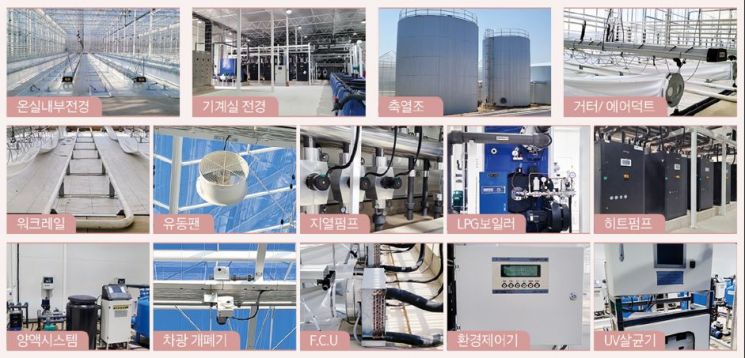
Additionally, to develop domestic technology for smart agriculture, demonstration support services are provided to related companies. Advanced equipment such as robots and pest control systems are tested directly in greenhouses and consulting services are also supported.
Various data such as growth information produced in the Innovation Valley are collected in the big data center, and as meaningful data accumulates over a long period, cultivation data models for each crop can be established.
Gyeongbuk Province has been conducting a pilot project since 2020 to apply smart farms beyond greenhouses to open-field production areas such as orchards by producing apples in smart farms.
In the Odae-ri area of Imha-myeon, Andong, about 60 farms participate in a 65-hectare scale project, establishing irrigation and fertilization, growth and pest monitoring, and unmanned pest control systems to create an open-field smart farm pilot complex.
Based on weather conditions measured by external weather stations, cultivation environments such as irrigation and mist spraying are automatically controlled, pests are controlled by unmanned pest control devices, and growth status and orchard conditions can be checked without visiting the orchard through AI cameras, CCTV, and other video data.
In this way, technologies that reduce labor and improve quality through remote control and automation systems are being disseminated even in open-field cultivation areas, reducing production costs and increasing income.
Gyeongbuk Province is making new attempts to take a step further into future agriculture. This is the 'vertical farm.'
Vertical farms are future agriculture models that can produce a fixed amount of agricultural products daily in a completely enclosed space without any influence from external environments.
Vertical farms can stably produce leafy vegetables, especially high-value herbs, and by cultivating with nutrient solutions on multi-tiered substrates, labor is reduced compared to traditional open-field crops.
The province plans to create rental-type vertical farms and lease them to young farmers to foster and promote vertical farms and create new jobs in the agricultural sector.
To this end, 5 billion KRW from the local extinction response fund has been secured, and by 2024, a 3,300㎡ rental-type vertical farm will be established in the Jibo-myeon area of Yecheon County.
The rental-type vertical farm can be leased and managed by about 20 farms for three years.
The rental-type vertical farm is the first agricultural model of its kind nationwide, a new project in Gyeongbuk agriculture aimed at enabling young farmers to stably produce high-quality agricultural products with minimal labor and earn more than 100 million KRW annually per person.
Lee Cheol-woo, Governor of Gyeongbuk Province, said, "The core of the great transformation of Gyeongbuk agriculture lies in the expansion of smart farms," and added, "We will lead future agriculture in Gyeongbuk so that agricultural models incorporating advanced technology spread further and young people can see hope in agriculture."
© The Asia Business Daily(www.asiae.co.kr). All rights reserved.


















