Use of Side Dish Specialty Stores Increased by 21.9% Compared to Previous Year
Accounts for 41.7% of All in Their 50s and 60s
Sales of Holiday Ready-to-Eat Meal Products Also Increased
Average Cost for a Family of Four is 323,268 Won
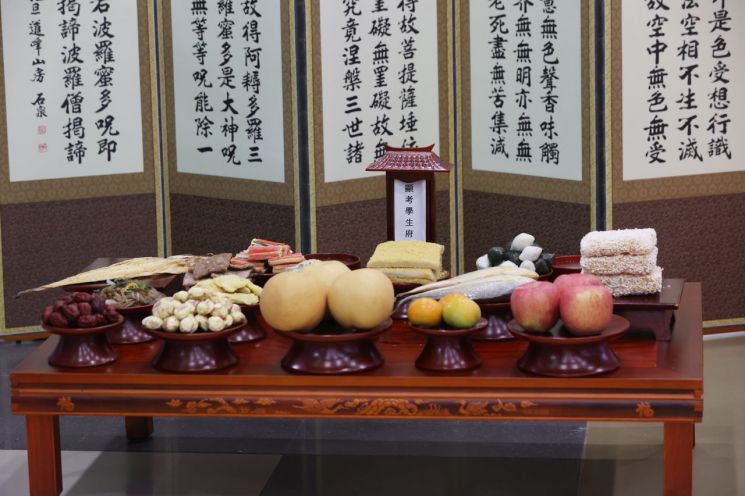 On the morning of the 5th, a ceremonial table was set up at Hanaro Mart Yangjae Branch in Seocho-gu, Seoul for children's cultural experience. [Image source=Yonhap News]
[Asia Economy Intern Reporter Kim Gun-chan] During holidays, the trend of using side dish specialty stores or purchasing holiday-ready convenience foods rather than making food from scratch is becoming established. Amid rising prices and increased costs for preparing Chuseok ancestral rites tables, the use of side dish specialty stores by people in their 50s and 60s, who used to make holiday foods themselves, has also significantly increased.
More people are using side dish specialty stores to purchase holiday ancestral rite foods. According to an analysis by Shinhan Card Big Data Research Institute on Shinhan Card sales data during holiday periods from 2019 to 2022, the number of visits to side dish specialty stores as of the day before this year's Lunar New Year increased by 21.9% compared to the previous year. This is a growing trend following increases of 12.5% during Lunar New Year 2020 and 15.9% during Chuseok of the same year. Although last year, when social distancing measures limited gatherings to four people or fewer due to the COVID-19 pandemic, the growth rates were only 4.5% and 2.2% respectively, the number of visits to side dish specialty stores has continued to rise.
In particular, the use of side dish specialty stores has increased among the 50-60 age group, who used to buy ingredients at marts or markets and prepare holiday foods at home. As of the day before this year's Lunar New Year, 26% of side dish specialty store users were in their 50s, and 15.7% were 60 or older, accounting for 41.7% of the total. This represents a 13.2 percentage point increase compared to 2019, when the proportions were 19% for those in their 50s and 9.5% for those in their 60s. However, while younger generations tend to buy most of their holiday foods from side dish specialty stores, those aged 50 and above appear to purchase only foods that are difficult or cumbersome to prepare themselves.
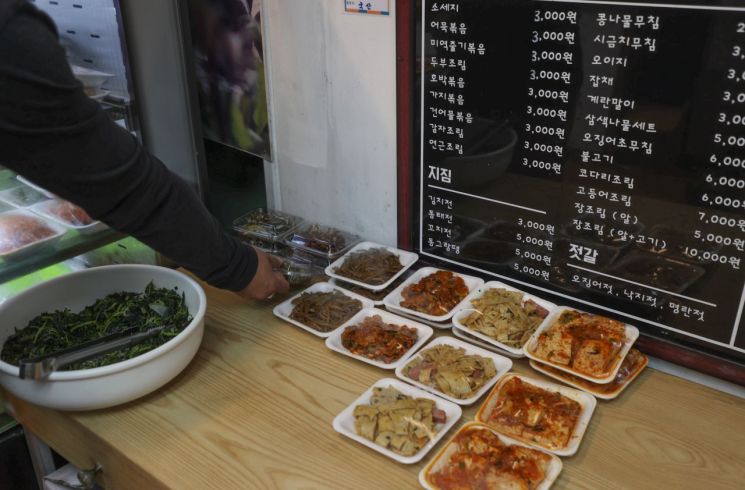 A citizen is purchasing side dishes at a side dish specialty store in Seoul in June. [Image source=Yonhap News]
The increase in side dish specialty store use among middle-aged and older adults is interpreted as a recent shift in the perception that making ancestral rite foods by oneself is a given. A 50-year-old housewife, Mrs. A, who purchased some ancestral rite foods from a side dish specialty store this Chuseok, said, "I had planned to shop and cook myself, but considering the current high prices and the effort required to prepare food, I decided to buy some dishes from a side dish specialty store this time."
Not only side dish specialty stores but also sales of holiday convenience food products are increasing. According to Market Kurly on the 10th, sales of Chuseok table-related products from August 15 to September 1 increased by 18% compared to the same period before last year's Chuseok. Sales of assorted namul (seasoned vegetable dishes) and three-color namul increased by 58%. Emart's sales of holiday convenience food products are also on the rise. According to Emart, sales of holiday convenience food products have been growing by more than 20% annually. Emart's private brand 'Peacock' holiday convenience food sales also increased by 8% compared to the previous year.
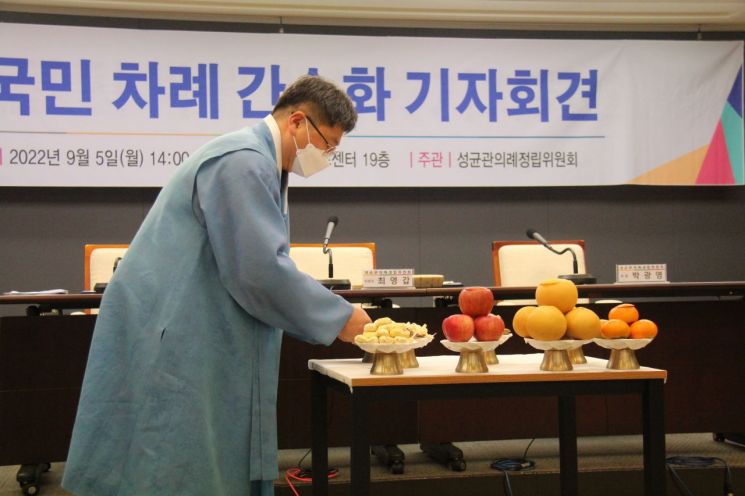 The Sungkyunkwan Ritual Establishment Committee announced the 'Simplification of Ancestral Rites' plan on the 5th at the Korea Press Center in Jung-gu, Seoul. [Image source=Yonhap News]
The cost required to prepare a Chuseok ancestral rites table has also increased due to high prices. According to a survey released on the 7th by the Korea Consumer Organization's Price Monitoring Center, the average cost for a family of four to prepare a Chuseok ancestral rites table this year was 323,268 KRW. This is an 8.5% increase compared to the same period last year. Among the 24 items surveyed, prices for 20 items rose by an average of about 16% compared to last year, and prices for ingredients used to make ancestral rite foods, such as cooking oil and flour, also surged significantly.
Meanwhile, the trend of simplifying holiday ancestral rites tables is likely to continue spreading steadily. On the 5th, the Ritual Establishment Committee of Sungkyunkwan University announced a standard plan to simplify the Chuseok ancestral rites table. Sungkyunkwan stated, "There is no need to place fried or pan-fried foods on the ancestral rites table," and added, "Using oily foods such as wheat pancakes or yubeong (fried dough) for ancestral rites is not proper etiquette." According to the standard plan released by Sungkyunkwan that day, the basic foods for the Chuseok ancestral rites table include six items: songpyeon (rice cakes), namul (seasoned vegetables), grilled dishes, kimchi, fruit, and alcohol.
© The Asia Business Daily(www.asiae.co.kr). All rights reserved.
![Clutching a Stolen Dior Bag, Saying "I Hate Being Poor but Real"... The Grotesque Con of a "Human Knockoff" [Slate]](https://cwcontent.asiae.co.kr/asiaresize/183/2026021902243444107_1771435474.jpg)


















